The Scale of Uncontrolled Airspace and What Every Pilot Pays When Towers Are Absent
Without towers, pilots carry the traffic work, and the risk data lags.
The safety gap at uncontrolled airports in the U.S. National Airspace System is a transfer of traffic-management work from infrastructure to pilots. Without a tower, pilots must build their own traffic picture, work out who will use the runway, and spot conflicts while flying. Digital towers offer a way to restore external control, but the evidence requires a careful distinction between documented hazards and measured risk.
Why do most small airports in the U.S. have no control tower?
Roughly 527 towered airports exist beside nearly 20,000 non-towered landing facilities, including public airports, private strips, grass and turf runways, gravel strips, and seaplane bases. That comparison describes infrastructure. It establishes how widely pilots encounter operations without local tower control, but it does not establish the share of aircraft movements occurring there.
The cost of building and staffing traditional towers has long kept tower services out of reach for many small airports. What is missing is more than a building. A tower provides a controller who issues legally binding clearances, sequences traffic, and intervenes when conflicts develop. At a non-towered field, position reports on the Common Traffic Advisory Frequency, or CTAF, distribute information but do not create that authority.
No local tower controller monitors ground movement or directs arrivals into a common sequence. Pilots must do that work themselves, using what they see and know to make decisions. The absence of a tower does not, however, mean that regulations and operating procedures disappear.
What pilots are required to do in the absence of a tower
Pilots remain responsible for complying with applicable regulations and following established procedures at non-towered airports. Their coordination depends on position calls, listening, and visual scanning. The radio layer is voluntary. No outside observer verifies that each pilot has heard a transmission, identified the relevant aircraft, or understood the developing sequence.
NASA’s ASRS CALLBACK Issue 548 describes a DC3 first officer reporting a developing critical ground conflict during non-towered operations. The crew announced an intended departure on a downhill runway because of the aircraft’s size and the slope away from the airport, while normal arrivals used another runway. The announcement communicated the crew’s intention. It did not provide a clearance or establish that other traffic had received and reconciled that intention with its own plans.
That distinction answers what happens when two aircraft approach the runway at the same time. Pilots must work out the conflict together, using the procedures that apply and what they know about nearby traffic, without a controller to direct the sequence. The system depends on other pilots listening on the correct frequency and seeing traffic that may not have announced itself.
How the FAA's runway incursion data is built around the assumption that a controller is present
The FAA classifies runway incursions into three types, namely pilot deviation, vehicle or pedestrian deviation, and operational incident. The last category depends on a controller being present. At a non-towered airport, that category disappears because there is no local controller whose action can produce such an incident. A transportation oversight body puts pilot deviations at close to two-thirds of all U.S. runway incursions, but that share across the whole system does not, on its own, show the exposure at non-towered airports.
The classification reflects who participates in the operation. It cannot, by itself, reveal how removing one participant changes the risk or the likelihood that an event enters the record. Severity categories still show how serious recorded events were, but encounters can go unreported when no outside observer is there. The Inspector General’s March 2025 audit found that the FAA lacks an integrated approach to analyzing runway incursion data and identifying risk.
NASA’s Aviation Safety Reporting System has accounts of encounters with details about what happened that the combined data cannot explain. Reports describe aircraft turning final in front of one another, students entering runways without hearing calls, and opposite-direction traffic whose pilots were unaware of each other. Those accounts have important limits. NASA states that submissions are voluntary and are not corroborated by NASA, the FAA, or the NTSB, so they cannot establish prevalence across the National Airspace System.
The database is therefore a floor of reported experience. Its strongest use here is identifying failure mechanisms. It shows how coordination can break down, without supporting an estimate of how frequently each failure occurs.
What the severity trend in runway incursions reveals about where the system is actually under stress
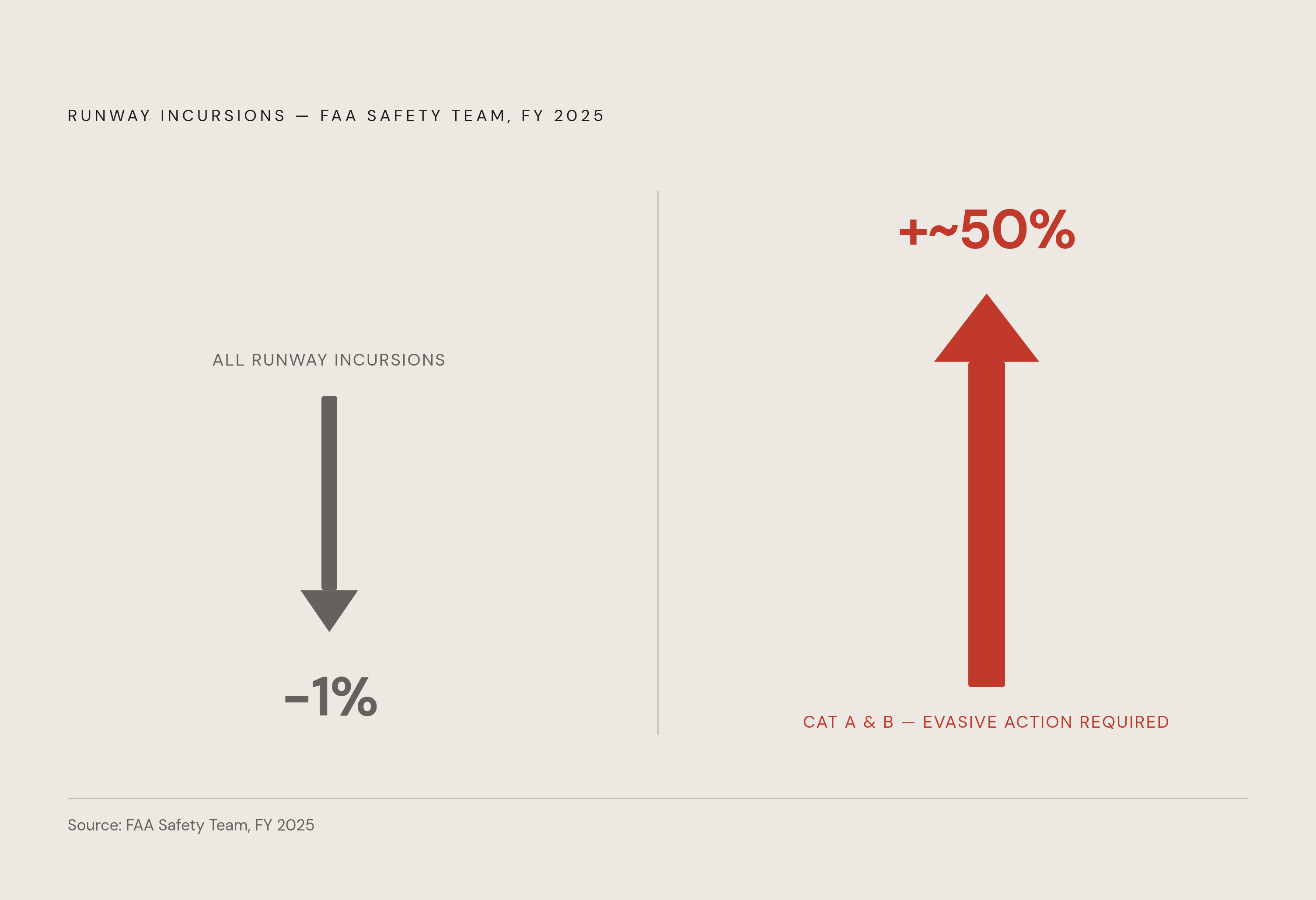
The FAA Safety Team reported that Category A and B incursions rose by nearly half in fiscal year 2025, even as total events fell about one percent. These categories describe encounters in which collision was narrowly avoided or evasive action was required. The two trends move in opposite directions. A lower total does not establish improving safety when the most dangerous recorded encounters are increasing.
That divergence is a stronger finding than aggregate stability alone. It indicates that the factors limiting overall event counts are not necessarily controlling the most consequential conflicts. It does not, however, locate the increase at non-towered airports. Without a breakdown by operating environment and exposure, the severity trend supports a system-wide warning rather than a claim about where the deterioration is concentrated.
The fatal-event examples also require care. The documented accidents named in the available material occurred at major towered airports, including LaGuardia in New York, Haneda in Tokyo, and Jorge Chávez in Lima. Those accidents do not back the claim that all recent fatal runway incursions took place at non-towered facilities. Tower coverage provides a protective layer even where fatal conflicts occur.
Conversely, comparing midair collisions per hundred airports cannot establish that towered operations are more dangerous. Towered airports have far more movements at each airport. A meaningful comparison of risk per operation must account for traffic volume rather than simply count airports, and fatal-event counts do not remove that requirement. The defensible conclusion is narrower but substantial, namely that worsening recorded severity warrants attention while the relative risk of non-towered operations remains incompletely measured.
The workload pilots absorb on every non-towered flight, and where it concentrates
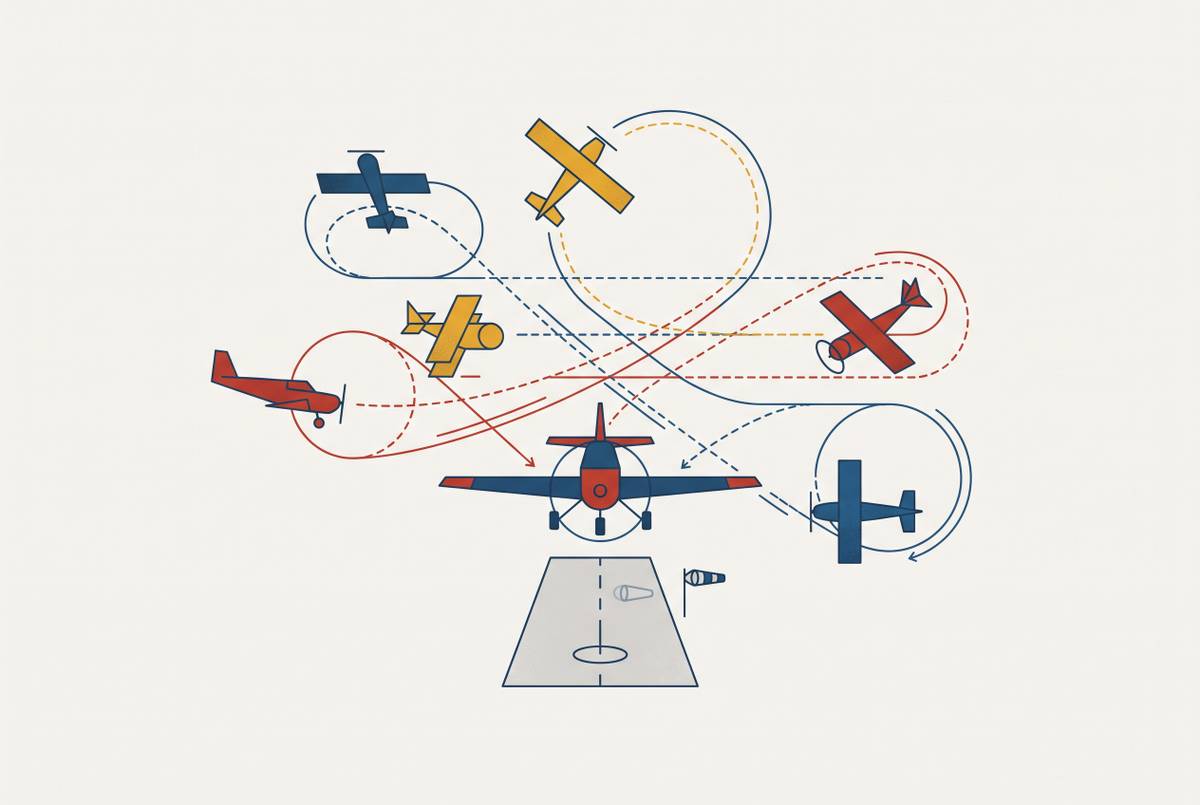
The operational burden is clearer than the comparative accident rate. At a non-towered airport, pilots must construct a traffic picture from radio reports and visual observations while controlling the aircraft. They listen on CTAF, make their own calls, find traffic, and decide how their movement fits with that of others. No controller maintains a shared sequence for them. These tasks compete for attention during arrival, departure, and runway movement.
ASRS narratives show how fragile that picture can become. A pilot on the wrong frequency may think no other traffic is there, while another pilot hears nothing to change that same belief. A congested frequency can mask a critical call. Non-standard phraseology can make a call harder to understand, and listening to the radio alone cannot fill the gap left by an unseen aircraft.
The same reports describe instructors dealing with student errors while building situational awareness without help from a controller. The instructor must address what is happening inside the cockpit while detecting conflicts outside it. When an aircraft enters a runway without hearing a call, the remaining pilots have to recognize and resolve a problem that their earlier traffic picture may not contain.
This burden concentrates where unfamiliarity and training demands overlap. Canada’s transport safety investigation agency’s 2025 Watchlist found that incursions cluster at a small number of airports, many of them flight-training facilities. At non-towered training fields and airports with substantial transient traffic, limited local familiarity adds pressure to a coordination system that already depends on individual attention.
Why the broader aviation safety system is not absorbing this pressure well right now
The Flight Safety Foundation’s 2025 Safety Report identifies airspace demand and operational complexity growing faster than the systems designed to manage them. Airlines are not the only source of growth. Business aviation, helicopter operations, uncrewed systems, and new operational concepts bring different kinds of traffic into airspace that has only so much room.
The Foundation warns that a system operating near its limits in people, infrastructure, or procedures has less capacity to absorb disruptions and surprises. Non-towered airports face that pressure without a local controller who can step in. Their safety margin depends more heavily on procedures and cockpit awareness when traffic becomes difficult to interpret.
Uncrewed systems expose a particular limit of that model. Voluntary radio exchanges and visual scanning between pilots are not enough on their own to coordinate mixed crewed and uncrewed traffic fully. Meanwhile, the analytical weakness identified in the Inspector General’s audit makes it harder to determine where intervention is most urgent. As traffic grows more complex and risks remain partly unseen, each problem makes the other worse, so decisions about infrastructure lack a full picture of what is needed.
What digital tower technology does to the pilot-burden equation
High-definition cameras, sensors, and displays provide a continuous 360-degree view of runways, taxiways, and surrounding airspace. These systems can offer automatic target detection, aircraft data tags, infrared cameras, and better visibility in low light. The technology replaces the tower building. A remote controller still issues clearances, sequences traffic, and intervenes in developing conflicts.
That distinction is central to the workload argument. Better information alone leaves pilots responsible for negotiating the sequence, while controller service restores an external decision-maker. A remote center can potentially allow one controller to cover multiple low-traffic airports, reducing the need for a separate on-site staffing footprint at each facility. Sharing controller capacity depends on the airport and traffic conditions.
The FAA launched its digital ATC tower program with the first two operational systems at Bartow Executive Airport in Florida and Kenai Municipal Airport in Alaska. The Working Families Tax Cut Act allocated $50 million toward deployment at qualified non-towered airports. Five additional airports are planned under the same funding round. These deployments establish a U.S. implementation path rather than merely a proposal for future infrastructure.
Digital coverage can also provide partial support for mixed-traffic management by placing a controller in the loop where crewed and uncrewed operations share airspace. The same technology can provide nighttime coverage when an existing tower would otherwise close or serve as backup during outages. Its value therefore extends from expanding coverage to preserving it when conventional facilities are unavailable.
What closing the coverage gap actually requires, and what pilots and operators can do now
Providing ATC remotely avoids the $5–10 million cost of building a traditional tower and lets airports that are suited to it share qualified controller capacity, addressing the difficulty of maintaining a dedicated local staffing footprint.
For airport operators, the practical response is to track digital tower deployment and its applicability to their facilities. Federal funding and the initial installations provide a concrete basis for that assessment. Policymakers considering modernization should treat non-towered coverage as an infrastructure question rather than an unavoidable feature of small-airport operations. The priority is extending controller service where the operational need is greatest.
For pilots operating without that coverage today, the immediate response remains disciplined procedure. Standard-phraseology CTAF calls and listening continuously on the frequency help pilots stay aware of one another, while visual scanning is still needed to find traffic that has not announced itself. These measures cannot guarantee reciprocal participation. A pilot on the wrong frequency or not listening can break the coordination chain without warning.
Pilots still have operating responsibilities under tower control, but they no longer have to do all the work of managing local traffic themselves. Digital towers offer a means of transferring that work back to infrastructure.