What Pilot Incident Narratives Actually Reveal About Close Call Frequency at Non-Towered Fields
NASA incident reports show where non-towered coordination fails.
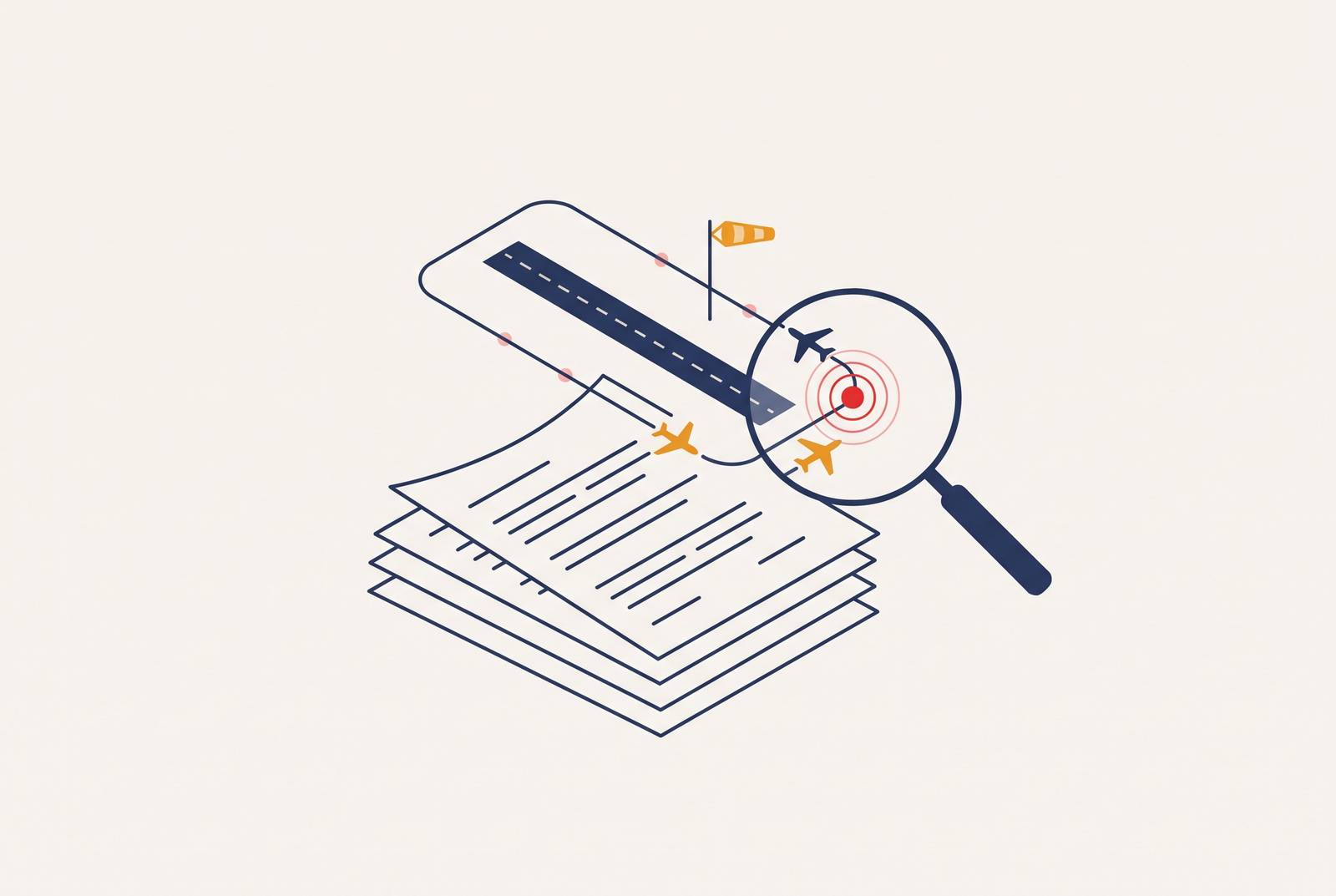
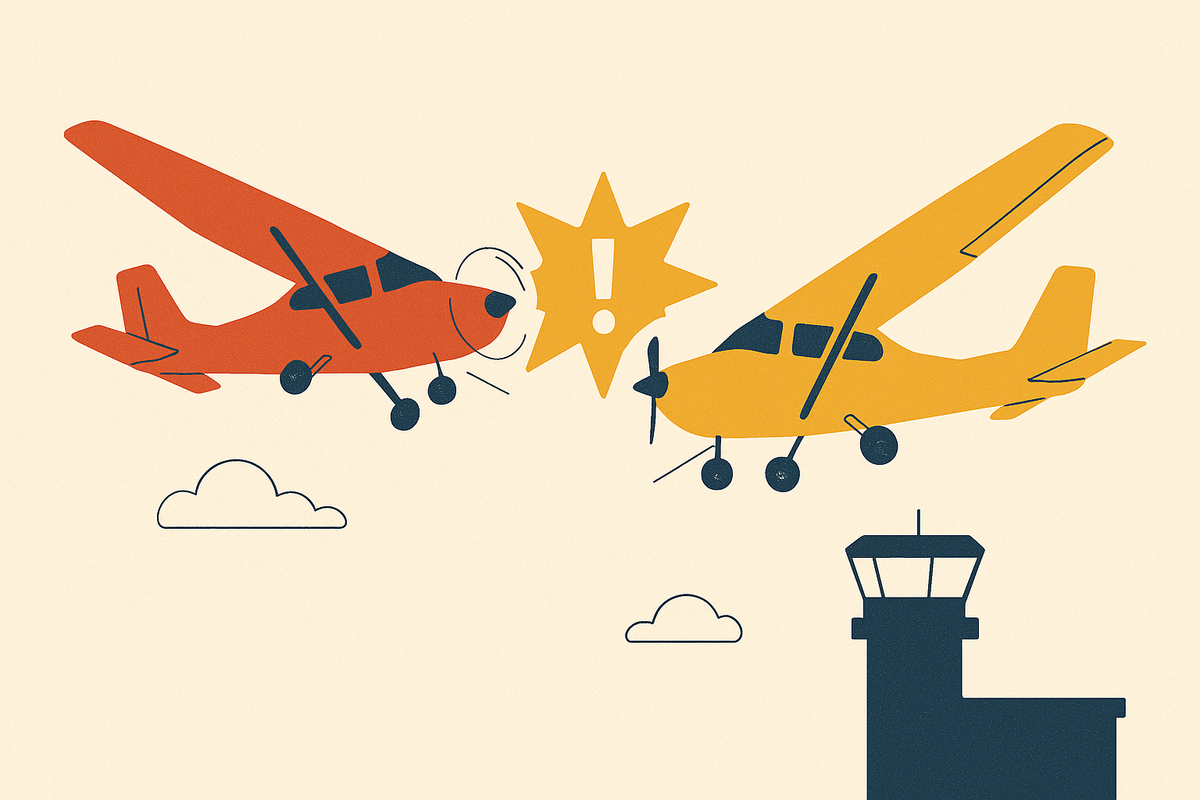
Pilot incident narratives show a gap in how safety is managed at non-towered airports in the U.S. National Airspace System, but they do not measure the close-call rate. When two aircraft approach the same runway, pilots must resolve the conflict without a controller, and a missed transmission or wrong frequency can defeat that coordination. The recurring failures in these reports make active traffic management an infrastructure question rather than simply a question of individual pilot performance.
Why ASRS narratives are the right lens for studying non-towered close calls
NASA’s Aviation Safety Reporting System has detailed accounts of what goes wrong during non-towered operations. Pilots, instructors, and crews describe the decisions, procedural gaps, and developing conflicts behind an incident. The ASRS Non-Tower Airport Incidents report set, updated June 17, 2026, contains 50 records screened for relevance, with reports ranging from early 2025 through 2026. It is a concentrated collection.
NASA’s disclaimer expressly rules out using these voluntary reports to infer the prevalence of a problem in the NAS. The reports are not independently corroborated or investigated further, and their number cannot supply an incident rate. NASA’s lower-bound principle gives reported occurrences a narrower role, without making them verified events or establishing how often they occur per operation. The right question is therefore not “how often does this happen?” but “what keeps happening, and why?”.
What happens at non-towered airports when two planes approach the runway at the same time
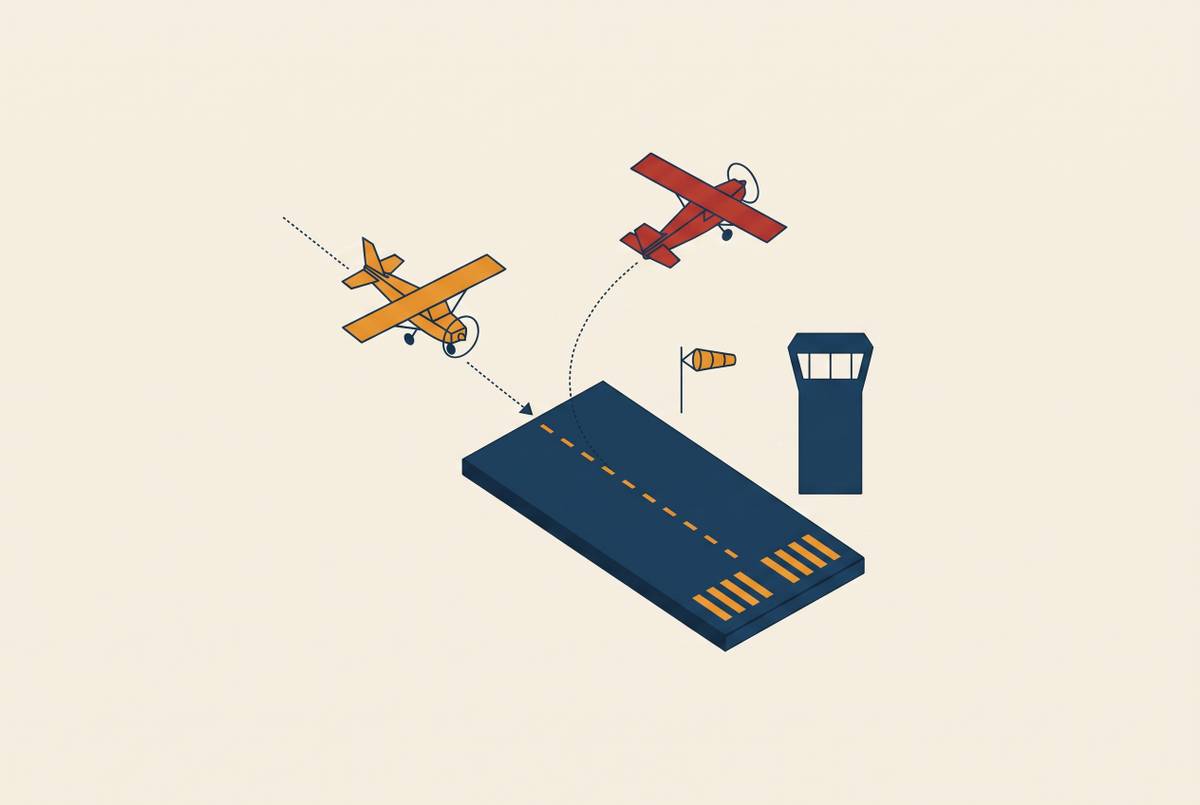
At a non-towered field, pilots must coordinate runway use without an authoritative controller sequencing traffic. Common traffic advisory frequency, or CTAF, announcements support that coordination, but their value depends on other pilots transmitting and listening on the same frequency. Correct conduct by one crew is not enough. Another aircraft can be missing from the shared traffic picture even when that crew follows its procedures.
At a towered field, a controller provides a corrective layer that can identify and correct a pilot’s lapse before it compounds into a runway conflict. Without that layer, the lapse can persist until another pilot recognizes the danger and resolves it. CTAF compliance is therefore load-bearing. This difference helps explain why the same small error can have different results depending on how traffic is managed, even when pilots have the same skill.
Wrong frequency as the most consequential single failure mode in the narratives
ASRS CALLBACK Issue 548, published in September 2025, describes a DC-3 crew facing a developing ground conflict at a non-towered airport. The first officer reported that the crew announced its intention to depart on the downhill runway, consistent with its standard operating procedure for the aircraft’s size and the slope away from the airport. Normal arrivals used the other runway direction. That difference made coordination essential before departure.
The incident developed through the lineup, a warning, and three unanswered calls. The other aircraft was a student-instructor pair operating on the wrong frequency, and the instructor had not caught the error before the conflict developed. The DC-3 crew’s announcements could not repair that disconnection. The crew was participating in the self-announce system, but the other aircraft was unreachable through it.
Wrong-frequency operation is especially consequential because it disables both initial coordination and the usual radio-based recovery. A warning, traffic advisory, or go-around call cannot help the intended recipient if it is never heard. The failure is therefore not merely a missing position report. It severs the channel through which another pilot could correct the developing conflict.
Opposite-direction traffic as the pattern that recurs across aircraft types, operator categories, and airports
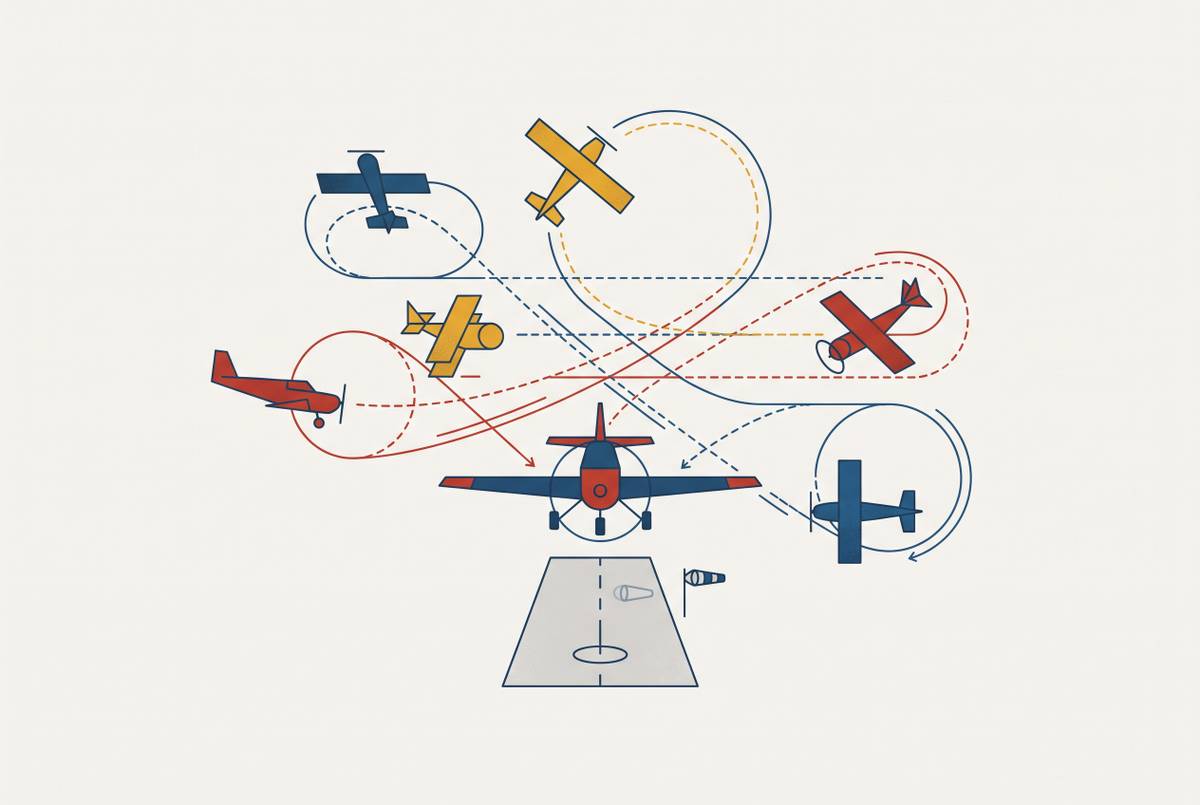
The opposite-direction narratives show that the trouble goes beyond choosing a frequency. Across aircraft types, operator categories, and airports, pilots describe incompatible runway-use decisions that survive long enough to produce a conflict. The repeated configuration is the important finding. Different participants reach the same hazardous arrangement because no common authority reconciles their intentions before they converge.
Landing-roll conflicts make the consequences particularly clear. In the reports describing this phase, aircraft are committed to the runway, moving at speed, and sharing an occupied surface. Coordination has failed before the conflict becomes visible there. By that point, the available margin is much smaller than it was while runway direction was still being selected.
This pattern requires recognition that two independently reasonable assessments can still be incompatible. A controller provides a point at which those assessments can be reconciled before runway use. The narratives show what happens when that function is left entirely to communication between aircraft.
Short final as the highest-concentration zone for near mid-air collisions in the report set
The report set concentrates near mid-air collision accounts around short final, where converging aircraft have little time or maneuvering room to respond. In ACN 2330691, a PA28 flight instructor reports another aircraft on short final flying 100 feet below them. The proximity is explicit in the account. It locates the conflict on the approach path rather than somewhere in the wider airport environment.
ACN 2330671 describes an instructor experiencing a near mid-air collision while flying in the pattern with a student, taking control, and departing the area. That account supports the broader pattern-conflict finding, although its synopsis does not place the encounter specifically on short final. ACN 2330654 describes the corresponding threat from the ground, with an RV-12 pilot entering the runway and causing an approaching aircraft to execute a missed approach. The conflict can begin outside the approach corridor and still culminate there.
Another instructor reported a go-around from 15 feet after seeing an aircraft taxi onto the runway. The landing had reached its final moments when runway occupancy forced the instructor to abandon it.
NOTAM failures and closed-runway incursions as a separate but related breakdown in the information system
ACN 2336060 references a closed airport without signage indicating the closure. Another account describes a C210 pilot landing at a non-towered airport that was NOTAMed closed and losing control in a runway excursion. These failures of the information chain extend beyond failures to hear another aircraft.
The distinction is important because correct radio use alone does not resolve missing or unretained closure information. A controller can provide a live check before a pilot reaches a closed runway. Without that check, the closure’s underlying hazard may become the condition the aircraft encounters on landing. The C210 account establishes the closed-runway landing and subsequent excursion, although it does not establish every causal step between them. NOTAM and CTAF failures share a structural root because neither has an authoritative downstream layer to catch what a pilot missed.
Why training operations are overrepresented in the narratives and what that reveals about where the risk concentrates
A student-instructor pair can be the unreachable aircraft, while another instructor can be the pilot forced to intervene. Their presence spans several failure modes. It is not confined to one kind of mistake or one phase of flight.
That recurrence is consistent with training’s concentration at non-towered fields, where frequency management and traffic-pattern coordination are themselves skills under development. An instructor’s presence adds expertise but does not restore communication with an aircraft on another frequency or supply authoritative sequencing across the airport. The instructor accounts therefore expose the limits of individual supervision. They show conflicts developing despite a certificated instructor being aboard.
The report set often lists environment unrelated to weather, human factors, and procedure as contributing factors. Those categories extend beyond certificate level. The prominence of training in these narratives does not establish a higher incident rate per training operation, because the necessary exposure denominator is absent. It identifies a population repeatedly encountering the structural gap at the airports on which it depends.
What the narratives cannot tell us and why that limit strengthens rather than weakens the argument
The narratives cannot establish whether non-towered close calls are increasing, decreasing, or stable. Reporting culture can influence which incidents enter ASRS, and a concentration of reports need not mean a higher underlying rate. Recurring mechanisms do not eliminate that selection effect.
Wrong frequency, incompatible runway directions, converging approaches, and missed closure information recur in recognizable configurations across separate accounts. Each configuration identifies a way that information or coordination can fail. The evidence helps explain how those failures happen, but it cannot put numbers to the difference in safety between towered and non-towered airports.
This distinction also defines what a remedy must address. A response aimed only at the last pilot error would leave the missing corrective function untouched. The useful output of the reports is therefore a topology of failure, showing where the system loses contact, coordination, or warning. Understanding that topology is the prerequisite for designing a structural response.
How the deployment of digital ATC towers addresses the structural conditions the narratives expose
Digital ATC towers fill that missing role with controllers who manage airport traffic from a remote operations center. A controller can sequence aircraft, give go-around instructions, keep track of traffic across the pattern, and give pilots live information beyond what they hear from other pilots.
Sequencing addresses incompatible runway use and converging approaches, while live control adds an opportunity to catch closure-information gaps. Aircraft on the wrong frequency are still hard to reach, but a controller watching the traffic has another chance to spot a conflict as it develops. It does not make an unheard instruction effective by itself.
The FAA Reauthorization Act of 2024 mandated a framework and timeline for approving and deploying digital towers. The Working Families Tax Cut Act set aside funding for non-towered airports that qualify, and in September 2026 the FAA awarded an indefinite-delivery/indefinite-quantity contract for a remote tower program aimed at rural and small community airports. These measures connect the technical response to an implementation path. Their significance is the restoration of a missing operational layer.
The constraints digital towers face and what they do not resolve on their own
Digital towers still need infrastructure built for them and human controllers to run them. FAA guidance requires a closed, physical point-to-point network and an independent fiber optic feed between the sensors and control room. Wireless transmission is not currently permitted. Additional infrastructure work is also required before deployment at federally owned conventional towers, so the potential cost savings do not remove site-specific civil work.
Staffing remains a separate constraint. Controllers must still be hired, trained, and scheduled for remote operations centers during an ongoing national controller shortage. Changing the location of the control room does not remove that requirement. Nor does the technology, on its own, correct pilot frequency management or guarantee that every instruction will be received.
Capital funding further limits deployment. IIJA supplemental airport funding has no new annual allocations after FY2026, although prior-year funds retain obligation windows extending to FY2029. Airports Council International–North America estimates that the infrastructure needed costs far more than the federal funding available each year. These constraints affect the pace at which coverage can expand. Seven airports are in the initial deployment wave, while thousands of public-use non-towered airports remain outside it.
What the ASRS pattern argues for at the scale of the National Airspace System
Digital towers in use at Bartow and Kenai show that the concept works with live traffic, while the regulatory framework offers a path to putting more towers into use. It establishes that the corrective function identified by the narratives can be delivered through a different infrastructure model. The remaining question concerns coverage and execution as much as technology.
The prominence of training operations gives coverage expansion a clear safety rationale. Students, instructors, and newly certificated pilots rely on fields where the reports show coordination failing again and again. Prioritizing that exposure follows from the failure pattern rather than from a claim that those pilots are inherently less safe. It places the response where the missing layer is repeatedly consequential.
ASRS can show why treating each report as an isolated lapse misses the common architecture beneath it. Putting digital towers into use therefore belongs within NAS infrastructure policy, which must treat the staff, connections, and capital they need as parts of the safety system. The structural gap is the absence of authoritative traffic management at fields where pilot-to-pilot coordination can fail without a corrective layer.