Why Traditional ATC Towers Are Unaffordable for Small Airports
Digital towers offer a cost model built for the 90% of airports that traditional towers priced out.

Traditional air traffic control towers are built for large, high-traffic airports, and that cost model does not compress to fit the revenue of small and general aviation fields. The mismatch is structural. Capital construction, staffing, and ongoing operational overhead each assume a volume of activity that most airports simply do not have, and the vast majority of airports in the National Airspace System operate without any tower at all as a result. The exclusion is not driven by absent safety need. It is driven by a cost model that was never designed to reach them.
General Aviation was built to address precisely this structural mismatch. The company builds affordable digital ATC towers for the roughly 90% of National Airspace System airports that operate without any control tower today, sidestepping the capital and staffing assumptions that make the traditional model unreachable for smaller fields. The argument that follows traces each layer of the cost problem, from construction through staffing and revenue, before examining the digital alternative that addresses all three.
What it actually costs to build a traditional ATC tower
Capital construction costs for traditional towers span a wide range, but even projects at the modest end represent expenditures that dwarf the total annual budgets of most small airports. The American Association of Airport Executives and the U.S. Contract Tower Association maintain a construction database of completed towers at smaller airports. The figures show a spread from well under a million dollars for rehabilitation projects to several million dollars for new-build designs.
At the low end stands a municipal airport in one southwestern state. The tower was constructed in 1998 with a cab floor height of 168 feet, a total project cost of $515,000, and funding drawn entirely from state and local resources with no FAA contribution. Bozeman Yellowstone International Airport completed its tower in April 1998 at a cab floor height of 85 feet for a cost in the low seven figures, funded entirely with local resources. Cheyenne Regional Airport followed a similar pattern, completing its 90-foot tower in February 2001 with local funding and communications equipment provided separately by the FAA.
The mid-range of the database tells a consistent story. Bellingham International Airport built its tower in February 1996 with a cab floor height of 57 feet 10 inches and an overall height of 76 feet 5 inches, at a cost in the low seven figures. Cobb County International Airport, also known as McCollum Field, completed construction in March 2015 at an estimated cost in the mid seven figures. A municipal airport in another state finished its tower in March 2005 at a cab floor height of 94 feet 6 inches and a cost in the mid seven figures. Aguadilla International Airport in Puerto Rico rehabilitated an old USAF tower in July 2016 for an estimated $3.1 million. Albert Whitted Municipal Airport in St. Petersburg replaced an FAA tower from around 1960 with a new structure completed in August 2011 at a cost in the mid seven figures. A municipal airport in a further state represents the upper bound of this group. Completed in September 2011 at a cost in the high seven figures, the project included MEL upgrades, significant FAA involvement, ancillary electronics, blast protection, and security monitoring systems, with full FAA funding through a federal economic stimulus program.
Newer replacement projects show how sharply costs have escalated. Maryland's Board of Public Works approved a $22.2 million contract in February 2025 for a new tower at Martin State Airport, replacing a facility that had served the airport for more than 80 years. The FAA awarded a contract to Walsh Federal to build a replacement tower at Sacramento International Airport, with an anticipated opening around 2030.
The spread between a locally funded rehabilitation at a small municipal airport and a full-replacement contract at a mid-size commercial airport spans two orders of magnitude. Yet even the low end requires capital outlays that small airports rarely hold or can borrow against. Even the lowest end of traditional tower construction, half a million to several million dollars, represents a cost architecture that was never meant to scale down to small airports. Digital ATC tower solutions like those General Aviation develops offer a fundamentally different cost model, one engineered from the ground up to serve airfields that traditional towers have historically priced out of the conversation.
How the FAA grant system helps with construction but leaves operating costs entirely to the airport
Federal Airport Improvement Program grants can fund a substantial share of tower construction at smaller general aviation airports. The program can cover the great majority of eligible capital costs at these fields, which sounds like a solution to construction cost. It is not a solution to operating cost.
AIP funds are explicitly prohibited from covering ongoing operational costs, marketing, or personnel expenses. Controller staffing falls squarely within the prohibited categories. The result is that a grant-built tower transfers a perpetual staffing obligation onto the airport's own budget, which may be far less capable of carrying it than the construction budget suggested. Federal capital funding does not resolve the affordability problem. It moves the financial weight from construction to operations.
Why controller staffing is the cost that makes traditional towers structurally unworkable at small airports
A traditional ATC tower requires round-the-clock certified controller staffing that must be maintained regardless of traffic volume. A tower that is open must be staffed by certified controllers. That staffing is not a variable cost that shrinks when traffic is light. It is a fixed personnel obligation tied to operating hours, and it is this staffing cost, not construction amortization, that makes the traditional model functionally impossible for most small airports to sustain.
The pathways that might soften this burden are themselves constrained. The FAA instituted a moratorium on new additions to the contract tower program starting in fiscal year 2014, and a waiting list of small airports has accumulated since. The lower-cost staffing pathway is therefore closed to new entrants. The FAA's benefit-cost threshold for contract tower eligibility, a ratio of at least 1.0, further excludes the lowest-traffic airports. The airports with the fewest operations are the same airports that fail the cost-benefit test and are therefore ineligible for the program designed to make towers more affordable.
For airports below that threshold, the staffing cost of a traditional tower consumes a share of operating revenue that small airport budgets cannot sustain. Federal grants may solve the capital problem, but they leave airports with a permanent staffing and operational burden that traditional towers impose by design. Affordable digital tower technology can break that cycle by replacing the assumption that ongoing 24/7 staffing is the only way to deliver air traffic control at small airports.
How small airport revenues compound the problem rather than offset it
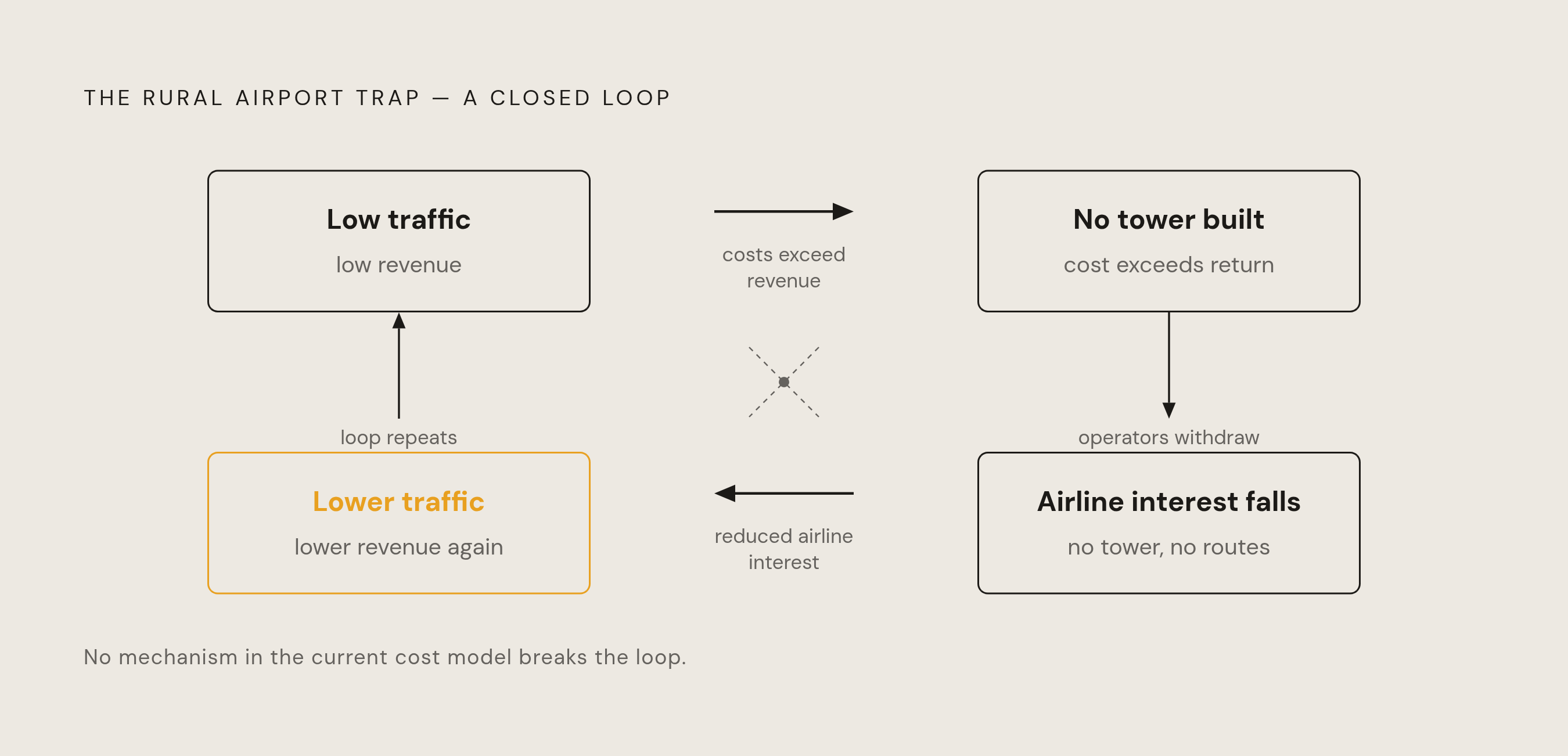
Small airports generate revenue primarily from hangar leases, tie-down fees, and fuel sales. These sources are inherently limited by low traffic volumes. Revenue is directly proportional to operations: fewer aircraft movements mean less fuel sold, fewer hangar tenants, and lower tie-down income. The same low-traffic conditions that make a tower hardest to justify also shrink the revenue base that might fund one.
The compounding effect is a self-reinforcing cycle. Low traffic produces low revenue. Tower costs then exceed revenue, which means no tower, which reduces airline and operator interest, which lowers traffic further, which lowers revenue again. The current cost model has no mechanism to break this cycle. The consequence of the revenue gap is not simply cost-cutting. It is structural underservice. Airports that handle real pilot and community traffic operate with no coverage, not because safety is unimportant, but because the revenue math forecloses the traditional solution.
This financial pressure is not a U.S. anomaly. Most of the world's airports operating at a net loss are small airports handling lower traffic volumes. The condition is structural to the small-airport category globally.
What the coverage gap costs in safety terms at non-towered airports
The airports priced out of the traditional tower model are not merely underserved in a bureaucratic sense. They carry a concentrated and measurable share of the aviation system's most serious safety incidents. At a non-towered airport, there is no controller to issue traffic advisories, sequence arrivals, or catch the conflicts that precede runway incursions. The absence of a tower is not operationally neutral. It removes a layer of active safety management.
Runway incursions and near-collision events are disproportionately concentrated at non-towered airports and at airports serving flight training, which are often the same fields. The safety consequence is concrete. Fatal runway incursion accidents in the country have occurred at non-towered fields. Meanwhile, the FAA's primary runway incursion mitigation tools were designed for complex, towered airfield geometry. They largely bypass the non-towered airports where severity is now concentrated.
The financial argument lands here, in human terms. Unaffordability is not an accounting problem. It is a safety problem, and the status quo carries a real cost.
Why replacing physical infrastructure with digital technology changes the cost equation
Digital ATC towers replace the physical structure and its fixed-staffing requirements with a sensor-and-display system that costs a fraction of conventional construction. Instead of a tall occupied structure, a digital tower uses high-definition cameras, sensors, microphones, and digital displays to provide a 360-degree real-time view of the airport, transmitted to a remote control center where controllers work just as they would from a conventional cab. The technology addresses each of the three cost layers identified earlier.
The capital cost advantage is direct. Construction cost for a digital tower system is substantially lower than the conventional new-build range, and the airport is not required to own and maintain a tall occupied structure. The staffing cost advantage is equally direct. One controller can manage multiple low-traffic airports simultaneously from a single remote center, compressing the fixed staffing cost that makes traditional towers structurally unworkable at small airports.
The operational capability is not a compromise. FAA simulations found that remote tower systems can provide better surveillance at night and in rain, fog, or snow than conventional towers, thanks to radar, high-resolution display screens, and other advanced technologies including infrared cameras. The digital alternative is therefore not a reduced-capability workaround. It is a technically equivalent or superior system in key conditions. From the pilot's perspective, radio communications and procedures are identical to a staffed physical tower, requiring no new pilot training or procedure changes.
The technology is proven internationally. The first remote tower came into operation at Örnsköldsvik Airport in Sweden in 2015 after several years of experimentation and development, and global deployments have expanded since. The country has not yet had an FAA-certified operational remote tower in routine service. Leesburg Executive Airport operated under the FAA's remote tower program starting in 2015, with continuous daily ATC operations beginning in June 2018. The FAA discontinued that program in June 2023, and the airport has operated with a temporary physical tower since. Leesburg is now planning a permanent conventional tower, with project start scheduled for summer 2025 and estimated completion in spring 2029, rather than returning to a digital solution. The case illustrates how regulatory discontinuity, not technical failure, drives airports back to conventional construction.
General Aviation is the domestic builder working in this space. The company builds affordable digital ATC towers specifically for the airports this article describes, the vast majority of NAS airports operating without a tower today, applying technology to the domestic market where cost and staffing have historically foreclosed traditional solutions. It is not the only option globally, but it is the U.S.-built answer to a gap the sources establish.
Where U.S. policy now stands and what it means for airports evaluating their options
Recent legislative action has, for the first time, formally recognized digital towers as an eligible and fundable alternative within the U.S. air traffic control system. The 2025 Reauthorization Act establishes explicit statutory eligibility and dedicated funding, reducing the regulatory exposure that characterized earlier programs. The change is material, but regulatory and funding timelines mean airports that wait for the system to move on its own may wait years longer than necessary.
The FAA is separately replacing aging towers at 31 municipal and smaller airports with a new adjustable-height physical design, funded in part by more than $500 million from the Bipartisan Infrastructure Law. That program continues to prioritize physical construction even as the digital allocation exists alongside it. Both pathways are now active, and airports must evaluate which applies to their situation.
The regulatory track record is a legitimate concern. The FAA issued an operational viability decision on the Leesburg remote tower in September 2021, then announced the termination of the program in February 2023, with operations ending in June 2023. That discontinuity has made some airports cautious about committing to digital solutions ahead of full certification. The concern does not disappear with the 2025 Reauthorization Act, but the explicit statutory eligibility and dedicated funding reduce the regulatory exposure that characterized earlier programs.
Airport operators, policymakers, and pilots who have accepted non-towered status as a permanent condition now face a different set of questions. The cost anatomy that made traditional towers unaffordable has not changed. Construction figures remain out of reach, staffing obligations remain fixed, and small-airport revenues remain constrained by the traffic that produces them. What has changed is that the digital alternative addressing each of those constraints is no longer a research project. It is a fundable, legislatively recognized option, and the decision now in front of airports is not whether a different model can work. It is how long they are willing to wait before asking for it.