CTAF Limitations and Communication Failures in the Pattern
Voluntary participation and signal failures erode safety in uncontrolled-airport traffic patterns.
The Common Traffic Advisory Frequency exists so pilots can tell each other what they're doing, not so anyone can tell them what to do. Pilots announce position and intention on a shared channel, building a mental picture of who else is in the air and where, in place of a controller who would otherwise issue clearances and hold aircraft apart. The design assumes a chain of things go right: that every aircraft carries a working radio, that the pilot flying it is tuned to the correct frequency, that the call goes out at the right moment in the flight, and that someone else is listening closely enough to hear it. None of those conditions is guaranteed by rule or by hardware.
SKYbrary's account of uncontrolled aerodrome communications describes this as a layered system rather than a single standard. Some fields offer no ground service whatsoever, and pilots simply call "traffic" blind on a common advisory frequency. Others have an Air/Ground radio operator who can relay information but holds no authority to issue clearances. A smaller group offers an Aerodrome Flight Information Service, which gives pilots a fuller picture of traffic in the vicinity. Even the most well-resourced uncontrolled field offers information, never authority. A pilot who never keys the mic, mishears a call, or misjudges another aircraft's position faces no regulatory consequence in the moment and no controller positioned to intervene.
That absence of authority reflects a deliberate design choice. It reflects what CTAF was built to do: extend situational awareness among pilots who are, by design, responsible for their own separation. Judged against that narrow purpose, the system functions reasonably well most of the time. Judged against what pilots and passengers actually need in the busiest minutes of a flight, near the ground, close to other aircraft, its limits are structural rather than incidental, and the rest of this piece works through exactly where those limits sit.
CTAF communication and the law at uncontrolled airports
No rule compels a pilot to say anything on frequency at an airport without an operating control tower. A radio-equipped aircraft can fly in from a distance out, enter the pattern, land, and taxi to parking without a single transmission, and no regulation has been broken anywhere along that path. SKYbrary is explicit that at every tier of uncontrolled aerodrome service, the safe conduct of the flight stays with the pilot, and no agency holds the authority to compel a call.
This is a structural fact about the system. CTAF was built on an assumption of voluntary participation, and voluntary participation has no enforcement mechanism behind it. The NASA Aviation Safety Reporting System's CALLBACK Issue 548 found that simple oversights or shortcuts taken in a non-towered environment can degrade flight safety more severely than the identical lapse would under a tower controller's watch, precisely because nothing in the uncontrolled environment catches the lapse before it compounds. A controller who notices a missed call or a misjudged sequence can intervene. In the uncontrolled environment, two aircraft transmitting simultaneously on the same frequency can block each other, and neither pilot knows the call was lost.
The entire system's safety margin rests on participation nobody has to give. Every pilot in a pattern can make flawless calls, scan the right frequencies, and fly a textbook circuit, and one aircraft that stays silent, by choice or by accident, erases the shared picture everyone else spent the whole approach building.
The physical reasons a CTAF transmission can fail even when a pilot makes it correctly
Voluntary compliance is only the first layer of the problem. Even a pilot who does everything by the book, tunes the right frequency, calls at the right point in the pattern, and uses correct phraseology, has no guarantee the call reaches anyone. A proper transmission can still fail to be received, for reasons that have nothing to do with discipline or training.
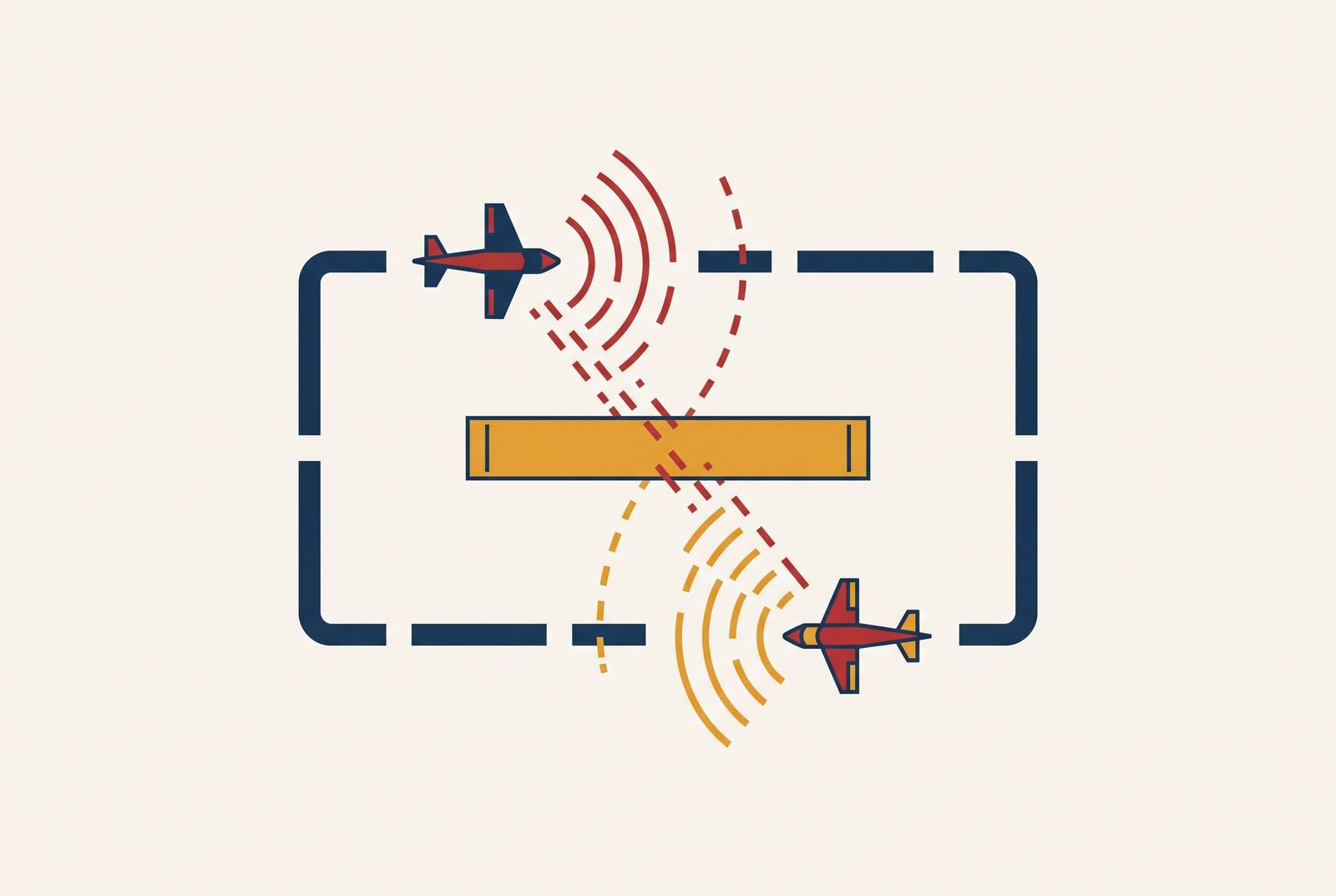
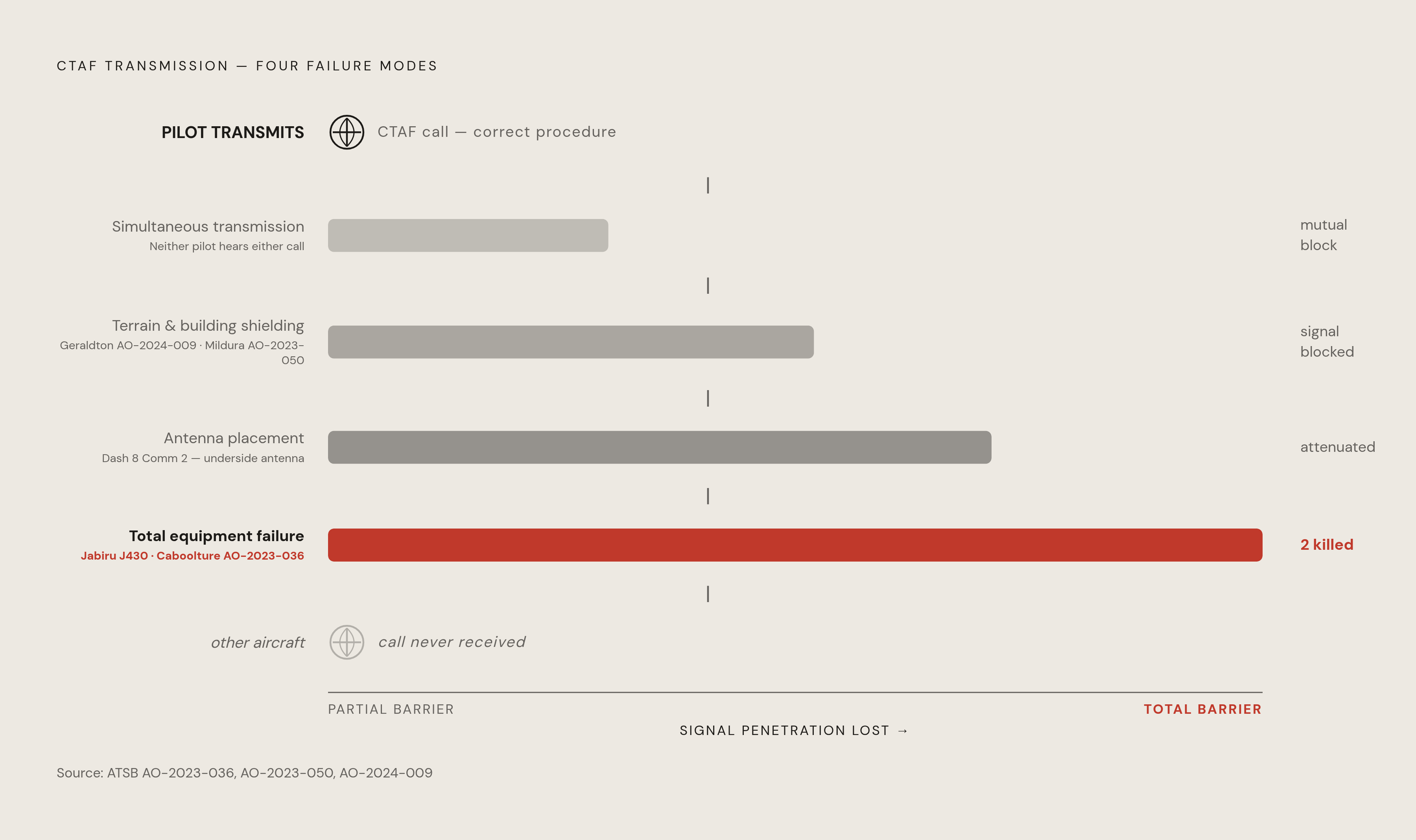
Two aircraft transmitting at the same moment on the same frequency will block each other outright, and neither pilot has any way of knowing the call was lost in the collision of signals. Terrain and buildings can shield a transmission from an aircraft close enough that visual separation should otherwise be straightforward. Flight Safety Australia's analysis of ATSB investigations identified radio shielding as a contributing factor in both the Geraldton near-collision, filed as AO-2024-009, and the Mildura separation incident, filed as AO-2023-050. The Mildura case adds a second, more mundane failure point. The Dash 8 crew involved was using Comm 2 to make CTAF calls, and that aircraft's Comm 2 antenna was mounted on the underside of the fuselage, while the Comm 1 antenna, mounted on top, offered markedly better signal quality. The choice of radio, not any failure of procedure, may have kept the crew from hearing the Lancair's broadcasts.
Equipment can also fail completely. The ATSB's investigation into the Caboolture mid-air collision, filed as AO-2023-036, involved a Jabiru J430 and a Piper PA-25 Pawnee, and concluded that the Jabiru most likely could neither transmit nor receive radio calls at all, though investigators could not pin down why. Two people aboard the Jabiru died in that collision. Taken together, these cases show a pilot can do everything procedure asks, and still be invisible to the one aircraft that matters most in that moment, for reasons no amount of training would have fixed.
The traffic pattern and the compression of failure modes
Every weakness described so far becomes sharper inside the traffic pattern, where aircraft fly close together, descend quickly, and demand the pilot's full attention at the exact moment a missed radio call does the most damage. A standard pattern runs through crosswind, downwind, base, and final in rapid sequence, and the window between a pilot announcing a position and that position becoming obsolete is measured in seconds. An announcement made a few seconds late describes an aircraft that has already moved somewhere else.
Several aircraft can occupy different legs of the same pattern at the same time without any of them having visual contact with the others. A pilot flying downwind has no way to see an aircraft on final behind them unless they deliberately look for it, and a missed or misheard call is the only warning that aircraft might get. At airports with flight schools running repeated touch-and-go circuits, the rhythm of entering, landing, and climbing out again can turn into routine, and routine tends to dull the sharpness of both the announcement and the visual scan that's supposed to back it up.
NASA ASRS's CALLBACK Issue 548 documented a case that shows how badly this can go even when people on the ground are actively trying to intervene. An aircraft on final at roughly 500 feet was contacted three separate times and told to go around; UNICOM repeated the instruction, and the aircraft kept descending toward the runway anyway. The crew already on the runway had no option left but an evasive taxi into the gravel to avoid being hit. That failure landed at the single worst possible moment: the aircraft on final was already committed to the runway, with no margin left to recover once the warning wasn't absorbed.
The Marana mid-air collision and a busy, nominally quiet field
The February 19, 2025, mid-air collision at Marana Regional Airport, Arizona (NTSB preliminary report WPR25FA097) is an anatomy of CTAF's limits under real-world pattern conditions. The Cessna had arrived from Chandler Municipal Airport on an instructional flight and was working touch-and-go landings in the pattern. The Lancair entered from the northwest, attempted a landing, and went around because of traffic congestion in the pattern, then took up a position behind the Cessna.
Both pilots were making CTAF calls. The flight instructor aboard the Cessna announced a planned stop-and-go, then heard the Lancair pilot announce he was going around again. She saw the Lancair converging with her position on ADS-B displayed on her iPad, and she keyed the radio to ask whether the Lancair pilot could see them. The Lancair was destroyed in the crash and both occupants were killed; the Cessna sustained only minor damage.
What makes Marana instructive beyond the tragedy itself is the volume of traffic the airport was handling as an uncontrolled field. In 2024 it logged a high number of operations, counting takeoffs, landings, and touch-and-goes together, with 259 aircraft based there and two flight schools running regular training operations. Marana was not a sleepy grass strip with one call an hour. It was a high-volume training environment where CTAF calls were being made and still did not prevent a fatal collision.
The institutional detail that closes the case is just as telling as the collision itself. Marana's need for a tower had already been recognized and funded through the federal program built for exactly this purpose, and the tower was still five years from completion at the time of the collision, held up by ordinary capital and scheduling constraints. An airport can know it needs a tower, get that tower approved, and still operate for years without one.
The per-airport collision statistics do not settle the safety question
This section lays out the strongest objection to everything above, a statistical one, before answering it. The United States has roughly 527 towered airports set against tens of thousands of non-towered landing facilities, and when collision counts are averaged across that enormous base, the aggregate numbers do not obviously justify building and staffing thousands of new towers. Anyone who has looked at the raw figures for uncontrolled airports as a category has a fair basis for skepticism about claims of systemic danger.
The answer to that objection is that averaging across tens of thousands of airports of wildly different character hides the one variable that actually matters: how much traffic any given field is handling at any given time. Towered airports handle traffic volumes and complexity that most uncontrolled fields never approach, so comparing per-airport averages across the two categories treats exposure as though it were uniform when it is not. Marana makes the distortion concrete. Its 2024 operations count, including touch-and-goes from two active flight schools, puts it nowhere near the typical non-towered airport, most of which see a small fraction of that traffic in a year. Counting Marana as low-risk because the category average for non-towered fields looks calm is a statistical error rather than a safety finding.
CTAF's voluntary structure means risk doesn't spread evenly across operations in the first place. One non-communicating aircraft can erase every other pilot's careful compliance in a single pass through the pattern, and that risk concentrates precisely at the moment of the pattern itself, most of all at high-volume training fields where touch-and-goes stack multiple aircraft into the same small volume of airspace repeatedly through the day. Whether non-towered airports are safe on average isn't the right question.
The uncontrolled-airport coverage gap as a resource and staffing problem
The vast majority of U.S. airports operate without a tower for reasons of cost and staffing capacity, not because anyone decided those airports didn't matter. The FAA's Federal Contract Tower program already does a great deal of work on a limited budget: it covers a substantial number of facilities, handles a large share of all National Airspace System operations, and its towers make up roughly half of all federal air traffic control towers nationwide, while consuming only a small fraction of the FAA's total tower operations spending. That ratio shows contract towers already function as an efficient tool at the margin. It also shows that tool has limits: it is not a solution that scales to cover every uncontrolled field in the country.
Even airports accepted into the program still have to cover their own capital costs for construction and ongoing maintenance, and Marana is the clearest illustration available. Its tower was approved and funded through the federal program, and was still five years from completion because of the ordinary capital and scheduling constraints that follow any public infrastructure project. Approval and funding do not translate into a working tower on any short timeline.
Beyond the capital constraints, a shortage of air traffic controllers makes the gap arguably harder to solve: as of May 2025 the FAA was short thousands of controllers, a shortfall that makes it structurally impossible to staff towers across the full range of non-towered airports even if every one of them had a tower built and ready tomorrow. The infrastructure gap and the staffing gap compound each other. And the fragility runs well past small airports: in September 2026, a communications failure at the Philadelphia regional facility knocked out the primary data line, and when systems tried to switch to backup, the backup fiber line turned out to have been severed, accidentally, by a construction crew. That combination, a primary circuit fault layered on an unrelated accidental cut rather than two simultaneous independent failures, grounded commercial traffic across the Northeast for hours. The entire national airspace communications system has shown itself vulnerable to exactly this kind of compounding failure, at every scale; uncontrolled airports are not uniquely fragile.
What digital tower technology can do that CTAF cannot
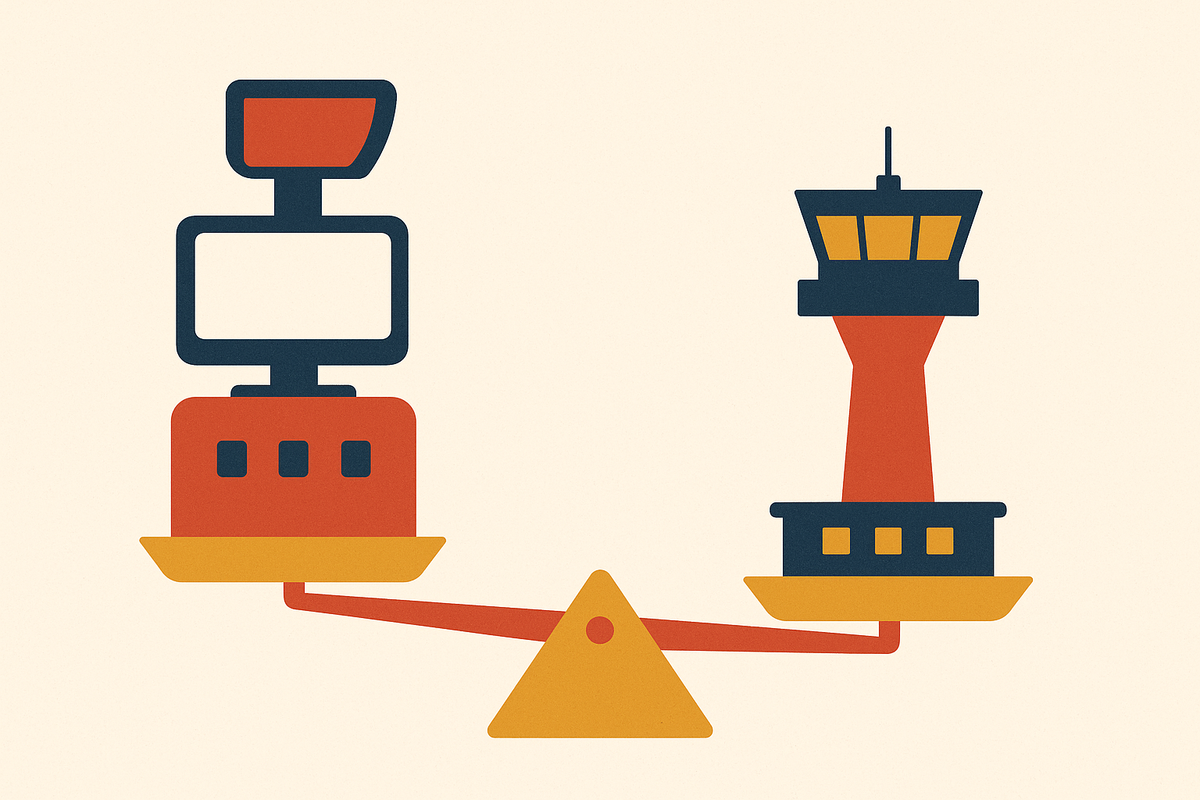
Digital tower technology replaces voluntary self-announcement with active oversight from a remote controller equipped with real information instead of secondhand radio calls, addressing the structural problem rather than the symptom. High-definition cameras, sensors, and real-time data feeds give that controller the same functional view of the airport environment a controller sitting in a physical cab would have, just delivered from a different location.
Cameras and sensors close the exact blind spots that break CTAF calls in the first place: radio shielding from terrain and buildings, documented in the Geraldton and Mildura incidents, and antenna placement, which in the Mildura incident may have contributed to the Dash 8 crew's use of a lower-quality Comm 2 antenna not hearing the Lancair's broadcasts. Infrared imaging extends that coverage into low-visibility conditions that would otherwise compromise the see-and-avoid principle CTAF depends on entirely. AI-driven systems layered on top of the camera feeds add real-time data analysis, predictive alerts, and pattern-conflict warnings, capabilities a pilot relying purely on CTAF self-announcement simply does not have. Because the cameras and sensors absorb much of the observational burden that a human controller would otherwise carry alone, digital remote towers need fewer controllers per facility than a traditional tower, and a single controller can manage traffic at multiple airports from one working position, a direct answer to the staffing shortfall already described.
Norway's Avinor offers the clearest operational proof. Avinor Air Navigation brought digital tower service online at Røst Airport on October 19, 2019, and by May 2022 its Digital Towers Centre in Bodø had four airports running in full operational service, Røst, Vardø, Hasvik, and Berlevåg, a setup described as the largest center of its kind in the world. Avinor intends to extend remote operations to additional airports by 2027. The approach isn't confined to low-traffic fields, either. London City Airport brought remote tower technology online in 2021, after recording a high volume of aircraft movements in 2019, which shows the technology scales to busy commercial fields, not only to quiet rural strips. Budapest became the first international airport in a mainland European capital to be fully managed by controllers working outside the conventional tower building.
The U.S. picture is earlier-stage but moving. Leesburg Executive Airport was the first municipal airport in the country to operate a remote tower, beginning testing in 2015 and running continuous air traffic control service from 2018 through 2023, a period during which its annual traffic grew substantially. The technology has already proven itself operationally in Norway, where Avinor's Digital Towers Centre in Bodø has four airports in operational service. Whether it reaches fields like Marana depends on how quickly U.S. certification catches up to what's already running overseas.
What needs to change for airports like Marana
Marana had the traffic volume of a busy field and the oversight structure of a quiet one, and that mismatch, documented operation by operation in the NTSB's preliminary report, is what CTAF was never built to resolve. The tower it needed was already approved and funded, and still five years away. The staffing shortfall that keeps thousands of fields like it uncontrolled is a national one, not a local funding failure, and it will not close on its own timeline. Digital tower technology, proven in operational service in Norway, offers a route around both constraints at once: less capital per facility, fewer controllers per airport, and oversight that doesn't depend on every pilot in the pattern making a clean call at the right second. Whether U.S. certification, FAA staffing, and funding priorities move fast enough to reach the country's busiest uncontrolled, high-volume patterns before the next one produces the same outcome, not whether the technology works.
Sources
- Beyond the broadcast: avoiding conflict at non-controlled aerodromes
- This Week’s Northeast Disruption Puts Spotlight on Aging Air Traffic System
- Uncontrolled Aerodromes - Communications
- cb 548
- Remote ATC towers and the changing airport landscape
- NTSB report outlines the moments before fatal mid-air crash in Marana
- Marana midair collision included plane operated by a flight school. Here's what we know