VFR Traffic Sequencing Problems Without a Tower
Pilots must coordinate perfectly at uncontrolled airports or collisions become inevitable.
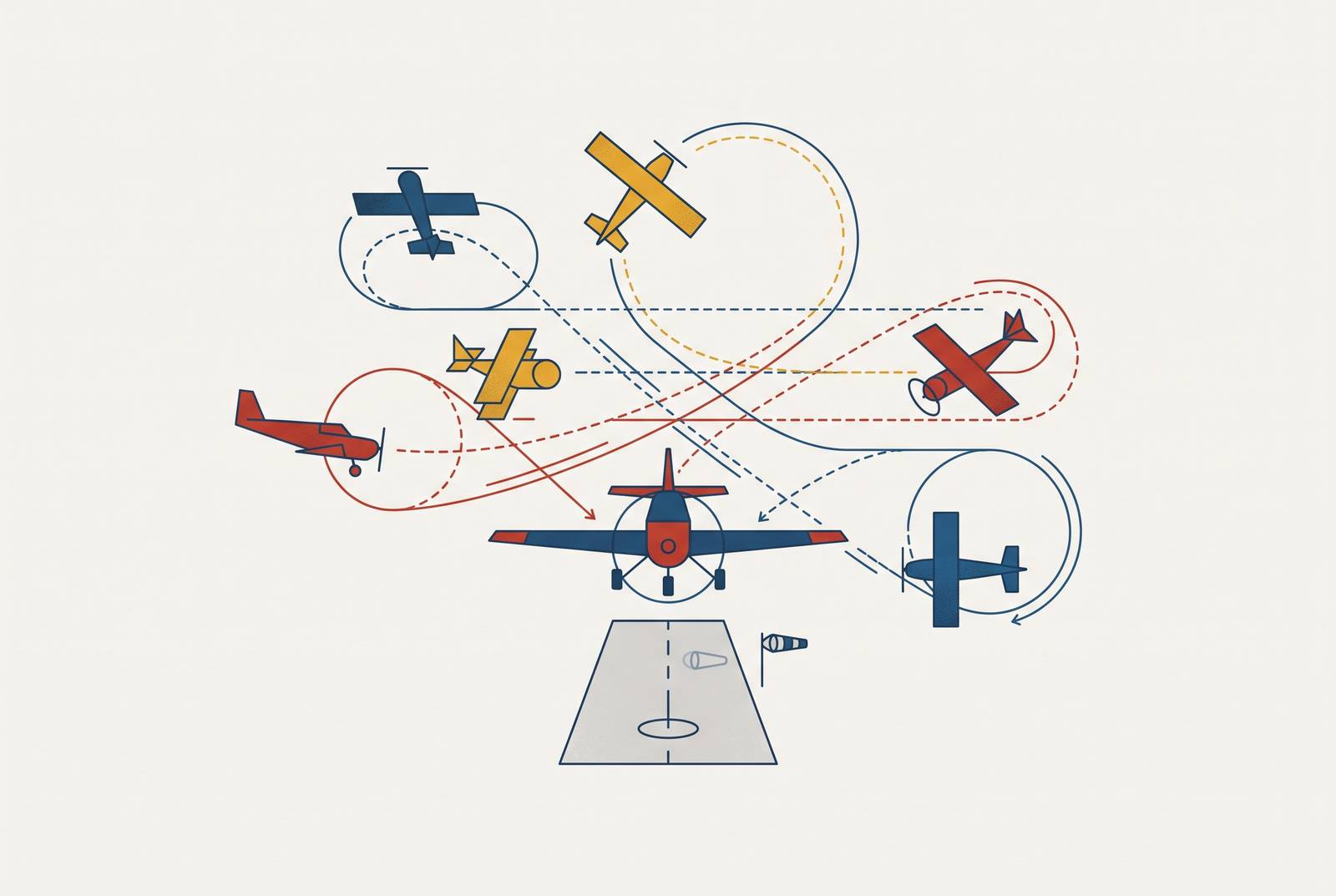
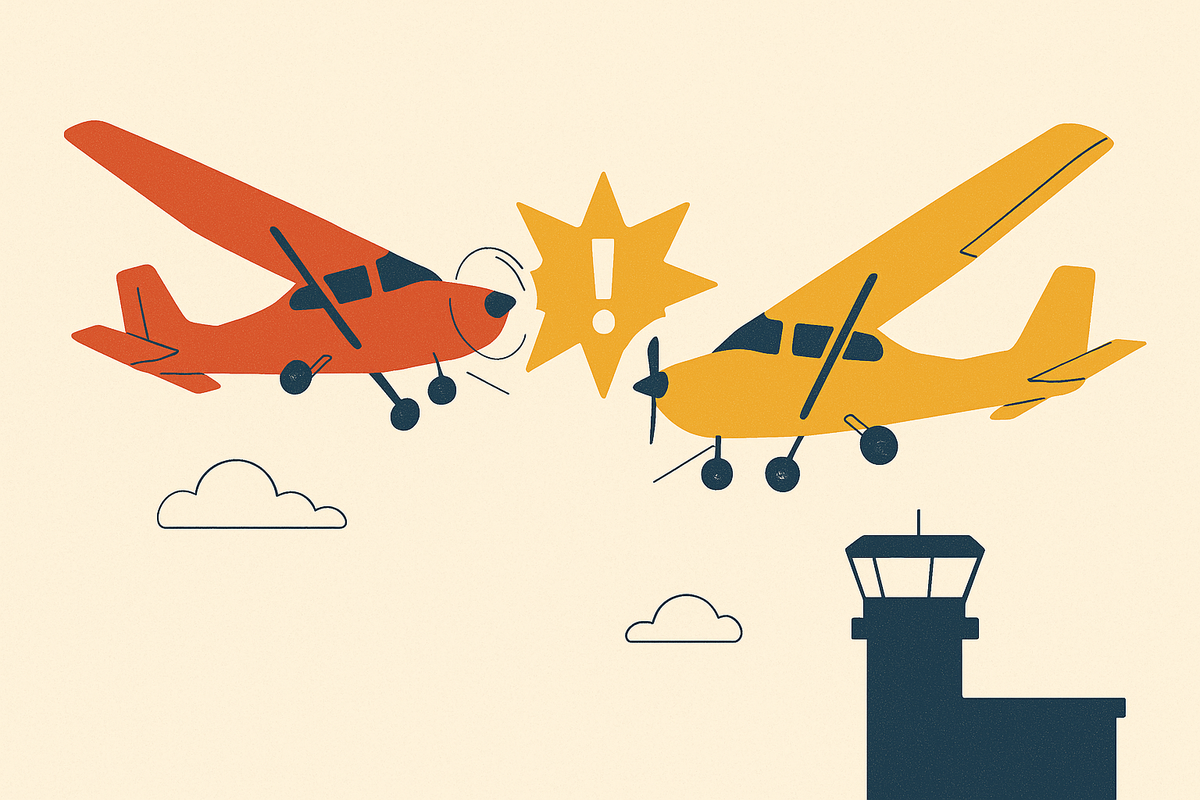
Self-sequencing at a non-towered airport replaces a controller's authority with the voluntary cooperation of every pilot in the pattern, all at once, rather than functioning as a stripped-down version of air traffic control. The FAA's Aeronautical Information Manual lays out the baseline: every radio-equipped aircraft must transmit and receive on a shared frequency, use the correct airport name on every call, and keep a visual lookout for traffic that may not be talking. That last clause matters. The AIM does not assume universal participation; it assumes some aircraft in the pattern may have no way to announce themselves, and it asks every other pilot to fly as though that gap could appear at any moment.
Nothing in this system issues a correction when someone gets it wrong. A pilot flying into a towered field who blows through an assigned altitude or misses a sequencing instruction hears about it immediately, from a controller whose job is to catch exactly that kind of error. A pilot flying into a non-towered field who shows up on the wrong frequency, skips a position call, or enters the pattern incorrectly gets no such feedback. Nobody holds the authority to flag the mistake, so the correction, if it comes at all, has to come from another aircraft recognizing the conflict and maneuvering around it. That is the structure: every pilot has to get it right, at the same time, with no backstop and no referee. The chain holds only as long as every link does.
How a single pilot deviation collapses the chain
Every pilot in a non-towered pattern operates on assumptions about what everyone else is doing, built from radio calls, visual scans, and standard pattern procedure. One pilot's deviation breaks those assumptions for the whole group, and nobody else in the pattern finds out until the conflict is already underway.
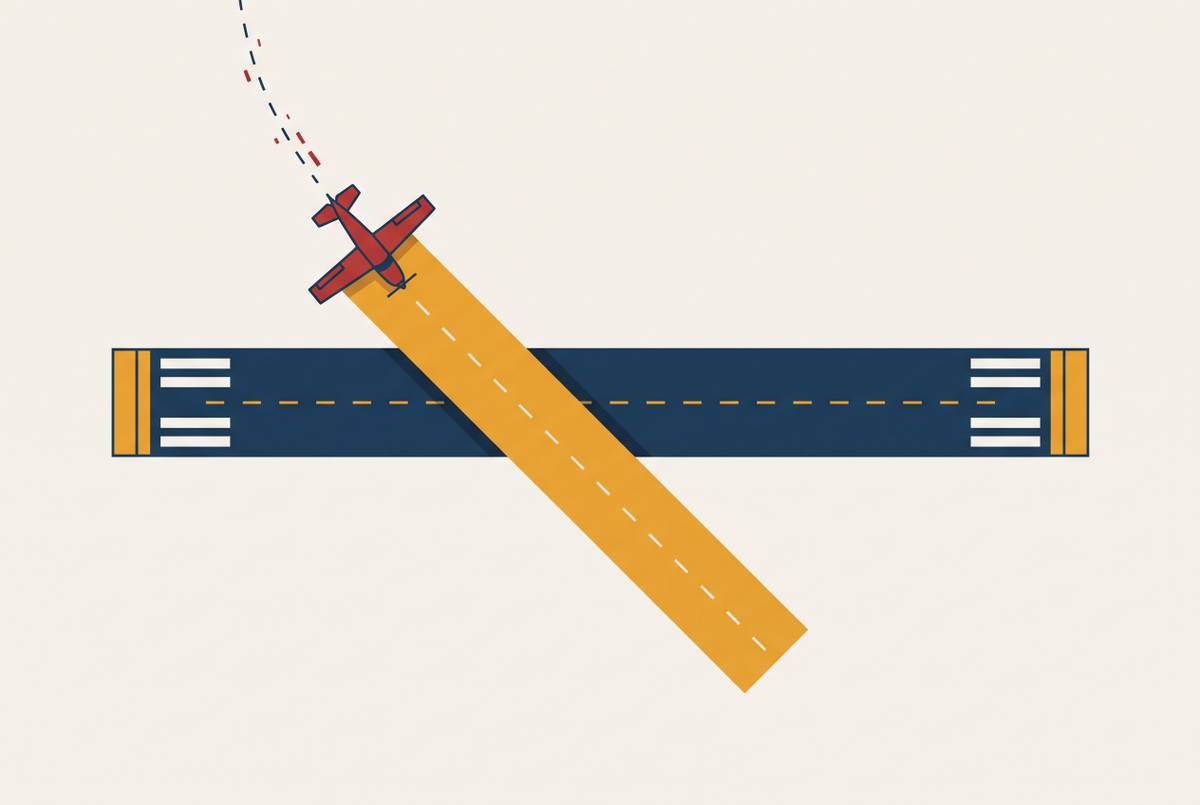
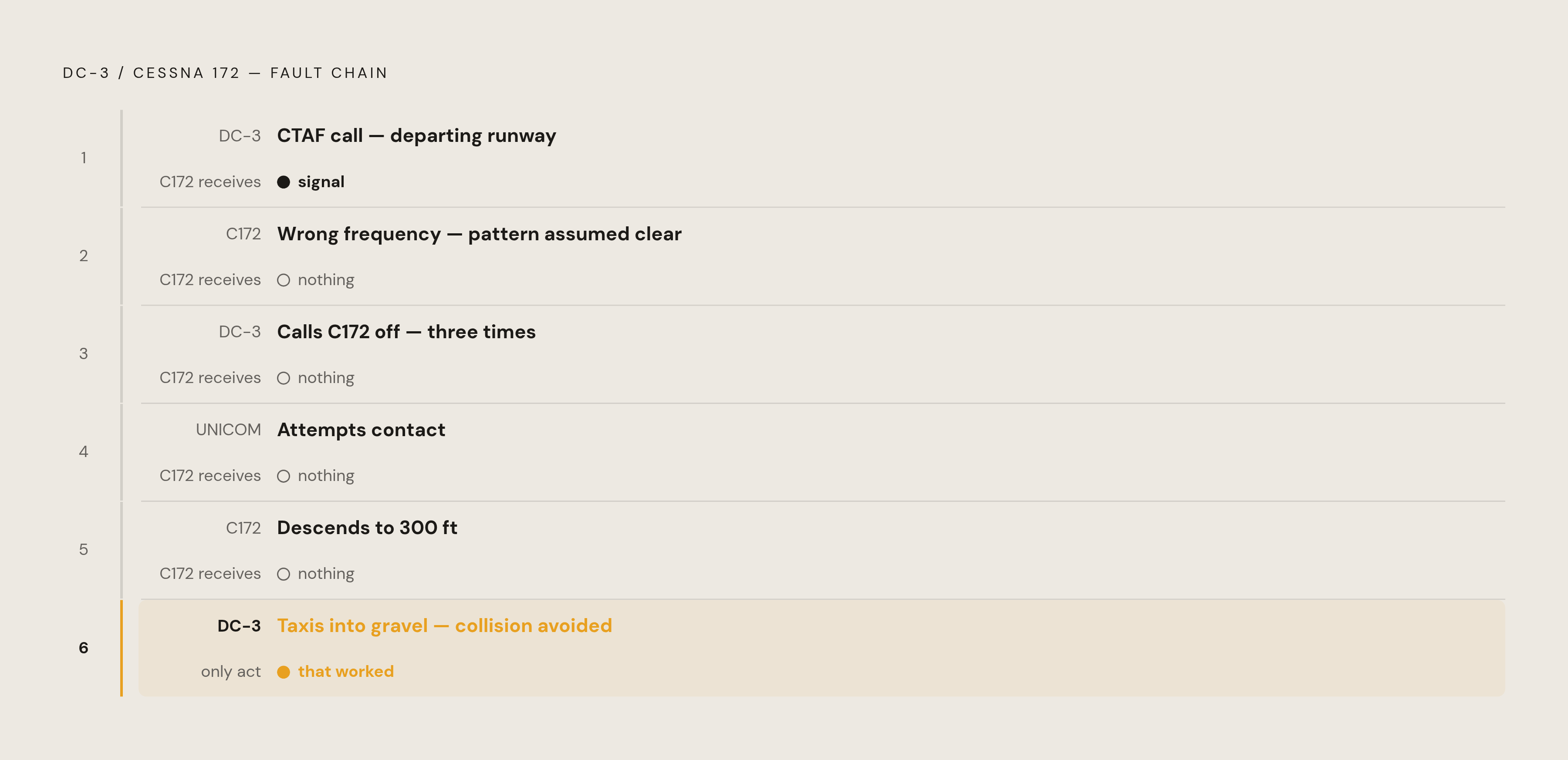
An incident recorded in NASA ASRS CALLBACK Issue 548, published in September 2025, shows how that plays out. A DC-3 crew followed procedure to the letter: they made proper CTAF calls announcing their intention to take off on a downhill runway, as their operation required given the aircraft's size and the terrain. A Cessna 172, flown by a student and instructor, was on the wrong frequency. The Cessna never heard any of it. From the Cessna's perspective, no one else was in the pattern, so it continued its approach toward the opposite end of the same runway the DC-3 was about to use for takeoff.
The DC-3 crew tried three times over the radio to call the Cessna off. UNICOM tried as well. None of it reached the aircraft, because the aircraft was listening to a different frequency. The Cessna kept descending, down to 300 feet, before the DC-3's captain made the only move left available: an evasive taxi off the runway and into the gravel. The conflict ended through a physical maneuver on the ground, not because the communication system caught the error. The FAA's own guidance acknowledges this exact failure mode: a pilot on the wrong frequency receives no signal that anything is wrong and simply continues the approach as planned, because nothing in the cockpit tells them otherwise. The deviation was invisible to the pilot who made it, right up until the moment someone else had to maneuver a vintage transport aircraft into loose gravel to avoid a collision.
Straight-in approaches as a predictable point of breakdown
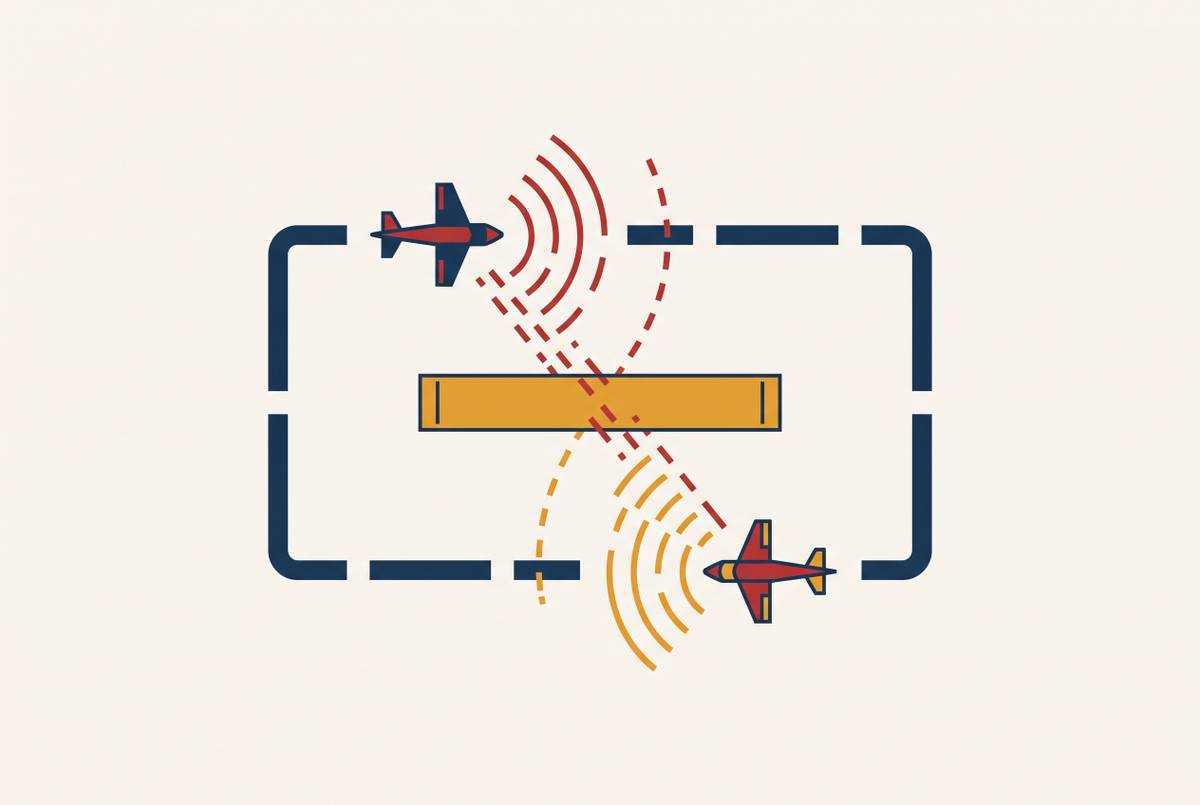
Straight-in approaches strip away the exposure points built into a standard traffic pattern. A pilot entering on crosswind, flying downwind, turning base, and then final has several chances to see other traffic and be seen in turn. A pilot flying straight in skips all of that and arrives directly on final, often at a point where other aircraft in the pattern expect that slot to still be empty until it's filled from the base leg turn.
The FAA does not prohibit straight-in approaches at non-towered fields. It discourages them. That distinction carries real weight, because discouragement without a controller to enforce it is advisory language with no teeth. A corporate jet incident recorded in ASRS CALLBACK shows what happens when the timing assumptions behind that advisory language fall apart on final approach, with both aircraft operating in good faith and still converging on the same runway at the same moment. Neither crew broke a rule. The jet's performance envelope and approach speed put it on a different timeline than the piston aircraft already working the pattern, and nothing in the system reconciled the two until they were close enough that the conflict became unavoidable. That is the structural limit the FAA's own guidance exposes: a straight-in approach is legal, pilots fly it according to procedure, and the system still produces a runway conflict because no one holds the authority to space the two aircraft apart in time.
Mixed IFR and VFR operations and the communication layer VFR-only pilots cannot parse
A second, separate failure mode appears when an instrument flight plan and visual traffic share the same non-towered field. Both aircraft transmit on the same CTAF, but what the IFR pilot says may not mean anything to a VFR pilot already working the pattern. If an IFR approach call is built around waypoints, published headings, or missed-approach procedure, a non-instrument-rated pilot has no training to interpret it, even when the call is transmitted correctly and received clearly.
The FAA AIM settles the question of priority directly: an IFR aircraft holds no higher claim to the runway than any other aircraft in the pattern. The IFR pilot is expected to talk to VFR traffic and work out sequencing using judgment, which puts the entire burden of resolving the conflict on the pilots in the air rather than on any controlling authority. The handoff compounds the gap. The AIM notes that ATC directs aircraft on an IFR flight plan to switch to the airport's advisory frequency once direct contact with a controller is no longer required, and that towers and centers don't hold traffic or runway-in-use information for airports without a tower. An IFR aircraft on approach to a non-towered field is leaving controlled airspace, losing ATC's picture of local traffic, and entering a pattern where the pilots already there may not be equipped to decode its calls. The busiest, most information-dense phase of the approach becomes the phase where the shared frequency carries the least shared meaning.
Where incident failures surface
The incidents on record line up with the failure modes already described: frequency errors, pattern timing conflicts, and the mismatch between IFR and VFR communication all appear repeatedly as proximate causes. NASA's ASRS CALLBACK gave an entire issue, Issue 548 in September 2025, to non-towered airport hazards, and the firsthand reports it published trace directly back to those same mechanics. The DC-3 and Cessna 172 conflict is one. A corporate jet and a smaller piston aircraft converging on final from incompatible performance envelopes is another, with both crews communicating correctly and still ending up in a runway occupancy conflict. A third account describes an Embraer crew entering a non-towered field at night, where the absence of a controller combined with difficult terrain to produce a controlled-flight-toward-terrain event. That one was resolved by the aircraft's own gear-warning siren, not by anything in the communication environment around it.
That ASRS devoted a full issue to this single category of hazard signals something about the volume and the pattern of reports coming in. None of this supports a claim that non-towered airports are statistically more dangerous than towered ones; the per-operation comparison between the two is genuinely contested, and the record here doesn't resolve it either way. What the record does establish is the mechanism: the same handful of structural gaps recur across unrelated aircraft types, unrelated airports, and unrelated crews. Research published in Safety Science backs this up from a different angle: it identifies miscommunication and inconsistent situational awareness as significant contributors to runway incursions generally. Those are precisely the two forces a non-towered environment concentrates, since it removes the one role whose job is to hold communication and situational awareness steady for everyone in the pattern at once.
Why the problem concentrates at high-traffic airports
The airports most exposed to this kind of breakdown are not quiet backcountry strips with a handful of landings a week. Many are reliever airports carrying real daily traffic, serving charter operators, flight schools, cargo runs, and the communities built around them, which is exactly the traffic mix that produces the pattern conflicts described above. Volume and mix are what turn a theoretical gap in the system into a recurring operational hazard.
Johnston Regional's airport director put the condition in terms that need no translation: it's the equivalent of removing every stop sign and every stop light from downtown Raleigh and expecting drivers to get where they're going effectively, efficiently, and safely anyway. That comparison captures the actual gap at these fields, which isn't a shortage of rules but a shortage of anyone empowered to enforce them in real time. And approval for a tower doesn't close that gap on its own. The absence of a tower at a high-traffic non-towered field is not a temporary condition waiting on paperwork but an open-ended state that persists until a certified system becomes available.
How a Digital Tower Changes the Problem's Architecture
A digital tower doesn't make self-sequencing work better. It removes the need for self-sequencing altogether and replaces it with the same kind of authoritative control that defines a towered airport, just without requiring a physical tower structure staffed around the clock. That is the shift that matters here: the problem up to this point has been architectural, rooted in the absence of anyone with the authority to direct traffic, and a digital tower answers that problem at the level where it actually lives.
The technology works by swapping the out-the-window view from a traditional tower cab for a network of cameras, sensors, and panoramic displays. A controller sits at a remote workstation with a continuous 360-degree view of the airfield, including infrared imagery for low-visibility conditions that a controller looking through glass in a physical tower cab simply cannot get. Mapped against the failure modes already laid out here, the fix is direct. A controller monitoring the frequency catches an aircraft that's gone silent or shown up on the wrong channel, rather than leaving that discovery to another pilot's luck. A controller can impose actual spacing and sequencing on a straight-in approach instead of relying on guidance that only discourages the maneuver without the power to stop it. And a controller sitting between an IFR approach and VFR pattern traffic mediates the two directly, closing the gap where one pilot's call means nothing to the other.
The staffing economics shift too. A single remote center lets a controller cover more than one airport, monitoring and directing traffic at one field at a time while holding certification across several. That matters for small and mid-traffic fields that have never generated enough volume on their own to justify a full-time tower and staff. Johnston Regional's airport director estimates a digital remote tower runs roughly half the cost of a traditional ATC tower, which industry reporting puts at $10 million to $20 million to build. That difference changes the calculation for a meaningful number of airports that currently sit just below the threshold that would justify conventional construction.
Digital tower deployment status in the U.S.
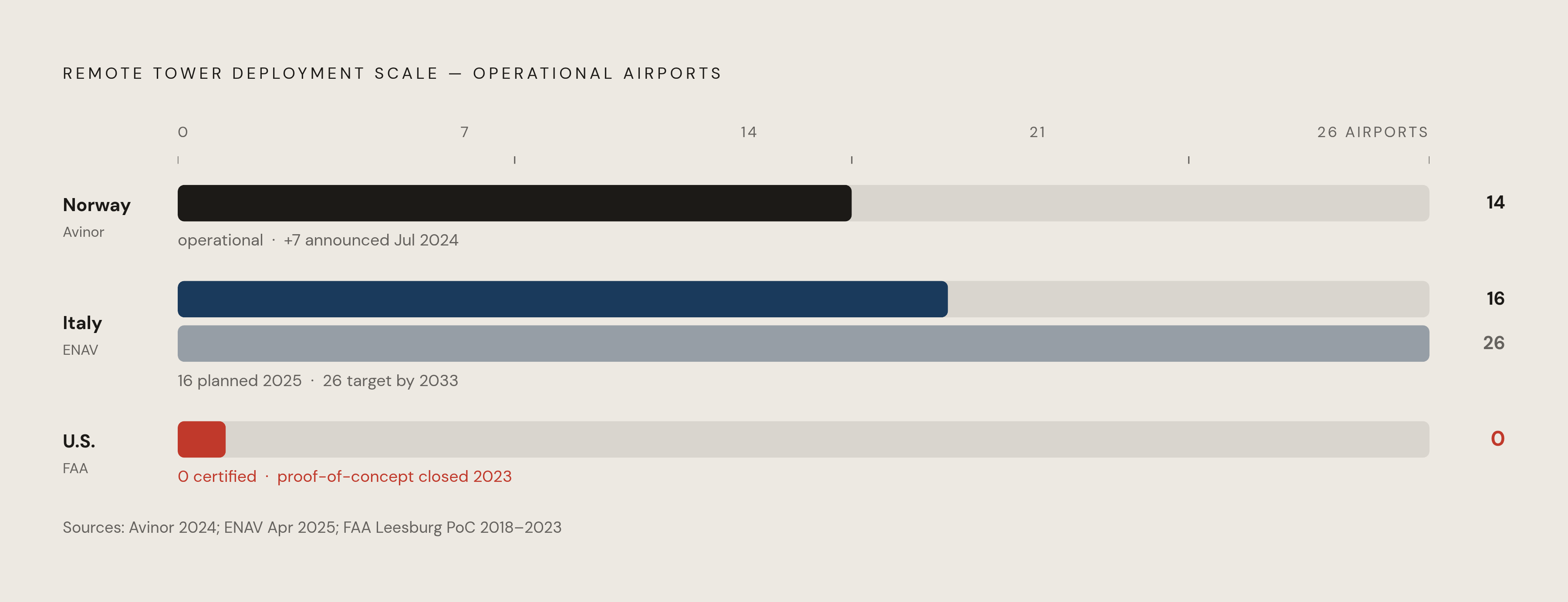
The technology works. It has been operating at scale abroad for years. What's missing is certification for routine integration into the U.S. national airspace system, so the airports facing the exact sequencing failures described throughout this piece have no path to the fix that addresses them yet.
Norway offers the clearest evidence of scale. Avinor, the country's air navigation service provider, runs 14 remote towers out of its Remote Tower Center in Bodø, and in July 2024, Kongsberg Defence & Aerospace announced an agreement to add seven more small airports to that network. Italy is moving in the same direction. ENAV, Italy's air navigation service provider, announced in April 2025 that it will convert its control centers at Brindisi and Padua into Remote Tower Centers managing 16 low-traffic airports, and it plans to expand to 26 airports by 2033.
The U.S. has its own proof of concept, and it's already closed. Leesburg Executive Airport in Virginia ran a remote tower from 2018 to 2023, the first municipal airport in the country to do so, Airport Director Scott Coffman said. The program worked. It also ended without producing a certified system eligible for integration into the national airspace system going forward, leaving U.S. airports exactly where they started: facing documented, recurring sequencing failures, with a working remedy proven on two continents and no certified version of it available at home.