Simultaneous Runway Arrivals at Non-Towered Airports and Who Survives the Judgment Call
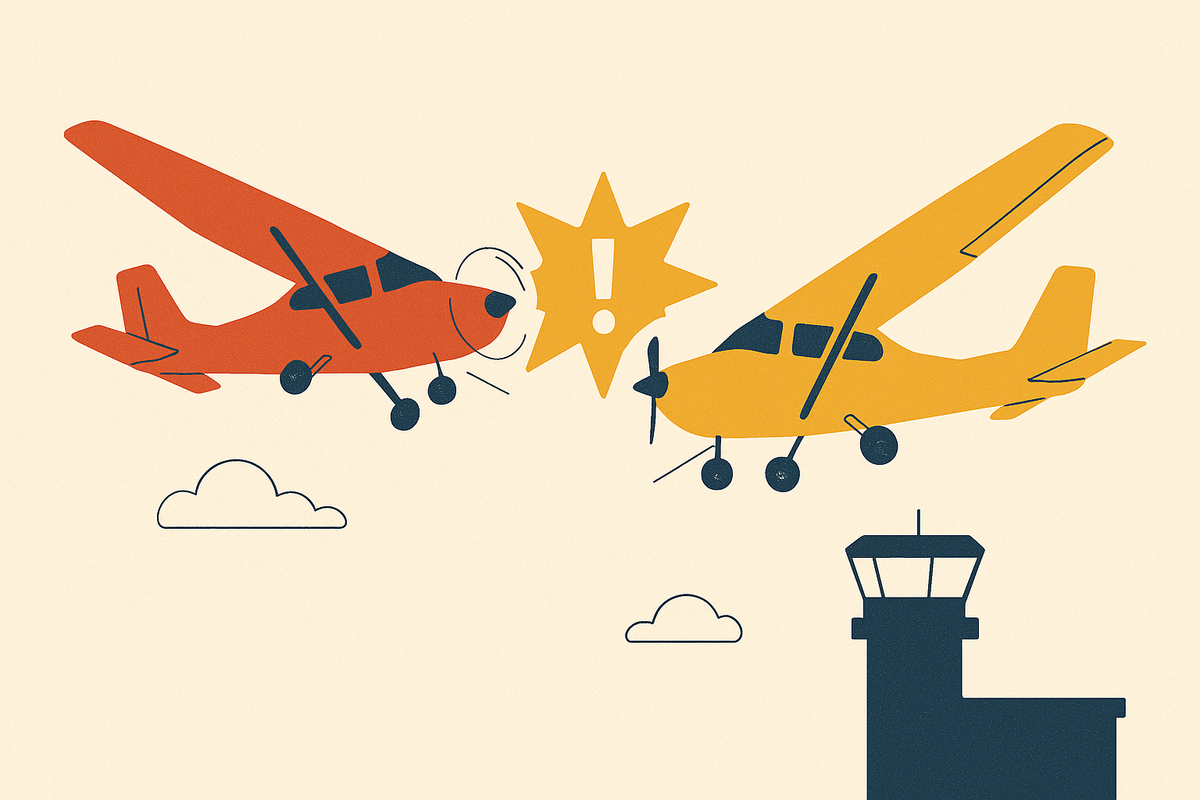
Without a controller, pilots alone must separate converging arrivals.
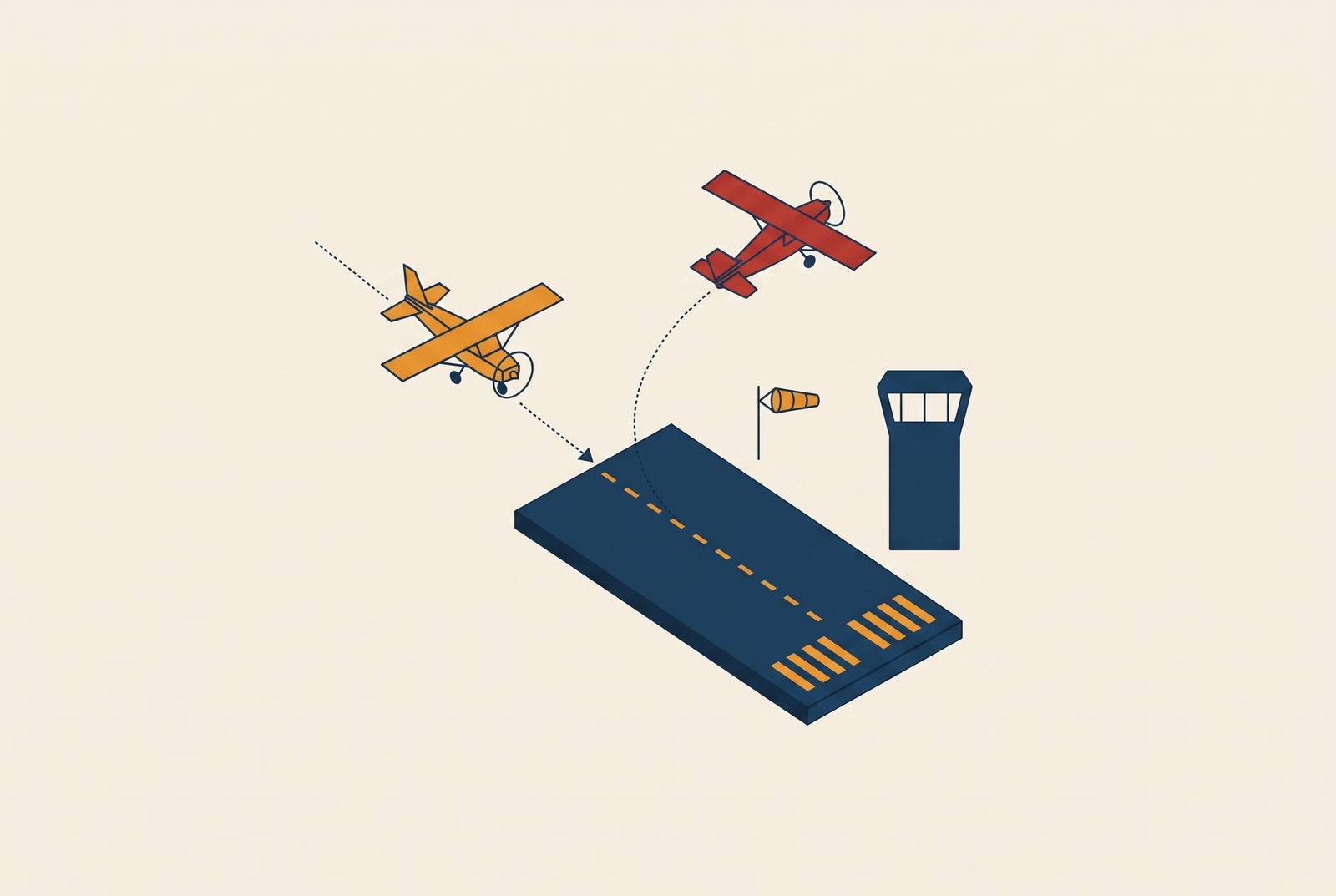
Simultaneous runway arrivals expose the safety gap at uncontrolled airports in the U.S. National Airspace System. Pilots must maintain separation through radio calls, visual scanning, and decisions about the traffic pattern, without a controller who has the authority to resolve a conflict. The gap is structural, and digital towers address it by adding the authority that self-separation lacks.
How runway separation actually works at non-towered airports
Air traffic control ordinarily suggests a controller issuing clearances, sequencing aircraft, and intervening when traffic converges. At a non-towered airport, that runway-level authority is absent. Pilots instead build a shared understanding through position reports on the Common Traffic Advisory Frequency, visual scanning, and adherence to standard traffic patterns. Each pilot must use that information to make a decision that fits with what the pilot in another cockpit decides.
That distinction separates communication from control. A position call can tell another pilot where an aircraft is, but it cannot assign an arrival sequence with the authority of a clearance. Nor does transmitting a call establish that another pilot heard it, understood it, or located the aircraft. Standard patterns give pilots a shared framework, but they help only when pilots can see how the traffic around them fits into it. There is no controller to reconcile conflicting interpretations.
The FAA’s runway incursion taxonomy makes this difference visible. It identifies three types of incursions, which are pilot deviations, vehicle/pedestrian deviations, and operational incidents. An operational incident requires a controller to be present, so that category cannot describe a failure at a non-towered airport. Its absence means that a necessary supervisory function is going unperformed by an air traffic controller.
Why the numbers that look reassuring are hiding the actual risk
The Department of Transportation Office of Inspector General’s March 2025 audit found that the total number of runway incursions at the end of fiscal year 2024 was roughly the same as in fiscal year 2019. That comparison describes frequency. A stable total can contain very different combinations of minor events and incidents in which a collision was barely avoided. Reading it as a complete safety assessment gives it more explanatory power than it has.
The FAA defines Category A as an incident in which a collision was narrowly avoided. Category B involves decreased separation with a significant potential for collision, which may result in a time-critical corrective or evasive response. These categories distinguish proximity to catastrophe from the simple occurrence of an incursion. The audit also found that the FAA lacks an integrated approach to analyzing incursion data and identifying risk. That limitation constrains what aggregate figures can explain.
Airport-category comparisons introduce another measurement problem. Towered airports handle far more operations at each airport, so collision counts alone or comparisons of counts per airport do not show how the risk per operation differs. Exposure has to enter the comparison. Fatal events also need to be sorted carefully by airport type, without assuming that they happen only at uncontrolled airports. The March 2026 fatal runway collision at LaGuardia Airport occurred at a Part 139 airport with an active control tower.
The defensible conclusion is narrower than an absolute ranking. Neither a stable national total nor a small number of fatal accidents establishes that self-separation is adequate wherever it is used. Conversely, a fatal event at a towered airport shows that a controller is not an infallible safeguard. Assessing that risk requires examining which defenses exist when separation starts to fail and whether the available measurements reveal their absence.
What actually breaks down when two aircraft arrive simultaneously
When two aircraft approach the same runway, self-separation requires several actions to succeed together. Both pilots must broadcast clearly, hear and correctly interpret the other’s call, and visually acquire and judge the other aircraft’s position. These actions occur in separate cockpits without a controller reconciling the results. Pilots may have only part of the information they need for each action. A pilot can perform one part correctly while another part of the chain fails.
Radio communication illustrates how that chain can break. Non-standard phraseology can make a position report ambiguous, while overlapping transmissions can prevent either pilot from hearing the other. A transient pilot may make an otherwise appropriate call using a reference point that local pilots do not expect. The words alone do not settle the geometry. Even when a transmission is audible, pilots must agree about what the reported position means for their own approach.
Visual acquisition must then resolve what the radio cannot. Yet the system requires both pilots to find the relevant traffic and correctly judge its position. Familiarity with local traffic patterns can support that judgment, while unfamiliarity adds another interpretation task. At a non-towered field, no controller is available to compensate for that gap. The pilots flying the approaches must also work out whether their plans conflict.
A transport safety agency says that pilots flying in the same area who do not communicate enough with each other are the most common cause of safety incidents near non-controlled aerodromes. That finding points to a dependence built into the operating model, rather than proving carelessness in any particular event. A controller can set the order of arrivals and act as a conflict develops, though controllers can also make errors. At an uncontrolled field, there is no equivalent controller backstop when the pilots’ shared picture fails.
Three recent collisions that fit the pattern exactly
The FAA’s preliminary accident statements describe three collisions near non-towered airports in a little more than a year. Their common feature is the operating environment. The investigations have not released probable causes. These events therefore show who had to make the judgments, while leaving open which error in communication, perception, or maneuvering led to each collision.
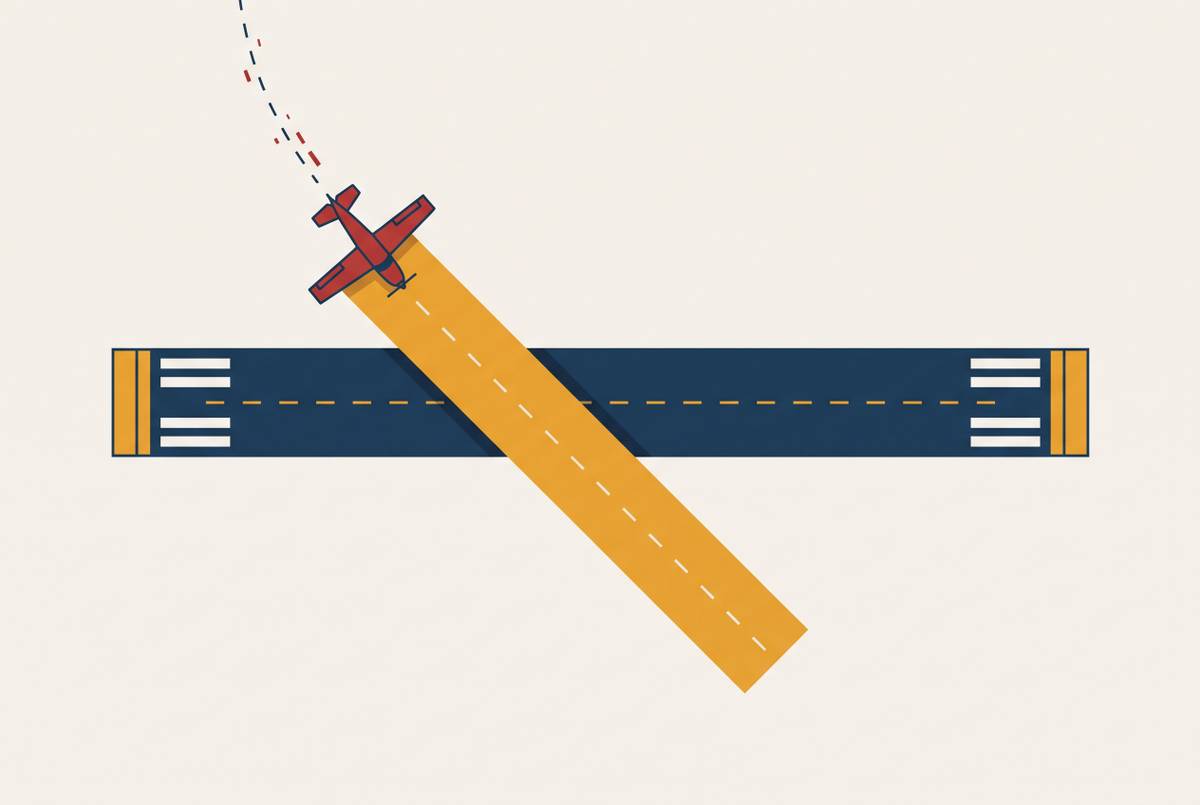
At Fort Morgan Municipal Airport, Colorado, a Cessna 172 and an Extra Flugzeugbau EA300 collided on August 31, 2025, while both aircraft were attempting to land. Two people were aboard each aircraft. The FAA and NTSB are investigating the collision. Of the three cases, this account most directly establishes the simultaneous-arrival situation. It does not establish what either pilot transmitted, heard, or saw before the aircraft converged.
At Hammonton Municipal Airport, New Jersey, an Enstrom F-28A helicopter and an Enstrom 280C helicopter collided in mid-air near the airport on December 28, 2025. Only the pilots were aboard the aircraft. The documented circumstances place the collision near a non-towered field, where pilots were responsible for self-separation. Establishing an arrival sequence or a specific radio failure remains a task for the investigation.
At McMinnville Municipal Airport, Oregon, a Robinson R22 helicopter and an Airbus AS350B3 helicopter collided in mid-air near the airport on October 29, 2026. Two people were aboard the R22, while only the pilot was aboard the other helicopter. The NTSB is leading the investigation. Across these cases, no controller was present to issue clearances or sequence the aircraft. That absence identifies the missing defense, but it does not prove that a tower would have prevented any particular collision.
Why the FAA's existing runway safety tools were not built for this problem
The FAA Runway Incursion Mitigation Program had addressed 100 complex airfield locations by the end of fiscal year 2024. Its work targets a concrete source of runway risk, including nonstandard taxiway layouts at towered airports. Reducing recurrence at those locations is a useful result. It does not, however, supply an arrival-sequencing authority at an uncontrolled field. Airfield geometry and an absent controller are different problems, even when both can contribute to runway conflicts.
This is a mismatch of tools and operating environments. A program meant to fix confusing pavement layouts cannot be expected to settle differences in how pilots understand airborne position reports. Nor can a classification system alone supply the supervisory function absent from a non-towered airport. The distinction prevents a misleading institutional conclusion. A program can do its assigned work well without covering the whole safety gap.
The reporting system has a corresponding boundary. Voluntary systems such as ASRS capture roughly six near-miss reports per month nationally, but that count reflects what pilots choose to report. Reporting is not continuous observation of the airfield. At a non-towered airport, a conflict that never becomes an accident has no local ATC record. Combined with the audit’s finding about fragmented analysis, that limitation helps explain why the existing system will not necessarily identify and correct this gap on its own.
What digital ATC towers actually change about the judgment burden
A digital ATC tower changes who can act on the traffic picture. It gives a controller a live view of the airfield without requiring that controller to occupy a conventional tower cab. High-definition cameras, infrared sensors, and microphones reproduce a continuous 360-degree view of runways, taxiways, and surrounding airspace inside a remote control room. Aircraft identification tags overlay the live video. The structural benefit is the controller’s authority.
At a previously uncontrolled airport, that authority adds clearances pilots must comply with and a means of sequencing simultaneous arrivals. It also creates an intervention path before aircraft converge on the same runway. Pilots still have duties to carry out and judgments to make. The change is that their independent decisions no longer constitute the entire local separation architecture. A controller can resolve the conflict rather than leaving each cockpit to infer the other’s intended action.
The FAA says Bartow Executive Airport, Florida, has the first Non-Federal Control Tower digital tower system to go into operation. Its cameras sit on a 76-foot tower roughly 600 feet from the control room, where screens arranged in an arc display the airfield. The installation cost $6.1 million, funded by the Florida Department of Transportation. Bartow demonstrates operational use, with collision-reduction results still unquantified. Because the airport already had a conventional tower, it also should not be presented as a measured before-and-after test of self-separation.
Money from the Working Families Tax Cut Act will pay for digital towers at five more non-towered airports. They are Winter Haven Regional Airport and Venice Municipal Airport in Florida, Montgomery County Airpark in Maryland, Johnston Regional Airport in North Carolina, and Durango-La Plata County Airport in Colorado. These planned installations extend the concept beyond Bartow. Digital towers also support UAS integration into the National Airspace System, giving the infrastructure a role beyond runway-arrival sequencing.
Current FAA guidance nevertheless constrains how installations can connect. It requires a closed, physically point-to-point network and an independent fiber-optic feed between the sensors and control center. Wireless transmission is not currently permitted. Separating the control room from the cameras remains subject to that connection requirement, which adds infrastructure work to the equipment and approval process.
Why the gap between five installations and thousands of uncontrolled airports is a policy problem, not just a funding one
Five funded installations do not constitute coverage of thousands of uncontrolled airports. Decisions about the scale and speed of deployment remain. A demonstrated architecture can leave the underlying safety gap largely intact if only a small share of airports receives it.
Funding is one part of that decision. The Senate FY26 spending bill includes $279.2 million for the FAA Contract Tower program, which would fund all 265 current contract towers and allow the FAA to add other airports. That program uses private contractors to support towers at smaller airports. It is not equivalent to a deployment program covering fully uncontrolled fields. Support for existing controlled operations and the extension of control to airports without it are distinct policy tasks.
Certification determines how quickly funding can become service. The 2024 FAA Reauthorization Act directed the FAA to define clear standards for digital and remote tower systems, while the technology reached operational status in 2026. The fiber-optic requirement adds a separate constraint. Whether lower-risk deployments could justify a streamlined requirement remains an unresolved policy question.
The choice is between retaining a system in which local separation rests entirely on pilot coordination and extending an architecture that adds enforceable sequencing and intervention. Digital towers provide a demonstrated means of changing that allocation of responsibility, without establishing that every collision would be prevented. How widely and how quickly that authority becomes available is a policy decision.