Wrong-Surface Landing Incidents at Uncontrolled Airports
Pilots mistake taxiways for runways even in clear weather, and towers are the only reliable catch.
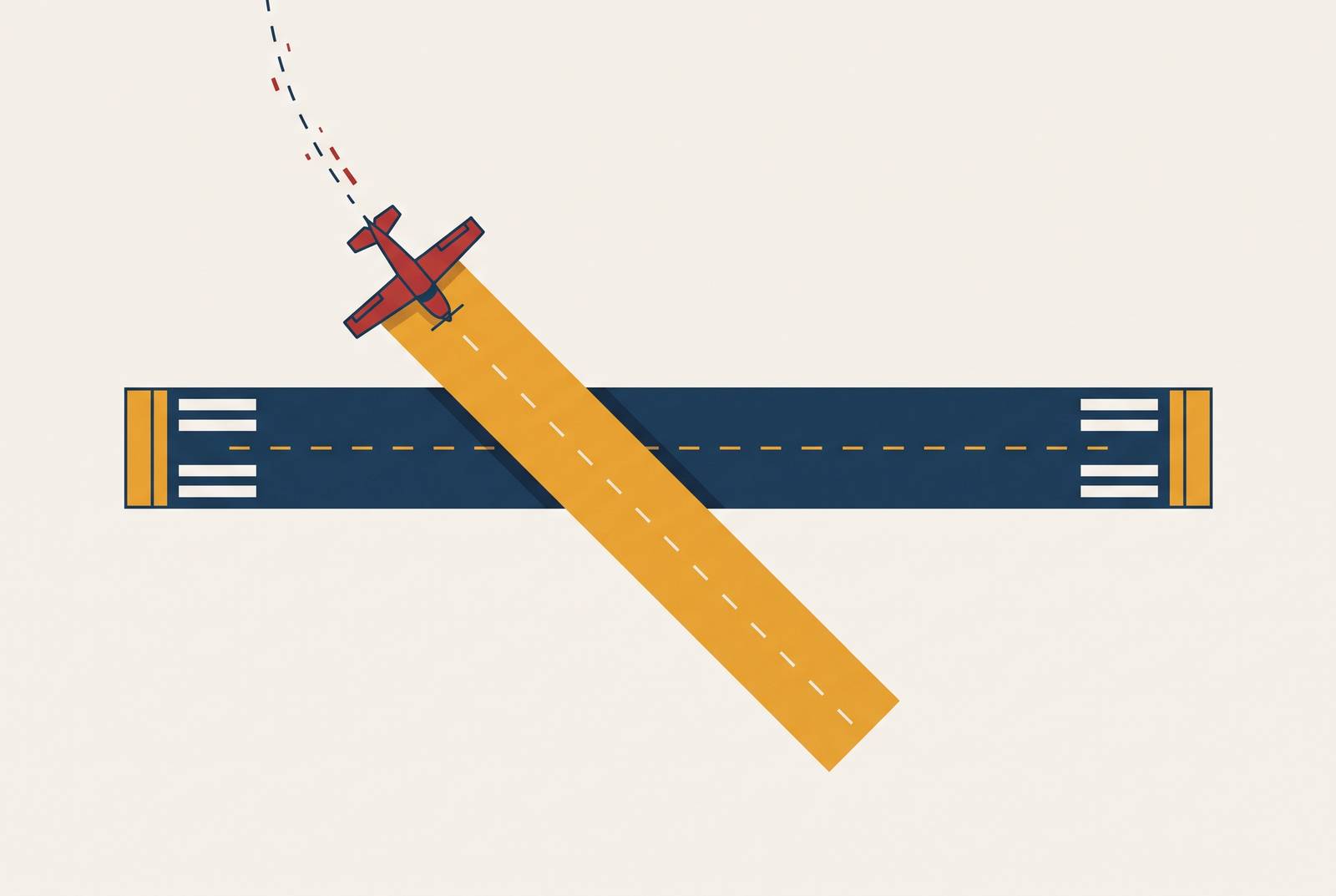
Wrong-surface events, landing or taking off from a taxiway, the wrong runway, or the wrong airport entirely, happen at an average rate of one per day in the United States. The NBAA puts this figure on record as a steady baseline rather than a spike tied to any particular year or incident. In fiscal year 2023 alone, the FAA logged 103 wrong-surface operations, most of them arrivals, and the agency's own runway safety team is blunt about who these events touch: pilots at every skill level, at airports of every size. The FAA has since named wrong-surface operations a Top 5 Safety Issue inside its Air Traffic Organization, a designation that reflects both how often these events happen and how badly they can end. The 2017 near-miss at San Francisco International, where an Airbus 320 came within 59 feet of a loaded taxiway, brought national attention, but the underlying pattern long predates that event.
The cognitive traps that produce wrong-surface errors are normal features of how pilots process a visual approach, not signs of carelessness
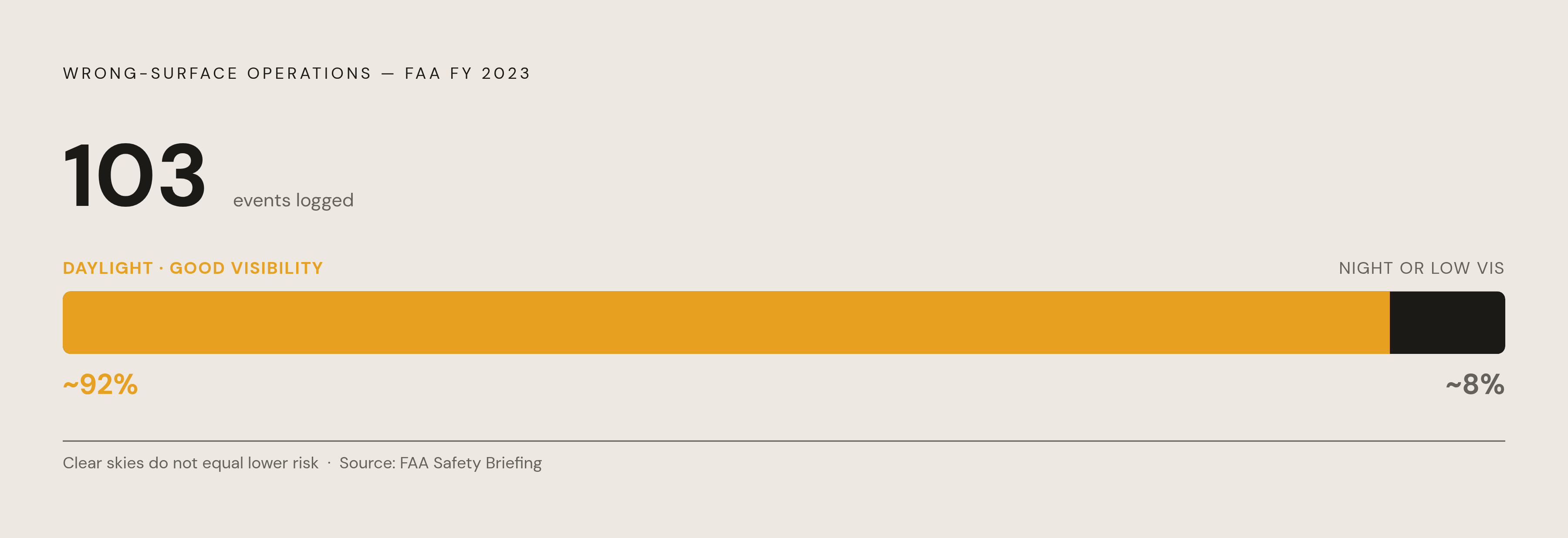
Wrong-surface events cluster in daylight, during visual approaches, in conditions pilots would call easy. FAA Safety Briefing data from fiscal year 2023 shows nearly all of these events occurred in daylight, and nearly all occurred when visibility sat well above the legal minimums. The daylight, easy-visibility clustering of these events is a documented pattern, and it points to something counterintuitive: clear skies do not lower risk, they change its shape. When conditions look easy, pilots lean harder on expectation and pattern recognition, the same mental shortcuts that make flying efficient in good weather and dangerous the moment the airfield doesn't match what the pilot expects to see.
The FAA has documented the specific conditions that trigger this mismatch. Parallel runways, taxiways with similar widths, confusing signage, and the ordinary static of radio communication all set up situations where a pilot's expectation of what a runway looks like overrides what's actually in front of the windscreen. None of this is unique to small, uncontrolled fields. Airfield geometry doesn't care whether a tower sits at the end of the runway.
What ought to give pause is that experience doesn't close the gap. FAA Safety Briefing recounts an experienced pilot at a busy airport who nearly lined up on the wrong surface and caught the error only by cross-checking instruments against what the eye was telling him. Skill improves the odds of catching the error. It doesn't remove the trap, and treating wrong-surface events as a failure of individual attention misses the point: the errors are a predictable output of how human vision and expectation interact with ambiguous airfield layouts, and any serious response has to start from that premise rather than from blame.
At towered airports, ATC functions as the last cognitive backstop, catching the errors that pilots' own awareness misses
A tower controller's job in this scenario is interception. It's interception, catching the mismatch between what a pilot believes is happening and what's actually unfolding on the airfield, before that mismatch turns into a landing on the wrong surface. The FAA's Approach Runway Verification system is built around exactly that function: it fires an audible and visual alert to the controller the moment an approaching aircraft lines up for the wrong runway or the wrong airport, and the controller acts on it. The system was live at a growing list of facilities as of mid-2024, with more coverage planned through the end of that year and into 2025. That expansion matters, but by design it only reaches staffed control facilities.
ARV sits inside a wider set of tools under the FAA's "Ending Serious Close Calls" initiative: the Surface Awareness Initiative, arrival alert notices, and controller training built around modernized simulators. Every one of them depends on a human controller sitting at a staffed position. If the controller is removed, none of these tools has anywhere to plug in.
The Cessna Pilots Association has made the case that if every pilot simply followed established procedure, wrong-surface conflicts would be rare. The claim is true on paper and useless in practice. Aviation safety, as a discipline, was built on the working assumption that people deviate from procedure, sometimes through fatigue, sometimes through the exact expectation bias described above, and the job of the system is to catch those deviations rather than assume they won't happen. A tower controller is that catch. Without the controller, the deviation runs its course unchecked. The FAA's own guidance backs this up in blunt terms: the same lapse that gets absorbed by a controller's attention at a towered field can degrade safety outright once that watchful presence is gone.
Uncontrolled airports remove that backstop entirely, while concentrating the exact conditions, geometry, radio ambiguity, expectation bias, that produce wrong-surface events
At an uncontrolled airport, there's no controller to intercept the sequence once it starts. The FAA has conceded as much directly: oversights and shortcuts that a tower would ordinarily absorb can degrade flight safety more severely in a non-towered environment, because nothing stands between the error and its consequence. It's the model's central weakness in the uncontrolled-airport model. It's the model's central weakness, and it compounds rather than merely coexists with the cognitive traps described above.
Consider what pilots actually have in place of a controller at these fields. Radio communication is the presumed substitute, yet radios aren't even required at non-towered airports, so the entire safety architecture rests on an assumption that can be wrong before a single transmission goes out. Common traffic advisory frequency depends on pilots accurately reporting their own position and actively listening to everyone else's, and those are precisely the behaviors that expectation bias and cognitive overload erode. The same mental shortcuts that cause a pilot to see a taxiway as a runway also make that pilot less reliable at self-reporting where they actually are.
The scale of exposure is lopsided. A few hundred airports in the U.S. system have towers. Thousands of public-use fields, plus tens of thousands of private and small strips, run on CTAF as the only layer of coordination available. The uncontrolled environment isn't a minor carve-out from the controlled system, it's the larger share of American aviation operating without the one mechanism proven to intercept wrong-surface errors before they become collisions.
Even towered fields feel this pressure and improvise around it. At Aspen-Pitkin County Airport, controllers started leaving runway lights on during daylight hours specifically to keep pilots from mistaking one surface for another. That's a tower, with a staffed controller, still patching a known risk with an ad hoc fix. Uncontrolled fields have no controller to improvise anything, and no equivalent workaround to reach for.
The incident data almost certainly understates how often wrong-surface events occur at uncontrolled airports
The count of wrong-surface events at non-towered airports reflects what gets reported, and reporting at these fields is voluntary with no outside observer to trigger a filing. NASA's Aviation Safety Reporting System made non-towered airport hazards its theme issue in September 2025, a sign of sustained concern at the institutional level, but ASRS itself is explicit that its submissions are voluntary and can't be treated as a random, measured sample of what's actually happening in the airspace.
At a towered field, a controller who spots or even suspects a wrong-surface event generates a paper trail almost automatically. At an uncontrolled field, that paper trail exists only if a pilot chooses to file it, and that pilot might be embarrassed, unaware anything went wrong, or simply never prompted to report. The FAA's own data shows most mid-air collisions happen on clear days in and around non-towered airports, and separately notes that a large share of near-midair collisions and runway incursions go unreported. The collision, the worst-case endpoint, is visible in the data. The precursor events that lead there mostly don't.
Any policy argument resting on the official incident count is arguing from a documented floor, not a real estimate of how often this happens. If the numbers already look serious enough to draw FAA attention at the current, undercounted level, the actual scale of the problem sits higher still.
The funding structure that governs small airports makes self-funded solutions nearly impossible, ensuring the coverage gap persists without external intervention
Airport Infrastructure Grant money gets distributed based on passenger enplanements, cargo tonnage, and similar throughput metrics. A small airfield with a documented wrong-surface risk profile qualifies for a fraction of what a major hub receives, and the formula has nothing to do with how dangerous the airfield's geometry actually is. Safety risk and funding eligibility are measured on entirely different scales, and only one of them decides the check.
The Flight Safety Foundation's Safety Report points to a broader erosion in compliance with international standards and procedures across aviation, a trend that adds pressure to a system already stretched thin. A GAO finding shows the mismatch is current: demand for grants to small communities keeps outpacing the funds available, and smaller airports report real trouble sustaining service once that grant money runs out.
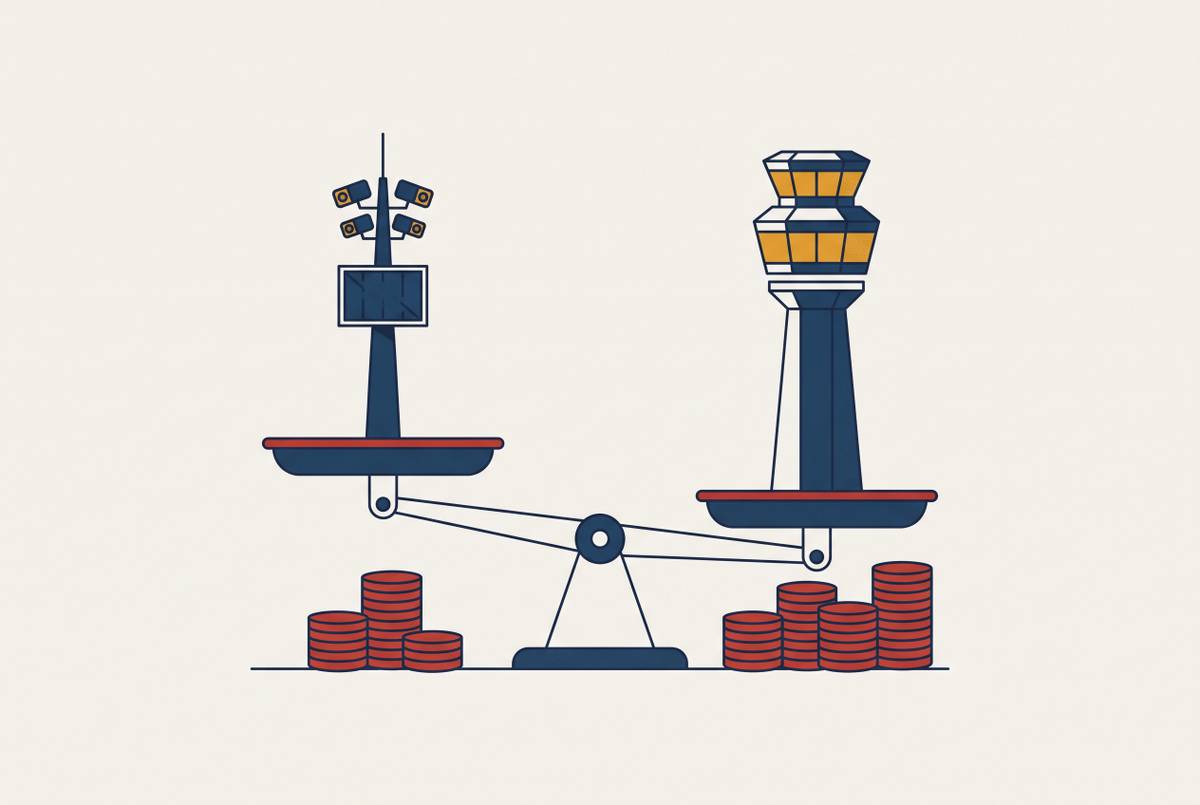
Traditional manned towers cost money to build, equip, staff, and keep running year after year, and those costs are simply out of reach for airports with low passenger counts. The same economics that make a tower affordable at a major hub make it unaffordable at exactly the airports where wrong-surface risk is concentrated. It's a direct byproduct of how the funding formula is built. It's a direct byproduct of how the formula is built, and it means the airports carrying the most risk have the least capacity to buy their way out of it without help from outside the system.
Digital and remote tower technology breaks the assumption that ATC coverage requires a physical tower and a fully staffed facility on-site
Remote and digital tower systems replace the physical structure with an array of cameras and sensors, letting a controller manage one or more airfields from a facility that might sit tens or hundreds of miles away. That single shift, moving the controller off-site, dissolves the cost and staffing math that has kept small airports locked out of ATC coverage for decades.
The proof of concept already exists, just not in the U.S. yet. London City Airport became the first major international airport fully run by a remote digital tower in 2021, with controllers stationed at Swanwick, roughly a two-hour drive from the airfield itself, handling live operations through camera and sensor feeds. Italy's air navigation provider ENAV announced in April 2025 that it will convert its Brindisi and Padua control centers into remote tower hubs managing 16 low-traffic airports, with plans to scale to 26 remote towers by 2033. Belgian Skeyes launched its Digital Tower Test Center in Steenokkerzeel in April 2024, and by 2026 air traffic at both Charleroi and Liege airports is to be managed from a new center in Namur. These are documented deployments, not vendor pitches, and they share a common shape: low-traffic airfields, consolidated under one remote control center.
A remote tower center can provide ATC coverage to multiple small airports simultaneously, spreading staffing costs across a portfolio rather than requiring a dedicated controller workforce at each site. The economics that ruled out a tower at any single low-traffic field stop applying once several fields can share the same control room.
The staffing math on the traditional side is only getting worse. The FAA closed fiscal year 2025 with fewer air traffic controllers than it had a decade earlier, even as total flight volume kept climbing. The staffed-tower model is under strain even at the airports that already have one, which sharpens the case for an approach that doesn't require a dedicated controller at every location.
The U.S. is moving toward digital tower deployment, but a certification bottleneck and a fragmented policy environment are slowing adoption at the airports that need it most
The direction is clear enough. Digital tower technology can, in principle, extend ATC coverage to airfields that will never generate the enplanement numbers needed to justify a conventional tower. What's slowing the U.S. down isn't the technology itself, it's certification. Bringing a remote tower online at a domestic airport means clearing an FAA approval process built around decades of assumptions tied to physical towers with controllers standing inside them, and that process moves slowly by design.
Policy adds a second layer of friction. Grant formulas built around passenger and cargo volume don't have an obvious lane for funding a remote tower center meant to serve several low-traffic GA fields at once, since the funding model still evaluates airports one at a time rather than as a shared network. The American system, with its fragmented mix of funding streams and airport-by-airport evaluation, doesn't have an equivalent lever to pull.
None of this means the model is wrong for the low-traffic airfields it would serve; it means the certification pathway and the funding structure both need to catch up to what the European deployments, including ENAV and Skeyes, have already shown works at low-traffic airfields resembling the ones scattered across American airspace. Until they do, the wrong-surface risk documented at uncontrolled airports keeps running into a policy environment that hasn't yet built the lane for the fix.
Sources
- Is that My Runway?. How to Avoid Wrong Surface Operations | by FAA Safety Briefing Magazine | Cleared for Takeoff | Medium
- Ending Serious Close Calls | Federal Aviation Administration
- February 2025 2024 Safety Report Flight Safety Foundation
- Wrong Surface Events | NBAA - National Business Aviation Association
- Wrong Surface Landing Risk as Hot Spots