Night Operations Safety at Non-Towered Airports
Pilots bear sole responsibility for safety at night when control towers are absent.
Most airports in this category have no control tower. At these fields, every function a controller would normally perform, separating traffic, sequencing arrivals, catching a pilot's mistake before it becomes a collision, falls on the pilots themselves. There is no one on the ground watching the pattern, no one listening for a missed radio call, no one empowered to tell an aircraft to go around. The entire safety architecture rests on three things pilots do voluntarily: making radio calls on the common traffic advisory frequency, scanning visually for other aircraft, and following traffic pattern conventions that carry no legal force beyond common practice and courtesy.
ASRS CALLBACK Issue 548, published in September 2025, states the consequence of this arrangement: simple oversights or cutting corners in a non-towered environment may degrade flight safety more than the same infractions would under the watchful eye of a tower controller. The same mistake that a controller would catch and correct at a towered field can run uncorrected at a non-towered one, because there is no one positioned to catch it.
This is not a gap in regulation. FAA Advisory Circular 90-66C, released June 6, 2023 and referenced in the Interagency Aviation Accident Prevention Bulletin issued that December, lays out the procedures that are supposed to govern non-towered operations in detail. Those procedures exist and they reflect current practice. What they do not do is enforce themselves. The December 2024 bulletin reaffirms that pilots must stay alert and use sound lookout judgment in addition to exchanging traffic information over the radio, a responsibility that falls entirely on the individual flight crew with no institutional backstop behind it. A controller at a towered airport functions as a live redundancy layer: a second set of eyes with radar, radio, and the authority to intervene. At a non-towered field, that layer simply does not exist. Every pilot operating there is, in effect, both the aircraft commander and the only safety check on the system.
Darkness and the Pilot's Primary Tools at an Uncontrolled Field
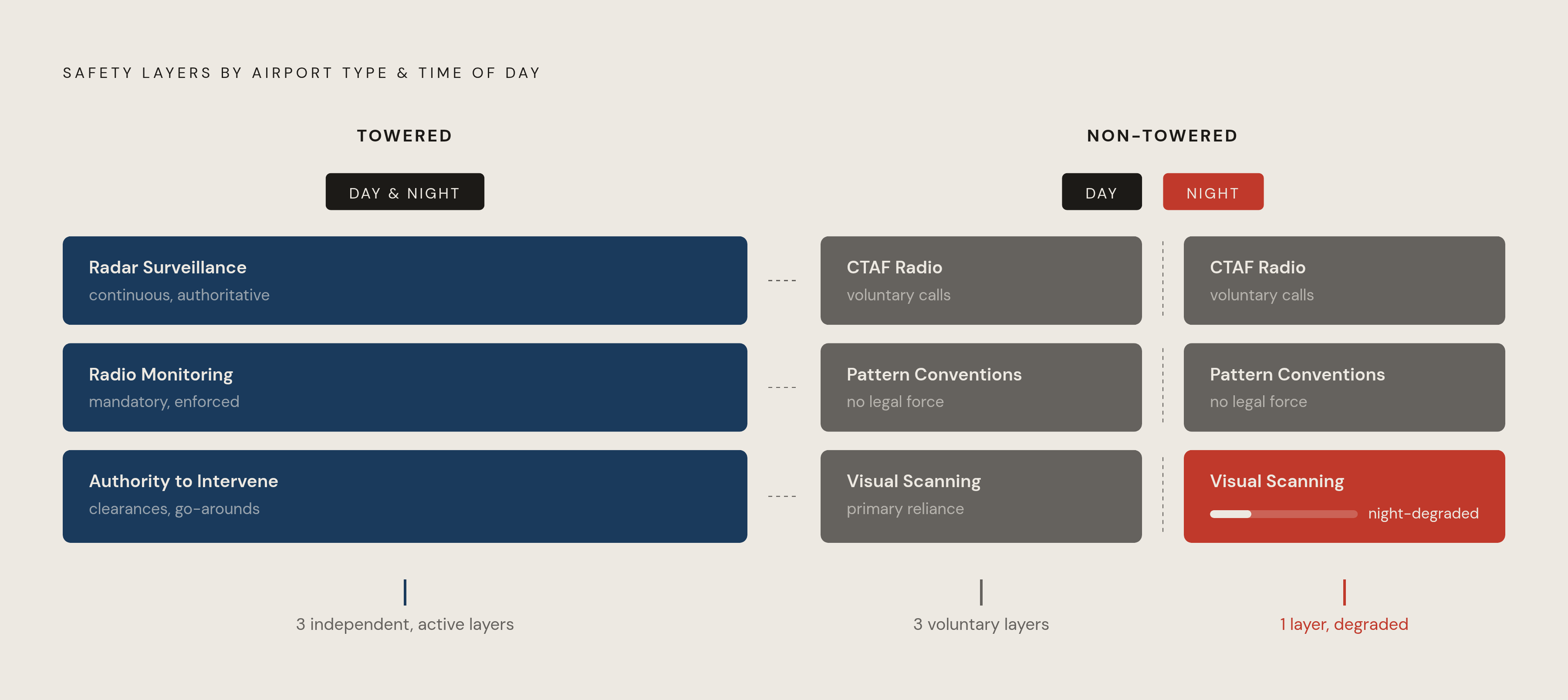
That baseline arrangement works, more or less, because daylight gives pilots the visual information they need to compensate for the absence of a controller. Night takes much of that information away, and nothing steps in to replace it.
See-and-avoid is the basic concept that non-towered operations depend on: pilots look out the window, spot other traffic, and maneuver to stay clear. After dark, this concept weakens sharply. Human visual acuity drops at night, and pilots are also susceptible to night myopia, a tendency for the eye to focus at a closer distance than intended when there isn't enough visual detail to lock onto, which makes distant traffic harder to detect even when it is in plain view. The NTSB has identified a pilot's failure to see and avoid other aircraft as the most probable cause of mid-air collisions. At a towered airport, a controller with radar can compensate for exactly this kind of human limitation. At a non-towered field, nothing compensates for it. The pilot's own eyes remain the only instrument in use, and at night those eyes are working at a fraction of their daytime capability.
Lighting adds a second, more specific hazard. Many non-towered airports rely on pilot-controlled lighting, and pilots activate these systems themselves by radio before landing. When that lighting fails to come on, crews can find themselves hunting for a runway or a rotating beacon they cannot locate. ASRS CALLBACK documents a Part 121 crew departing an uncontrolled airport at night under visual flight rules, where terrain separation was entirely the crew's own responsibility. When the crew queried air traffic control about it, the controller confirmed as much directly: terrain clearance was on them. A separate Part 135 Embraer crew arrived at a non-towered field at night and entered a descent that brought them close enough to terrain that the gear warning sirens went off, a warning system catching what no human controller was there to catch.
Darkness also erases a cue pilots don't usually think about: the visual distinctiveness of an airport. Two airports that look nothing alike by day can look identical after dark, and crews have mistaken one field for another as a result. A controller would catch a wrong-airport approach immediately. At a non-towered field, no one is watching for it.
Modern avionics are often held up as the fix for all of this, and ADS-B traffic displays do add real situational awareness. But the Interagency Aviation Accident Prevention Bulletin documents a near-midair at Birchwood Airport (PABV) in Alaska that shows the limits of that fix. A pilot's ADS-B display showed traffic 100 feet directly above the aircraft, and no audible alert came with it. The pilot happened to notice the visual display and pulled into a steep descending turn to avoid it. Had that pilot been focused elsewhere, which is a routine condition in a traffic pattern at night, a collision was a real possibility. ADS-B is a tool a pilot has to notice and interpret correctly in real time, under workload that is already elevated at night. It is not a substitute for a controller who is actively watching traffic and whose job is to call the conflict before it becomes a crisis. What the physiology of night vision predicts, the incident record confirms in detail.
Incident record patterns of these vulnerabilities in practice
You can see this same pattern, the one the physiology predicts, directly in NASA's Aviation Safety Reporting System. Reports from non-towered airports show a recurring set of conflicts, near-misses, and terrain encounters, produced largely by the absence of a controller. A number of the most serious took place at night or in low visibility.
One report describes a DC-3 crew that took the runway at a non-towered field after making the required radio call on the common frequency. An aircraft on final approach, at roughly 500 feet, had made no CTAF call of its own and did not respond after three attempts to reach it by radio. That aircraft continued its approach down to 300 feet before the DC-3's captain executed an evasive taxi into the gravel to avoid a collision. The aircraft on final turned out to be a student and instructor who were simply on the wrong frequency and never noticed the DC-3 was there. This incident shows how the CTAF system breaks: it depends on every pilot in the pattern being on the correct frequency and paying attention to it, and when even one of them is not, nothing in the system catches the gap before it becomes a near-collision.
A second report, involving a Part 121 crew departing an uncontrolled airport at night under visual flight rules, shows a different failure mode: confusion over where responsibility actually sits. The crew deviated from the airport's published obstacle departure procedure, failing to complete a required hold and climb at the ZZZ VOR, a deviation from both the obstacle departure procedure itself and the crew's own Operations Manual. Air traffic control caught the deviation and corrected it before it became dangerous, but the crew's own account acknowledges the lapse. At night, with the visual cues that would normally reinforce procedural discipline reduced, the margin for this kind of deviation narrows.
A third report, the Part 135 Embraer arrival described earlier, shows the terrain risk directly. The crew's descent brought them close enough to the ground entering the pattern that the aircraft's own gear warning sirens activated, a mechanical backstop firing because no human one was present.
These three incidents are drawn from a larger set. The ASRS Database Report Set on Non-Tower Airport Incidents documents 50 screened reports covering near-midair collisions, opposite-direction runway conflicts, and other close calls. Because ASRS submission is voluntary, that number is a floor, not a ceiling: the true frequency of these events in the National Airspace System is almost certainly higher than what the database captures.
You could point out that raw mid-air collision counts, normalized by the number of facilities, don't obviously favor towered airports over non-towered ones. That framing leaves out runway incursions, near-misses, wrong-runway landings, and controlled-flight-toward-terrain events, the categories that cluster disproportionately at non-towered fields and after dark. These are the events the ASRS record catalogs in detail, and a simple collision tally misses them.
The economics of small airports and the self-perpetuating safety gap
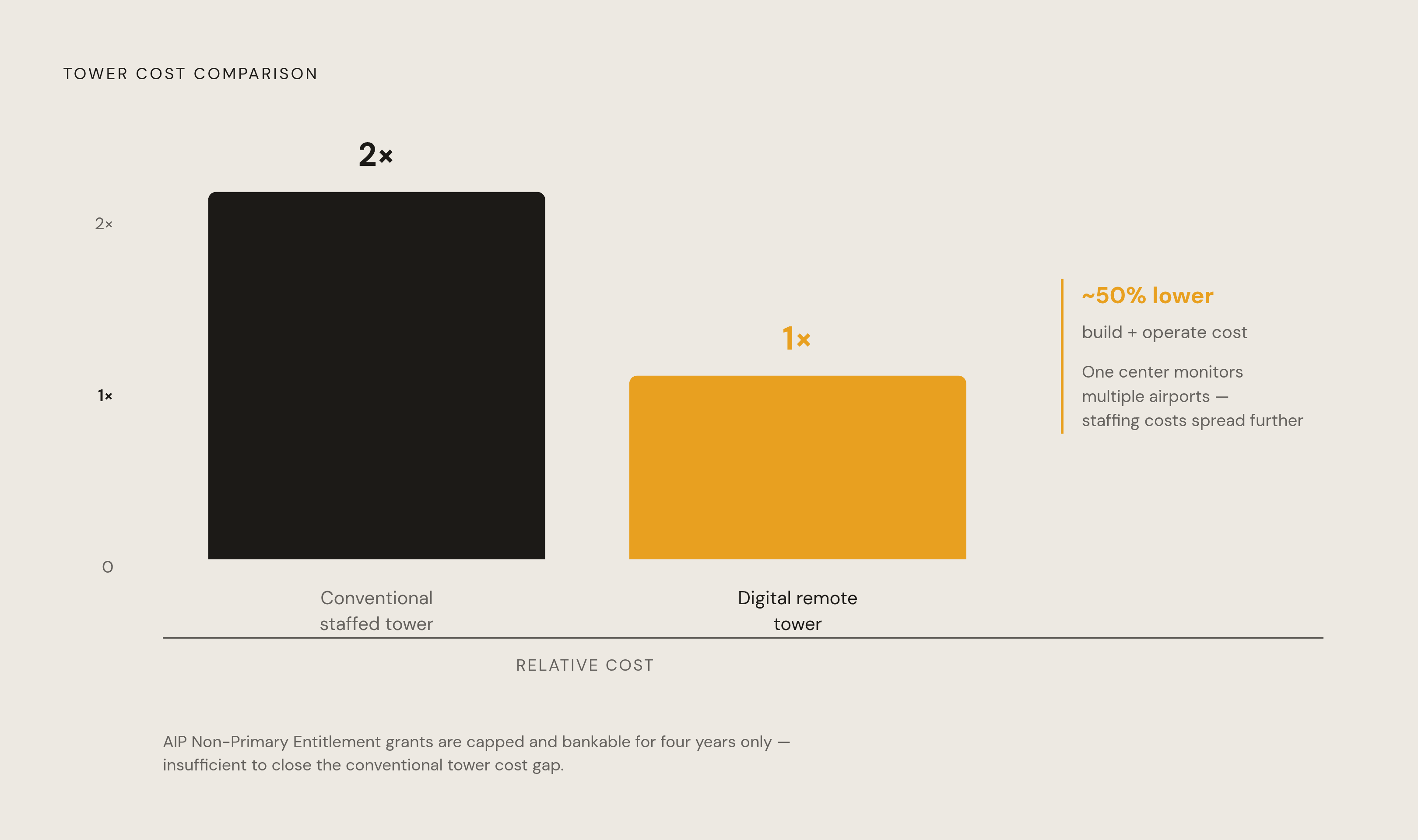
The safety gap persists at these airports because the standard fix, a conventional staffed control tower, is priced well out of reach for the airports that need it most. Federal entitlement grants for airports, distributed through the Airport Improvement Program's Non-Primary Entitlement program, are capped at a modest annual sum and can be banked for up to four years at most. The distance between what that funding provides and what it costs to build a conventional tower is enormous, and no amount of patience closes it.
Johnston Regional Airport Director David Harris has described the current uncontrolled arrangement in stark terms: it is, in his words, comparable to removing all of the stop signs and all of the stop lights from downtown Raleigh and expecting drivers to effectively and efficiently and safely get to where they're going. That description holds up in daylight. After dark, with visual cues degraded and fatigue setting in, it holds with even more force.
Construction cost is only half the burden. A conventional tower also demands certified air traffic controllers staffed across multiple shifts, a continuous payroll obligation that airports with limited daily traffic cannot support or justify. Under the old model, the airports with the least traffic and the least revenue are the ones without towers, those same airports are the ones where the absence of a controller is most dangerous once the sun goes down, and those same airports have the least financial capacity to build their way out of the problem using a conventional tower. If the standard solution is unaffordable by design, the real question is whether a different model can deliver the same safety function at a cost these airports can actually carry.
Digital tower technology's effect on cost and coverage for non-towered airports
Digital remote tower technology answers that question directly. Instead of building a physical tower cab, the airport installs a network of cameras, sensors, and panoramic displays across the airfield, and controllers staff the facility remotely, watching a continuous 360-degree digital reconstruction of the airfield from a workstation that may sit many miles away.
That architecture responds directly to the vulnerabilities the night-operations record documents. Digital tower systems can include night-vision and thermal imaging built specifically for low-light and adverse-weather conditions. Optical zoom cameras and infrared or thermal sensors extend a controller's effective vision well beyond what any human eye achieves looking out a conventional tower cab after dark, addressing the exact degradation in visual acuity that makes night operations at non-towered fields so much riskier than day operations. Layered on top, AI-based tools can handle object recognition, flag runway conflicts, and automatically detect potentially hazardous situations, functions that create a surveillance layer at airports where, today, none exists.
The economics change just as directly as the safety case. A single remote tower center can monitor multiple airports at once, spreading the cost of staffing and infrastructure across several airports. Harris estimates that a digital remote tower costs roughly half what it costs to build and operate a conventional tower. That difference is what moves the technology from a theoretical fix to something an airport sponsor can seriously plan for.
The same systems can also extend the hours of coverage at airports that already have towers but staff them only part-time. Digital tower platforms can provide control services during the overnight hours when a Part-time Class D tower is closed, or step in if a manned tower suffers an outage, covering precisely the hours when the risks documented earlier in this piece are most acute. And the same camera-and-sensor platform that delivers these air traffic services also supports the integration of unmanned aircraft into the National Airspace System, a secondary benefit that broadens the case for the technology beyond safety alone.
Digital tower deployment worldwide and the U.S. position for small airports
None of this is unproven technology waiting for its first real test. Remote and digital tower systems are already in wide operational use across Europe, where air navigation service providers in Germany, Norway, and Sweden run multiple small airports from single remote tower centers as a matter of routine infrastructure, not pilot demonstration. Europe has already carried this model from early trial to full operational deployment across a range of small airports with different traffic patterns and terrain, so the approach generalizes rather than working only under one country's specific conditions.
Set against that record, the overwhelming majority of non-towered airports in this country continue to operate with no controller coverage of any kind, day or night. The technology that could close the gap exists, it is already running at scale elsewhere, and the cost structure that has kept conventional towers out of reach for small airports in this country does not apply to it in the same way. The incident record from ASRS and the Interagency Aviation Accident Prevention Bulletin shows what that gap costs in practice. What remains is a question of deployment, not invention.