Differences Between Remote Towers and Automated Advisory Systems
Remote towers provide binding control, while advisory systems only offer information.
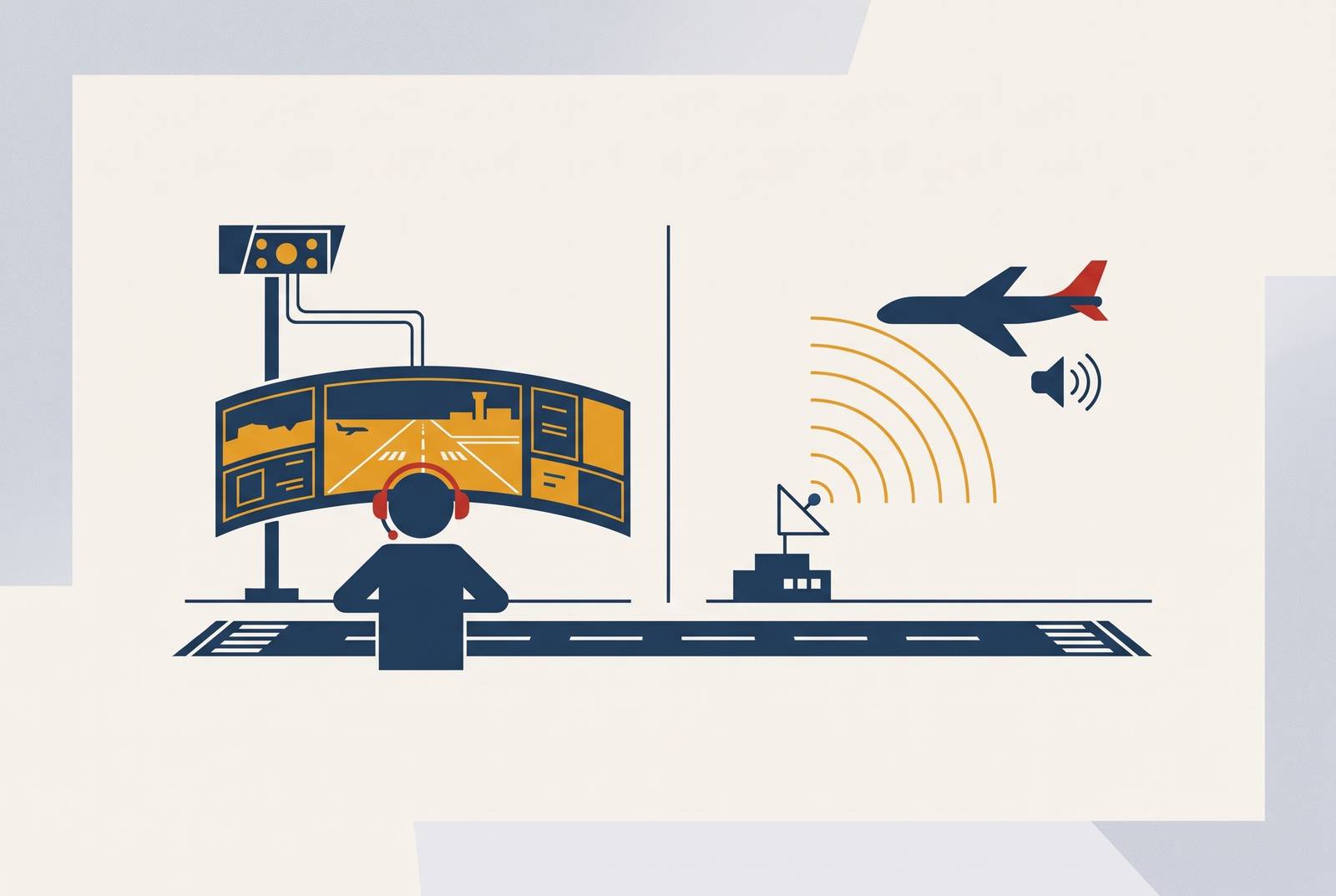
Remote towers and automated advisory systems both help fill the gap at non-towered airports, but only remote towers have licensed controllers who provide air traffic control. Advisory systems supply information. For airports evaluating digital ATC infrastructure for unmanned aircraft systems and drone integration, this distinction is fundamental. Better situational awareness does not, by itself, provide the authority to control traffic.
Why the same gap in ATC coverage produces two very different solutions
Most U.S. airports have no control tower. Pilots instead use the Common Traffic Advisory Frequency, or CTAF, to announce their positions and intentions over a shared radio channel. No controller verifies those reports, sequences traffic, or issues instructions. The pilots using the airport must coordinate with each other.
That arrangement works in normal conditions, but every pilot must broadcast correctly, hear correctly, and act correctly for it to work. There is no controller to intervene when that chain breaks. Both technologies respond to this structural vulnerability, but they address different parts of it. An advisory system supplies missing information, while a remote tower supplies the missing ATC service. A shared problem does not make them interchangeable solutions.
What the safety record at non-towered airports actually shows
The most dangerous events are becoming more common even where total incident counts hold steady or fall. The distinction is especially important at airports where pilots must coordinate without a controller.
Recent fatal runway incursion accidents have been disproportionately concentrated at smaller, non-towered airports that are not certified under federal safety standards. Fatal events have also occurred at major towered airports, so the risk is not exclusive to uncontrolled facilities. Still, the cluster at smaller uncontrolled airports shows that these events, though rare, have grave consequences. How much traffic an airport has does not fully explain its risk.
Runway incursions also cluster at certain airports, many of them used for flight training, and are unevenly spread across the system. Local conditions shape the risk. That pattern supports intervention based on how each airport operates, rather than assuming that every airport with little traffic has little danger. It also makes the intervention’s scope decisive, because improved information and binding traffic control address different sources of failure.
What automated advisory systems are, and what they are authorized to do
Remote Airport Advisory, or RAA, Remote Airport Information Service, or RAIS, and Remote Weather Advisory Service, or RWAS, belong to the informational side of this distinction. They provide weather and traffic information at airports without an operating control tower, with RWAS focused on weather. They do not issue binding instructions to pilots.
The FAA defines these services for airports that have certified automated weather reporting through voice capability, or remote locations that have noncertified automated weather reporting through voice capability. That definition establishes an information service. These systems also help pilots on different frequencies in uncontrolled airspace know about each other’s aircraft. Bridging that gap can improve what pilots know without replacing a controller’s judgment.
A pilot receiving an automated advisory remains responsible for self-separation, and the information creates no binding instruction to follow. An advisory system cannot issue a landing clearance. Nor can it issue runway, departure, or approach clearances. This is a limit on its authority.
The FAA Flight Service Specialist Handbook says pilots must get current automated weather before asking for remote ATC services at non-towered airports. In a layered architecture, automated reporting and advisory communications form an information layer, while ATC remains a separate service. Treating those layers as equivalent would obscure who can actually direct an aircraft.
What a remote tower is, and where the controller's authority comes from
A remote tower delivers the services of a physical control tower, including sequencing, traffic advisories, clearances, and runway assignments. The controller’s vantage point moves away from the airport. Instead of looking through a tower cab’s windows, the controller uses panoramic video displays fed by airport cameras and sensors. A secure data link connects that equipment to the control room.
The controller’s authority comes from the ATC regulatory framework. Controllers follow the same traffic procedures as in a traditional tower. Moving the workstation does not remove the binding force of the controller’s instructions.
Atrak’s MAESTRO platform, unveiled at the Airspace World exhibition in Lisbon in May 2026, illustrates this architecture. High-resolution cameras with optical zoom can use infrared or thermal imaging at night and in bad weather. The controller workstation receives radar surveillance data, AI-assisted object tracking, automatic detection of situations that could be dangerous, and real-time communication transcription. The controller retains decision-making responsibility.
MAESTRO has been developed and validated at Václav Havel Airport Prague for more than 18 months using real-time operational data, diverse weather conditions, and contingency scenarios. Its workstation can serve one or multiple airports from a single center. More broadly, remote-center controllers can be certified for multiple airports, with coverage transferred as demand shifts. Simultaneous Multiple Remote Tower Operations are also recognized and operationally deployed. This lets remote centers shift staff in ways a physical tower cannot.
The authority line that separates the two technologies
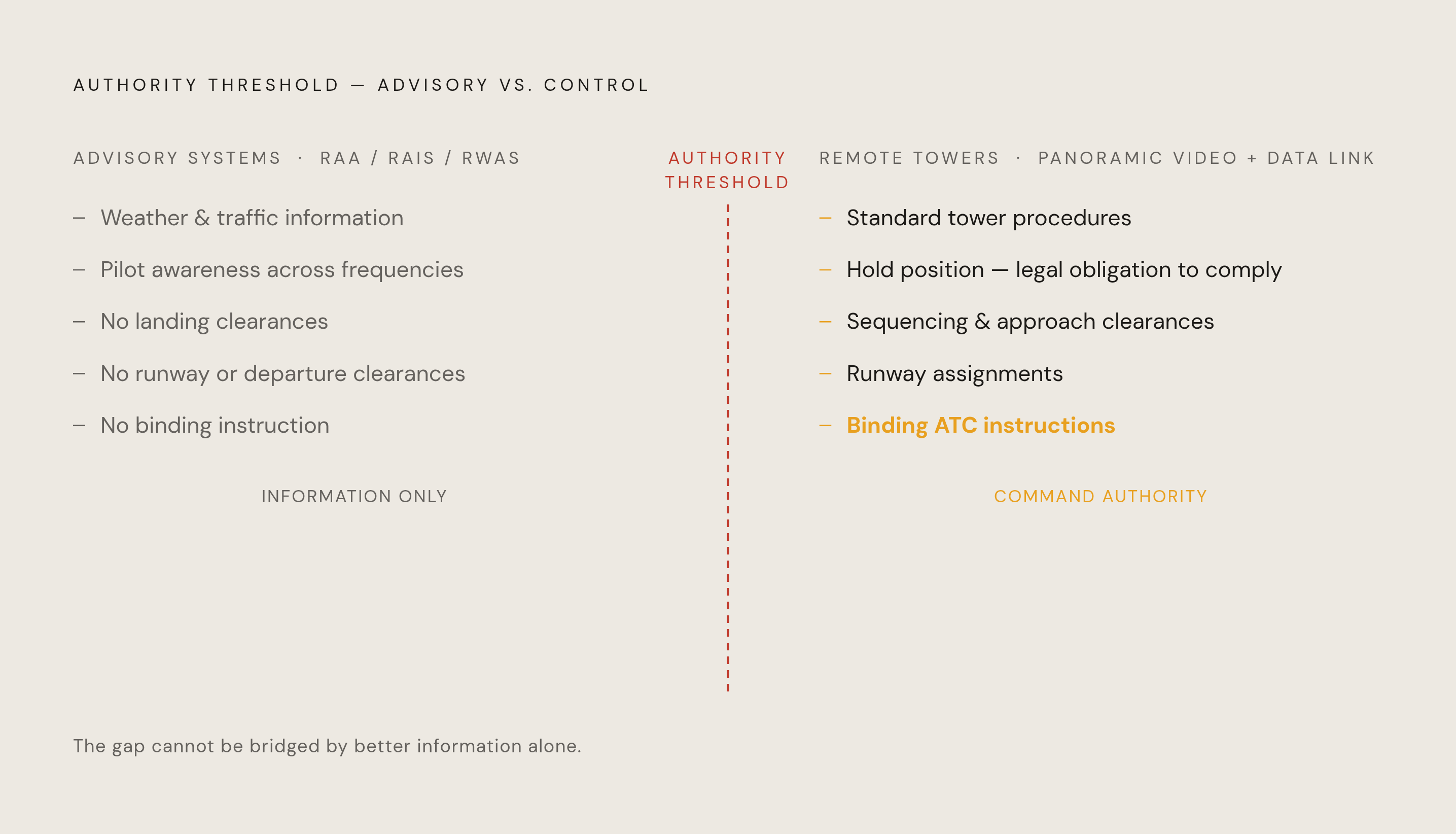
The decisive difference appears when a pilot is about to make a dangerous mistake. An advisory system can report that another aircraft is on final approach. A remote tower controller can instruct the pilot to hold position, creating a legal obligation to comply.
Pilot deviations account for a large share of runway incursions, including serious Category A and B events. Awareness does not necessarily produce compliance. An advisory system can improve the information available to a pilot, but it cannot turn that information into an enforceable direction. A controller can intervene with a binding instruction, although that authority is not a guarantee against every deviation.
Advisories are cheaper and faster to deploy, and they can improve situational awareness where self-separation remains appropriate. The error is to describe them as a smaller version of ATC. They perform a different function.
The argument that advisories are “good enough” at low-traffic airports consequently requires a site-specific safety judgment. Low traffic does not establish that self-coordination is sufficient. The concentration of serious events at uncontrolled facilities makes the absence of authority relevant even where movements are limited.
How remote towers are being deployed globally, and what the U.S. is doing differently
Remote towers are now in use in several countries, beyond tests in a laboratory. Planned expansions show the scale of that commitment. ENAV announced in April 2025 that it would complete the conversion of the Brindisi and Padua control centers into remote-management hubs for 16 low-traffic airports. It plans to have 26 remote towers by 2033.
Norway’s regional network illustrates the same application at low-density airports where a physical tower is difficult to justify. Seven Norwegian airports were contracted to receive remote tower systems in July 2024, with deployment planned for 2027. Australia’s Western Sydney International Airport is set to start Digital Aerodrome Services in 2026 with 25 high-resolution cameras that have night vision and object tracking.
Implementation nevertheless demands time and operational resilience. Belgium’s Charleroi Airport has pursued its remote tower project since 2018, with an original target of 2019. Skeyes expects full operation by the end of 2026. Spain’s Vigo airport experienced repeated disruptions in July 2025 that required temporary reversion to its old physical tower. That experience supports redundancy planning rather than a rejection of remote towers as a category.
The U.S. is pursuing a different deployment timetable. The FAA issued a request for proposals in April 2026 for Remote Tower Systems serving rural, small-community, and non-towered airports, with a program value of approximately $36 million. The solicitation was originally posted on April 14, 2026, and significantly amended on May 22, 2026. This creates a procurement pathway, but it is not equivalent to having an operational service available. For airports on this deployment timetable without access to an approved remote tower, advisory technology still cannot supply the authority available through deployments elsewhere.
The economics of the choice, and why cost alone does not resolve it
Many small airports have too little traffic to justify the cost of building a physical tower and paying its staff each year. That constraint has historically left advisory systems as the affordable option. Remote towers change the underlying cost structure. Their construction costs are a fraction of those of a conventional concrete tower, while a shared remote center can reduce staffing and operating costs across low-activity airports.
One manager per shift can cover what previously required one manager per airport. Coverage can also move between appropriately certified controllers as demand changes. Those advantages strengthen the economic case at scale, but they do not make a remote tower identical in cost or function to an advisory installation.
The FAA’s Contract Tower Competitive Grant Program supports airport-owned ATCT projects under authorization for FY 2022–2026 through the Bipartisan Infrastructure Law. Eligible uses explicitly include construction of a remote tower certified by the FAA. The FY 2026 funding notice offered up to $120 million in Airport Infrastructure Grant funds. That amount applies to a single funding round. In a separate proposal, the House FY27 bill would give the Contract Tower Program enough extra funding to support current contract towers and add more.
Reason Foundation’s May 2025 analysis found that remote tower centers draw younger recruits, cut controller workload and stress, and help with training by having simulators at the same site. These workforce benefits address another constraint on small-airport ATC. They do not remove the need to assess cognitive load when controllers manage multiple airports simultaneously. Concentration can introduce its own operational risk.
Some infrastructure analysts also argue that stabilizing existing NAS equipment should precede investment in new elements. That reasonable sequencing concern leaves the airport’s authority requirement unresolved. The purchasing distinction remains exact. An operator selecting an advisory system instead of a remote tower is buying a more limited service.
What the distinction means for airports deciding between the two
For airport operators, the decision should begin with the level of authority the operating environment requires. The criteria include traffic mix, training operations, runway geometry, and the airport’s history of incidents. Where self-separation can reasonably be expected to hold, an advisory system can improve situational awareness and weather information. Fields with very little traffic can become safer without getting full ATC.
Where those criteria indicate that pilot self-coordination is insufficient, a remote tower addresses a different requirement. It provides binding control through licensed controllers. The practical sequence is to establish the required service, assess the appropriate information and control layers, and then consider affordability and deployment. For remote towers, the Vigo experience also makes fallback capability part of that assessment.
Small regional airports without a control tower use the same distinction when they assess nearby unmanned aircraft operations. An information layer can support situational awareness, while an authorized control layer provides a different capability. Neither the presence of cameras nor an automated advisory establishes that an airport has full ATC. For pilots, the operative question remains whether a message supplies information or constitutes a controller’s instruction.
For policymakers, the FAA procurement effort and the Contract Tower grant program offer a way to bring remote control services to more airports. Funding and procurement must still result in services that airports can use. Modernization cannot be judged solely by how much information reaches an airport. Its adequacy depends on whether the available service includes the authority that the airport’s safety profile requires.