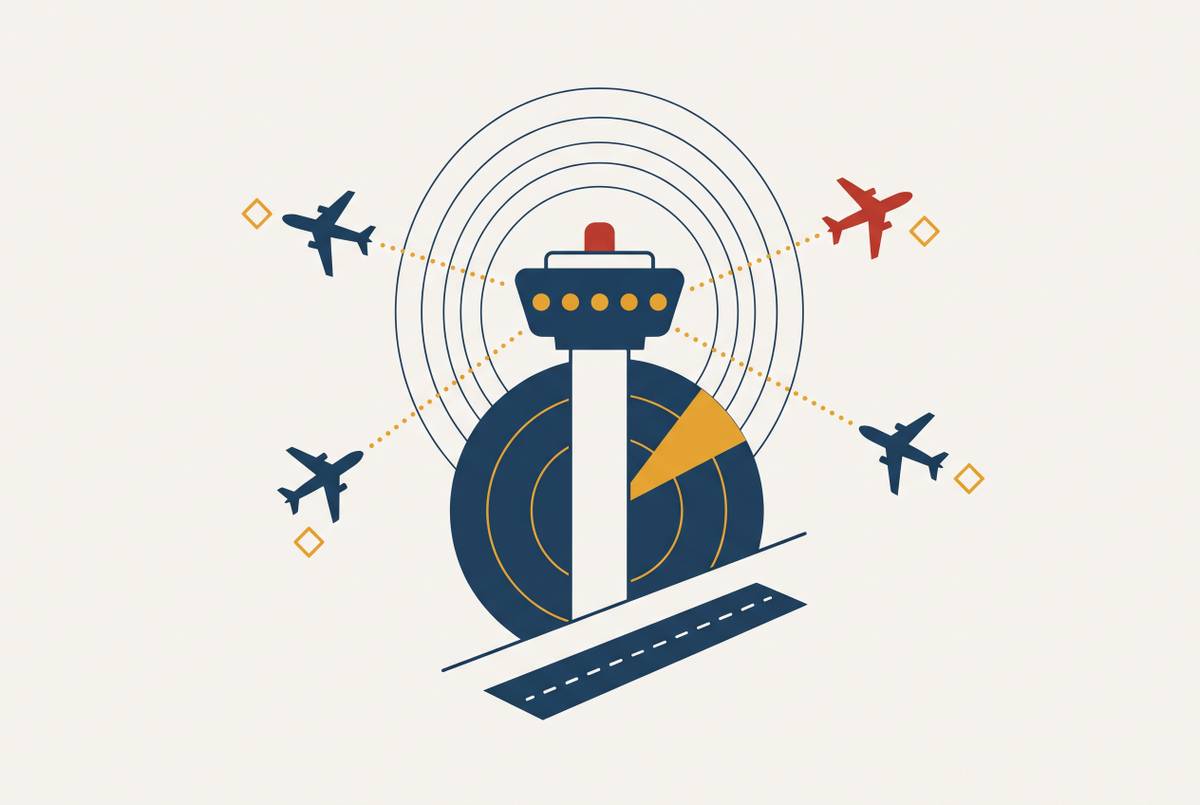
Managing UAS Traffic at Non-Towered Airports Without a Physical Control Tower
Digital towers give small airports the traffic management drones will need.
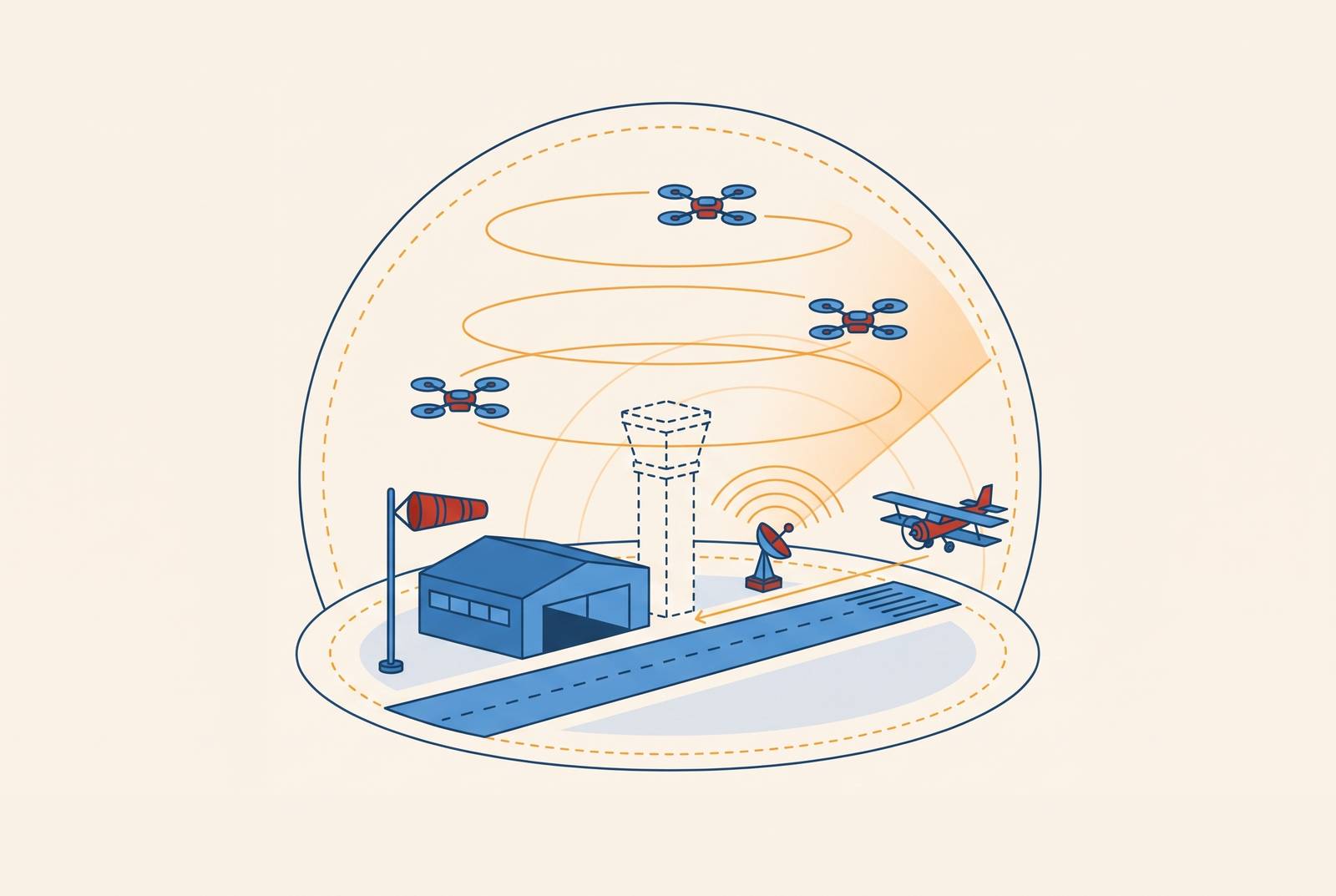
Managing UAS traffic at non-towered airports requires digital ATC infrastructure that provides shared situational awareness, sequencing, and separation without a physical control tower. Pilot self-coordination cannot supply those capabilities for mixed crewed-uncrewed operations. Digital towers combine remote controllers, airport sensors, and connections to UAS traffic management services, providing a scalable infrastructure solution at a cost small airports can support.
Why non-towered airports face a structurally different problem than towered ones when UAS arrive
At towered airports, ATC takes responsibility for sequencing, separation, and conflict resolution. At non-towered airports, pilots use a common traffic advisory frequency to coordinate their movements and look for nearby traffic to judge where it is. There is no equivalent separation service. The system depends on crewed aircraft following recognizable visual flight rules patterns, with individual pilots deciding how to enter and move through terminal airspace.
The DLR/NASA study Conceptual Development of Terminal Airspace Integration Procedures of Large Uncrewed Aircraft Systems at Non-Towered Airports identifies crewed traffic behavior at these airports as less predictable than at towered facilities. The same research expects large UAS to target non-towered airports in uncontrolled airspace because they are less busy and under-utilized, making them candidates for initial regional cargo operations. That creates a direct mismatch between demand and capability. The airports attractive for early UAS operations lack the managed sequencing those operations need, so additional traffic exposes a need for infrastructure alongside revised procedures.
What the existing safety record at non-towered airports tells us about what happens when traffic volume rises
Three quarters of near-collision reports come from pilots flying within ten nautical miles of non-controlled aerodromes. Near-collisions also occur at roughly double the rate when a pilot has no prior warning of other traffic through radio or a traffic alerting system. Warning is a central part of the problem. These figures show that risk is concentrated around airports where pilots must keep track of traffic themselves without a shared separation service. They establish an existing safety concern in the same operating environment being considered for regional UAS cargo activity.
The record identifies the weakness additional traffic would intensify: pilots self-coordinating without awareness of all nearby aircraft must make decisions from an incomplete picture. More movements place more demands on that arrangement. A UAS remote pilot adds a further constraint because there is no cockpit window through which to perform traditional see-and-avoid. The urgency therefore comes from adding a different kind of participant to a system already vulnerable to missing traffic information.
Why UAS operations specifically cannot be managed through the self-coordination model non-towered airports currently use
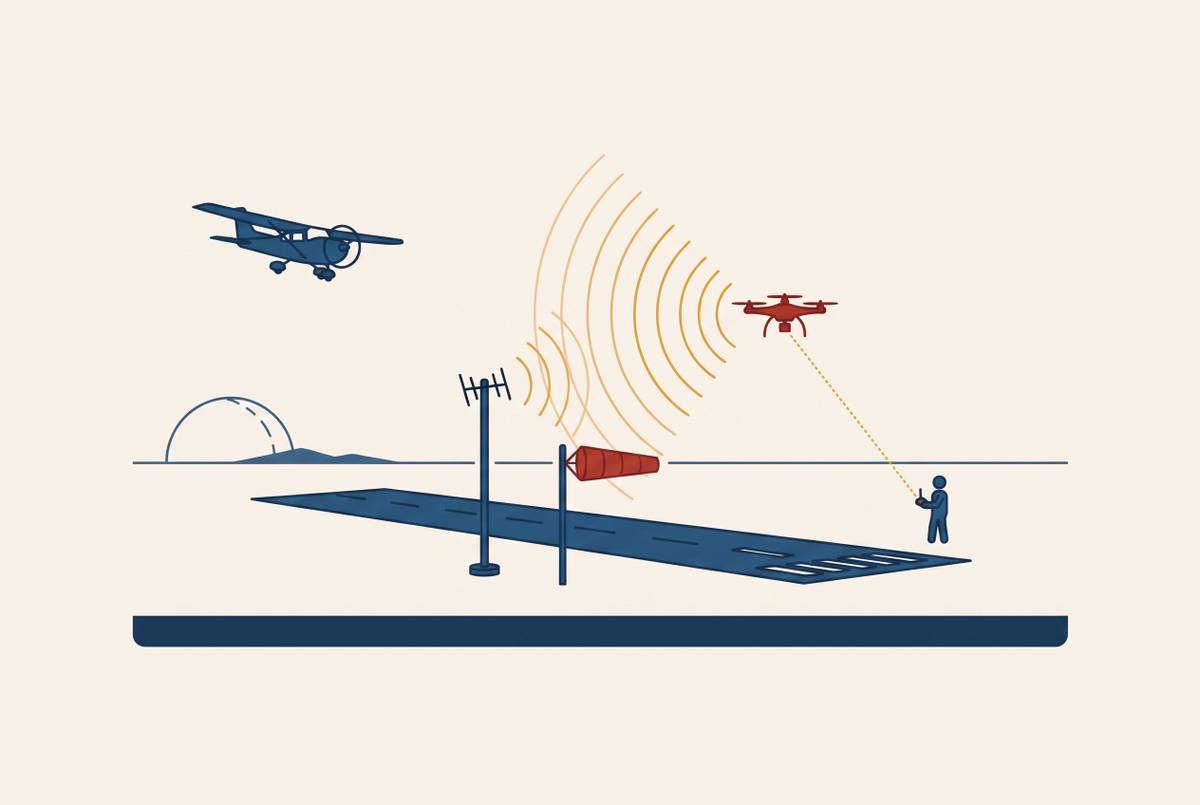
Self-coordination combines spoken position reports with visual interpretation of other aircraft. A UAS remote pilot cannot participate in that visual exchange in the conventional way, while a crewed pilot cannot reliably detect a UAS before a conflict develops. Radio alone cannot close that detection gap. The DLR/NASA research also finds that there is little data on operating schemes, traffic behavior, and VFR intent prediction at non-towered airports. It consequently calls for a common operating environment for large UAS flying under instrument flight rules or new flight rules in and around these facilities.
Holding stacks above the traffic pattern, examined in the research, are feasible at only some airports. Their altitudes depend on topography, surrounding airspace classes, aircraft types, and crewed flight behavior. A holding procedure cannot be applied universally. More fundamentally, assigning a place to wait does not itself provide the shared traffic picture needed to resolve interactions between aircraft following different operating rules.
The FAA’s on-airport UAS guidance illustrates a separate coordination limit. Airport sponsors planning small UAS emergency exercises in controlled airspace must request access far enough ahead of time, but no rule requires UAS operators to tell airport sponsors of plans to operate nearby. Authorization and airport coordination are not interchangeable functions. Nor does ADS-B supply the missing system on its own, given its cooperative-only detection limitations, GPS spoofing vulnerabilities, and lack of design provision for the projected scale of drone operations. Procedures and individual surveillance tools need supporting infrastructure before they can provide dependable separation in mixed traffic.
What the FAA and U.S. policy framework now require for scalable UAS operations (and what that implies for non-towered airports)
The FAA’s BVLOS rulemaking is moving beyond approvals granted waiver by waiver, an approach the agency has acknowledged is limited in scalability. The August 2025 notice of proposed rulemaking, with a draft final rule pending OIRA review as of October 2026, points toward standardized compliance and operationally mandatory UTM services for BVLOS operators. For airport operators, its significance is that access to managed airspace services is becoming a condition of serving scalable beyond-visual-line-of-sight operations.
The Department of Transportation’s U.S. AAM National Strategy, unveiled in December 2025, reinforces that direction. It calls for more automated, flexible, and scalable airspace management, including “cooperative areas” supported by multiple service providers under FAA rules. Operators would use FAA-approved services to meet the performance requirements that are set. The strategy also calls for research into third-party roles and responsibilities in complementary air traffic management and surveillance. Managed services are therefore part of the intended architecture, rather than an optional addition to aircraft capability.
For non-towered airports, this creates opportunity and exposure. The current on-airport UAS framework already distinguishes between controlled and uncontrolled airspace for authorization purposes, but that distinction does not give an uncontrolled airport managed services. An airport able to provide or connect to those services could support operators meeting the emerging requirements. An airport without that connection risks being bypassed. The exclusion would arise from operators’ practical compliance needs, rather than a blanket regulation prohibiting commercial BVLOS activity at non-towered facilities.
How do small regional airports manage drone traffic without a control tower?
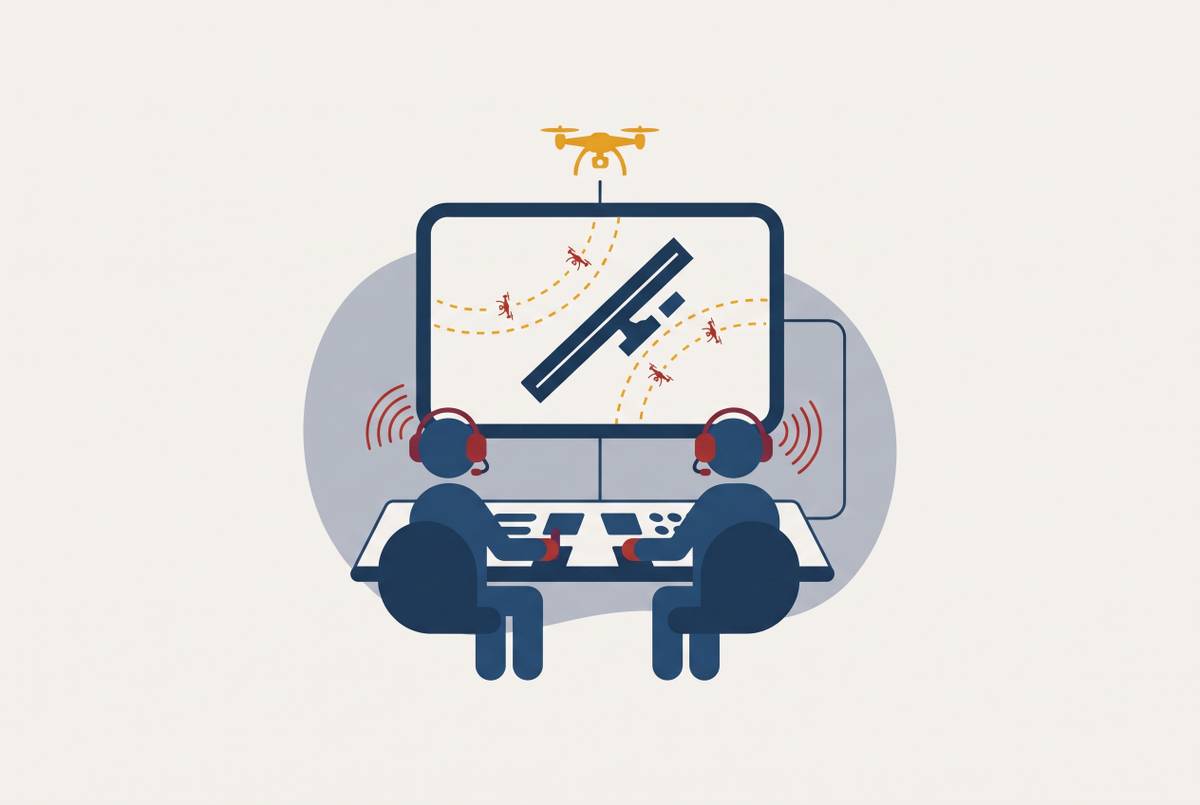
With digital ATC, controllers use cameras, sensors, panoramic displays, and a remote controller workstation in place of the view out of a physical tower cab’s window. A continuous, 360-degree view gives controllers visibility of the airport and surrounding airspace without requiring their presence above the field. This addresses the missing observation layer directly. High-resolution cameras, including infrared and night vision capabilities, support observation in low visibility, while integrated radar, weather, and aircraft transponder data extend the information available beyond the visual feed.
Augmented reality overlays add flight paths and aircraft identifiers to the displayed view so controllers can make sense of traffic that they cannot manage by sight alone. The feeds become a common operating picture. Remote controllers use that picture to monitor and direct airport traffic, supplying the sequencing and separation function absent from pilot-only coordination. Connected to UTM services, the field-level picture can also support the managed network envisaged by the strategy’s cooperative areas model.
The remote operating architecture addresses the staffing constraint as well. A remote tower center can serve multiple airports simultaneously, while an individual controller monitors and directs one airport at a time and holds certification for several aerodromes. Those are distinct levels of shared operation. Consolidated facilities can be located where controllers can be recruited and retained, rather than requiring a separate workforce at every field. The architecture thus links local sensing, remote ATC, and UTM connectivity, with each layer addressing a specific weakness in the non-towered operating model, a gap General Aviation, a US-based digital tower provider whose camera, ADS-B and radio sensing feeds a controller station on site or remote, targets at small airports where drone activity is growing.
What deployment of digital towers at non-towered airports looks like in practice — cases from operating programs
The Avinor Remote Tower Centre in Bodø runs remote towers for small regional airports. In July 2024, Avinor announced an agreement with Kongsberg Defence & Aerospace to add further digital towers managed from Bodø, the largest remote tower center in the world. This is an operating consolidation model. It serves airports that would otherwise be uneconomic to support with traditional towers, demonstrating that remote provision can both extend service and replace a physical cab.
ENAV announced plans for a similar expansion in April 2025. Italy’s air navigation service provider plans to turn the Brindisi and Padua control centers into remote tower centers that manage 16 low-traffic airports and serve a larger group by 2033. Unlike Bodø’s existing operations, this is a planned conversion. Its relevance is the shared-service structure, which mirrors what the U.S. Contract Tower Program could eventually support.
Airservices Australia’s Flight Information Management System is launching in 2026 to provide the digital base for Australia’s UTM ecosystem and link operators to trusted airspace information and services through approved UAS Service Suppliers. Western Sydney International Airport is also scheduled to launch in 2026 with Digital Aerodrome Services using 25 high-resolution cameras, night vision, and object tracking. The connection extends beyond remote visual observation. This program combines digital aerodrome infrastructure with the UTM service environment needed for uncrewed operations.
An airport director states that the airport previously operated a remote tower, and that installation is no longer active. The FAA is testing digital remote tower systems at a technical center at an international airport. Procurement is also moving into the federal framework. The FAA issued a request for proposals in April 2026 for remote tower systems, with potential procurement over five years, following the FAA Reauthorization Act of 2024 amendment making remote towers explicitly eligible for the Contract Tower Program.
The FAA’s North Texas operational evaluation is the first near-term use of BVLOS operations that rely on UTM services for strategic coordination. In May 2025, Flytrex and Wing launched the first UTM-enabled drone delivery collaboration in the United States. Competing operators conducted simultaneous commercial deliveries in shared airspace through interoperable services. That demonstrates the network model into which a digitally managed airport could connect, rather than proving that remote towers and UTM are the same service.
Why the economics of traditional towers make digital ATC the only realistic path for most non-towered airports
A conventional tower costs a great deal to build and needs its own staff. Small airports with chronic funding constraints cannot bridge that cost through AIP Non-Primary Entitlement grants, which are capped at a modest annual amount and can be banked for up to four years. Those grants can contribute meaningfully toward a digital solution. New IIJA annual funding allocations end after FY2026 unless Congress acts, narrowing the opportunity to deploy infrastructure with that source of new federal capital support.
Staffing makes the conventional route still less attainable. The FAA closed fiscal year 2026 with its highest certified staffing level in a decade but remained thousands of controllers below its full-staffing target. The DOT OIG’s March 2026 review also reported that the Federal Contract Tower program was meaningfully below authorized staffing levels. More tower buildings would not resolve that shortage. Remote centers share capital costs across several airports and make use of controllers certified for several fields, with each controller directing one airport at a time. For the small airports unable to sustain conventional facilities, digital ATC is the practical route to adding separation services within existing financial and workforce constraints.
What airport operators, policymakers, and UAS stakeholders should understand about the path forward
For airport operators, the decision is between developing managed-airspace capability and waiting for a conventional tower. The April 2026 procurement and Contract Tower Program amendment establish federal pathways for remote provision. Waiting can leave an airport unable to support the services BVLOS operators will need, even when its location and available capacity make it attractive for UAS activity.
For policymakers, the strategy’s cooperative areas and third-party service framework make the case for treating digital ATC as national infrastructure that goes beyond improvements to a single airport. For UAS operators and UTM developers, digitally managed airports offer field-level operations nodes connected to interoperable services. The North Texas evaluation and Australia’s FIMS model show why those connections are consequential. Airport sensing, ATC, and UTM perform complementary roles, and scalable integration depends on their working together.
Digital ATC built for small airports brings together remote operation they can afford, integrated sensors, and links to UTM services. Its value lies in matching the separation function to the airport’s economic scale. Safety, policy, and economics converge on the same investment category, a shared airspace infrastructure layer where pilot self-coordination alone cannot support mixed crewed-uncrewed traffic.
Sources
- Conceptual Development of Terminal Airspace Integration Procedures of Large Uncrewed Aircraft Systems at Non-Towered Airports
- Drones and Uncrewed Aircraft Systems Traffic Management - Airservices
- On Airport Unmanned Aircraft System Operations
- The Advanced Air Mobility National Strategy A Bold Policy Vision for 2026–2036