Midair Collision Risk at Non-Towered Airports
Half of all midair collisions happen inside the traffic pattern at non-towered airports.
The traffic pattern at a non-towered airport is where midair collision risk concentrates most heavily, and the physical shape of that pattern explains why. It's a precise argument about one location, one set of aircraft geometries, and one missing layer of protection that nowhere else in the system has to do without.
The traffic pattern as the most collision-prone environment in the airspace system
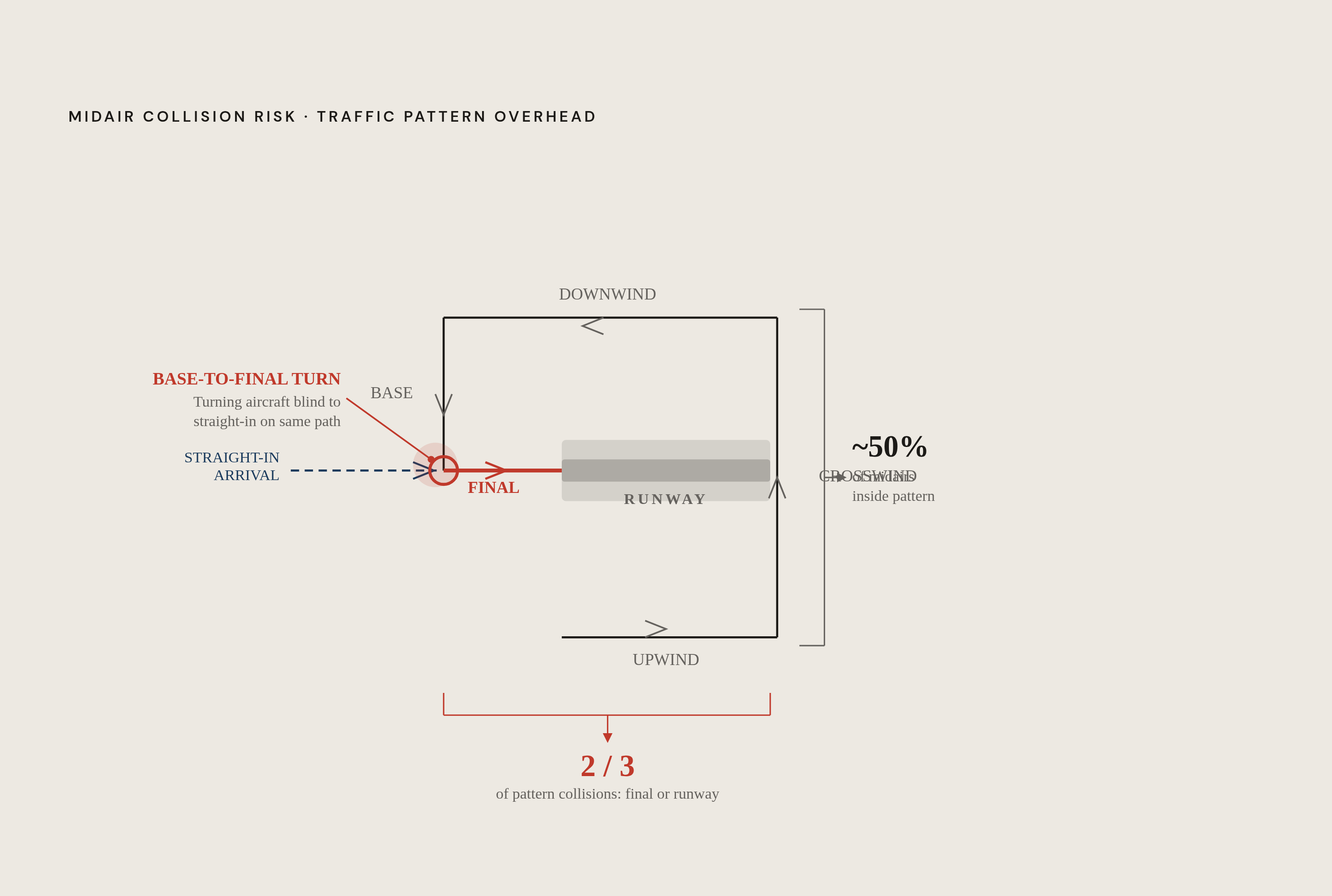
Picture the pattern from above: a rectangle traced around a runway, with aircraft entering and exiting at different points, speeds, and altitudes. Every aircraft in that rectangle converges on the runway threshold along a small number of standardized paths that put them close together by design, not accident. That compression is precisely why the pattern matters so much statistically. Roughly half of all midair collisions happen inside the traffic pattern, and two-thirds of those occur during approach and landing, on final or directly over the runway itself.
The most dangerous single moment in that rectangle is the turn from base to final. An aircraft turning from base can roll out on final at an angle a straight-in arrival can't see until the gap has closed to something uncomfortably short. The FAA's own guidance addresses this directly: Advisory Circular AC 90-66C recommends against straight-in approaches when other aircraft are working the pattern in visual conditions, precisely because a straight-in can put an airplane on a collision course with someone turning from base. That's a federal advisory circular acknowledging that the normal way pilots enter a pattern creates a blind spot for the normal way pilots arrive from cruise. The geometry itself is the hazard, and everything that follows in this analysis traces back to what happens, or fails to happen, inside that rectangle.
Non-towered airports' structural difference from every other environment in the airspace system
Calling a non-towered airport simply "a towered airport without the tower" understates the difference. What's missing is the entire infrastructure of sequencing and shared awareness that makes dense traffic workable elsewhere.
The United States has around 527 towered airports, against nearly 20,000 landing facilities with no tower at all. That ratio means any structural weakness in the non-towered environment isn't a marginal issue.
At a towered field, a controller holds the full traffic picture, every aircraft's position, speed, and intention, and sequences arrivals before their paths converge. That controller can order a go-around, hold an aircraft short, or slot a slow trainer behind a faster one, none of which any individual pilot can do alone. At a non-towered field, no one holds that picture. Each pilot assembles a partial, second-hand version of it from radio calls and their own eyes, with no external authority to correct errors.
Self-separation by radio announcement fails at the moment it is needed most
The substitute for a controller is the Common Traffic Advisory Frequency, a shared channel where pilots announce their own positions and listen for others doing the same. It works only if every pilot transmits correctly and on time, and only if every other pilot correctly interprets what they hear. That's a chain with several links that tend to break exactly when the pattern most needs them intact.
Workload in the pattern peaks at the worst possible time for radio discipline. A pilot on final is configuring flaps, managing airspeed, checking the runway, and scanning for traffic, all while trying to make a timely radio call. Cognitive bandwidth is thinnest exactly where the standard calls for it to be sharpest. And those calls are self-reported, with nothing to verify them. A disoriented pilot, one on the wrong frequency, or one unfamiliar with the pattern can transmit an incorrect position, and everyone else builds their mental model on that bad information.
AOPA Air Safety Foundation analysis found confusion about aircraft location and sequencing often starts early in the pattern, well before final approach. The conflict geometry is already forming before any pilot involved realizes there's a problem to solve.
One documented case involved a small recreational aircraft and a passenger jet carrying 170 people whose flight paths intersected with only 600 feet of vertical separation. The Jabiru pilot had no idea the A320 was there at all. The A320 crew didn't know either, until their onboard collision-avoidance system alerted them. Standard radio procedure was available to both aircraft that day, yet it still didn't produce shared awareness of the closing conflict. That gap between procedure and actual awareness is the whole problem in miniature.
TCAS's limited availability and effectiveness in the traffic pattern
TCAS II exists precisely to catch what radio calls miss, and it is the reason the A320 crew over Ballina found out about the Jabiru at all. In the non-towered pattern, that backstop is close to absent, and it fails in two compounding ways.
The first is carriage. TCAS II is standard on airliners and larger turbine aircraft, but the trainers and light singles making up most non-towered traffic don't carry it. The second is altitude inhibition. Even aircraft carrying TCAS II lose resolution advisories below roughly 1,000 feet AGL, since commanding a climb or descent that close to the ground is its own danger. The traffic pattern is flown at and below that altitude as a matter of course, so TCAS II is switched off exactly where pattern conflicts develop.
A third problem: TCAS II's resolution logic is geometric, projecting time to closest approach from current closure rate, built for airliners converging in level cruise, not aircraft turning through a rectangular pattern. Applied to pattern traffic, that logic both misses developing conflicts and generates false alerts on turns that would have resolved themselves, the PCAS research project found, using ADS-B data from KBTP.
It's a research prototype, an experimental multi-agent Transformer model with social attention, intended for training on that KBTP data (not yet built), and in early testing it detected conflicts earlier than a TCAS-style baseline at the same false-alarm rate. What that result suggests is not that a product exists to fix this. It suggests pattern-traffic geometry can be learned by a system built for it, a different problem than TCAS II was designed to solve. TCAS's successor, ACAS X, reflects the same recognition, replacing geometric closure-rate logic with probabilistic prediction; its ACAS Xu variant targets unmanned aircraft. The industry has acknowledged the geometric-logic limitation at the architectural level. No certified replacement yet exists for light aircraft flying non-towered patterns.
Student pilot concentration and its effect on non-towered traffic patterns
Non-towered airports are also where flight training concentrates, and student pilots are the population least equipped to absorb the self-separation burden the system places on everyone in the pattern.
A student pilot flying the pattern is simultaneously doing several demanding things for the first time: flying the rectangle, making correct CTAF calls, managing aircraft systems, and scanning for traffic. Those are the exact tasks that already strain experienced pilots under normal pattern workload. Asking a student to do all of this while also building judgment to spot problems stretches the self-separation model past its limits. The system asks the most of the pilots who can give it the least, and it asks that in the one environment where the request matters most.
Training traffic compounds this in another way. Student patterns are frequently irregular, go-arounds are common, airspeeds vary more than among similarly experienced pilots, and instructors sometimes use non-standard phraseology or make calls on a student's behalf. Every one of those factors erodes the shared mental model that CTAF depends on to work at all.
The 2021 midair collision at Centennial Airport in Arapahoe County, Colorado, illustrates the convergence risk mixed traffic can produce even where infrastructure exists. On May 12, 2021, Key Lime Air Flight 970, a Swearingen SA226TC Metroliner on a cargo positioning flight, collided with a privately flown Cirrus SR22 GTS G5 on final to parallel runways at Centennial. Both aircraft were badly damaged, and all three people involved survived because the Cirrus pilot deployed the aircraft's onboard parachute system. Centennial is a towered field, so this was not a case of self-separation failing outright. Its value here is showing parallel-runway convergence and mixed-traffic complexity, risks non-towered fields face constantly, minus the ATC support Centennial had that day.
What the collision data shows and cannot show
The NTSB's raw numbers, at face value, seem to cut against this argument. Some data-driven analyses note towered airports post more recorded collisions than this thesis would predict. That reading measures the wrong quantity, and the reason why matters for anything that claims to fix the underlying problem.
Towered airports handle far more traffic, more complex operations, and a wider mix of aircraft types than non-towered fields. Counting collisions per facility, without dividing by operations volume, favors whichever category has fewer flights, regardless of per-flight danger. The denominator that would settle the question is operations volume, and comprehensive operations data for non-towered airports simply doesn't exist.
That absence is a direct consequence of the same coverage gap this piece is describing. A field with no tower and no systematic traffic-recording infrastructure generates no operations log, so a genuine per-operation collision rate can't even in principle be calculated. The absence of an operations log for non-towered fields is the same coverage gap that produces the safety risk.
The January 29, 2025, collision over the Potomac River sharpens this point rather than complicating it. American Airlines Flight 5342, a regional jet operated by PSA Airlines for American Eagle, collided with a U.S. Army Black Hawk helicopter (callsign PAT 25), killing all 67 aboard both aircraft. That accident happened at Reagan National, a fully towered airport with a complete ATC data stream. The NTSB cited a lack of proactive data sharing and safety analysis to identify and mitigate midair collision risk as a systemic failure, even with that data stream in place. If a towered airport with full radar and recorded communications can still suffer that failure, it applies more forcefully at a non-towered field, where no ATC data stream exists to share or analyze. A safety system that can't be measured can't be managed, and in this case the absence of measurement is itself the finding.
The economic and staffing structure that makes the gap self-perpetuating
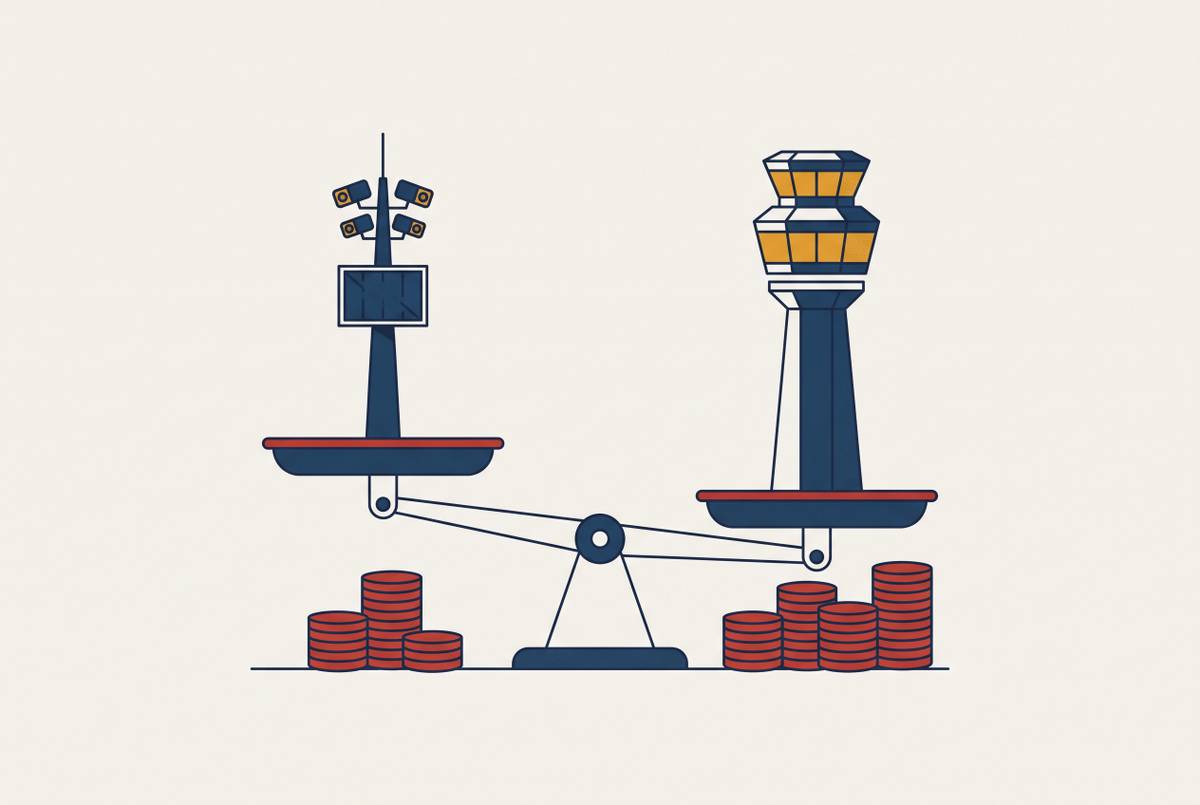
Most non-towered airports stay that way because the one conventional fix, a fully staffed control tower, sits financially and operationally out of reach for nearly all of them, not because their operators are indifferent to the risk.
Small general-aviation airports typically run on thin, unreliable revenue, and capital costs land on already-stretched local sponsors. A traditional tower competes for scarce funding against runway resurfacing, lighting upgrades, and fuel system maintenance, and rarely wins. Even where an airport could somehow scrape together the capital, the controller workforce needed to staff a new tower isn't there to hire. The Government Accountability Office reported that the FAA closed fiscal year 2025 with fewer air traffic controllers on staff than it had a decade earlier, a shortage that discourages new tower construction even at fields that could otherwise justify one.
The result locks into place rather than resolving itself over time. Airports too small to fund a tower, a controller workforce too thin to staff one even where funding exists, and a federal grant pipeline stretched thin, all while the safety exposure a tower would address keeps running. That is a structural equilibrium, not a temporary funding shortfall waiting for the right budget cycle.
Digital tower technology's effect on the economic and operational equation
Digital tower technology addresses the barriers of cost, staffing, and infrastructure by separating the control function from any single physical tower and running it from a centralized facility.
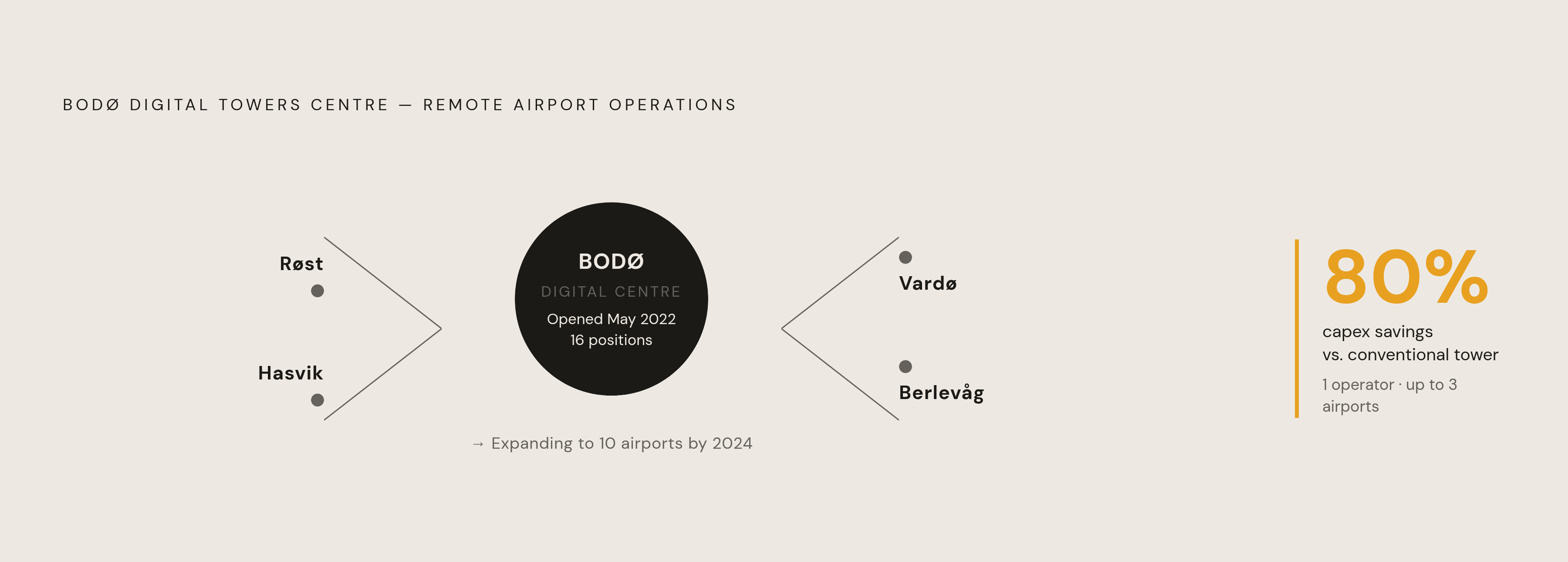
Norway's Avinor offers the clearest operational proof that this model works at scale. Avinor Air Navigation brought digital tower service online at Røst Airport on October 19, 2019, with suppliers Kongsberg Defence & Aerospace and Indra. By May 2022, a Digital Towers Centre opened in Bodø, running four airports (Røst, Vardø, Hasvik, Berlevåg) from one facility, then the largest of its kind. In February 2024, Avinor's board approved moving six more airports into that center, alongside an earlier decision to add the new Mo i Rana airport. The Bodø center runs 16 working positions, and a single operator can handle up to three airports from one position at once.
Other operators have taken the same approach in different settings. London City Airport became, in 2021, the first major international airport fully run by a remote digital tower, with controllers based 115 kilometers away in Swanwick using Saab's r-TWR system. Budapest's system layers high-resolution cameras and sensors into a panoramic real-time view with artificial intelligence flagging anomalies automatically, with full deployment planned for 2026. In April 2025, Italy's ANSP ENAV announced converting control centers at Brindisi and Padua into Remote Tower Centers to manage 16 low-traffic airports initially, rising to 26 by 2033. Reported industry figures put capital expenditure savings as high as 80%, from avoiding construction and upkeep of a conventional tower, plus further operating savings from centralized staffing.
The multi-airport center is what speaks most directly to the American gap in non-towered coverage. A single staffed facility can provide sequencing authority and traffic awareness to several small fields at once. That is precisely the capability missing from every rectangle-shaped pattern described at the start: one set of eyes with authority to see every aircraft and say which goes first.
Sources
- Are Non-Towered Airports Safe? The Data Says Yes
- GitHub - basharfkhan/pcas: Predictive Collision Awareness System: learned conflict warning for non-towered airports, where TCAS is inhibited and most midairs happen · GitHub
- U.S. Department of Transportation Federal Aviation Administration Advisory
- 2021 Colorado mid-air collision
- 2025 Potomac River mid-air collision
- COLLISION AVOIDANCE AT NONTOWERED AIRPORTS Teresa Ann Sloan
- Reducing the collision risk around non-towered airports | ATSB
- ADVANCING REMOTE TOWER DEPLOYMENT IN THE UNITED STATES