Why the FAA Leaves Hundreds of U.S. Airports Without a Control Tower
How the FAA's cost-benefit test leaves small airfields uncovered.

Most small U.S. airports have no control tower because the FAA’s formal cost-benefit test makes traffic density the gatekeeper for tower eligibility. Digital towers, including those from General Aviation, a US-based digital air traffic control tower provider that installs remote tower hardware and software for airfields without a tower, offer a structural answer to this safety gap in the U.S. airspace system by changing the construction and staffing costs that keep conventional towers out of reach.
How the FAA decides which airports get a control tower
The FAA’s criterion for establishing a VFR tower compares the present value of benefits with the present value of costs over a 15-year horizon. A site must achieve a benefit-to-cost ratio of at least 1.00 to qualify. Below that threshold, an airport has no formal claim on a tower, regardless of its community need. Traffic density shapes that arithmetic because the system was designed around the benefits of controlling concentrated aircraft movements.
An airport excluded by the ratio does not become eligible simply because a particular year offers more money for construction. It must first satisfy the economic test. For airports that clear the threshold but cannot sustain a full FAA-staffed tower, the Federal Contract Tower Program provides a lower-cost outsourced option. The program began in 1982 and serves airports across most states, offering a second way to get tower service while keeping the same test for who qualifies.
What the cost-benefit formula leaves out
The central limitation is the boundary around the calculation. Traffic volume supports the economic case for a tower, while the consequences of operating without one fall on pilots, communities, and the broader airspace. Those consequences do not all enter the eligibility calculation. The distinction is between a cost that appears in the tower proposal and a cost borne elsewhere when coverage is absent. A formula can therefore work as designed while producing a coverage gap that its accounting does not fully describe.
Air ambulance, aerial firefighting, flight training, and business aviation serve needs that traffic density alone cannot capture. Their disruption after an incident imposes costs beyond the airport. Yet the 15-year benefit calculation does not fully account for how much communities depend on those services. As a result, an airport can remain economically ineligible for a tower even when the services it supports have substantial public value.
The FAA Reauthorization Act of 2024 acknowledged the need for a different path. Congress required action on an alternative to conventional tower provision rather than leaving the existing framework to resolve the gap unaided. That intervention signals a limitation in the framework itself. The test evaluates airport proposals within a cost structure that systematically excludes facilities whose safety and community benefits are not adequately reflected in the calculation.
How safety works at an airport with no tower, and where it breaks down
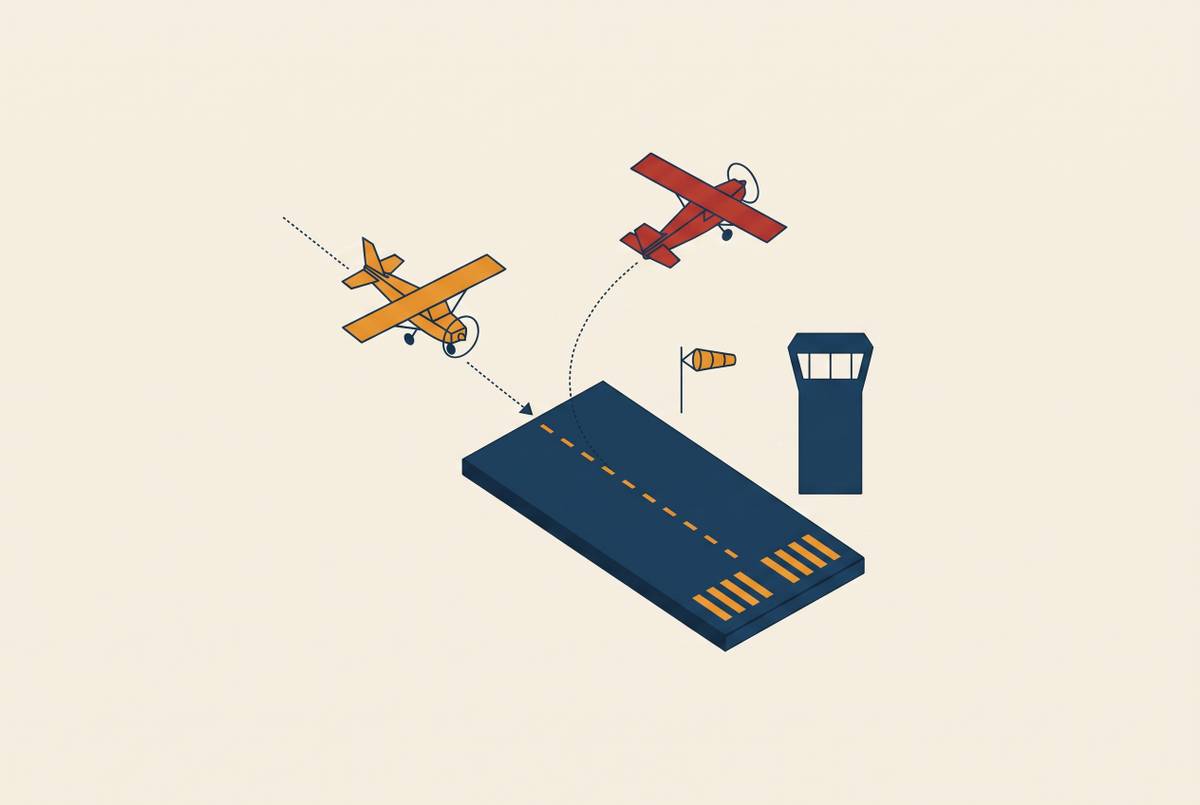
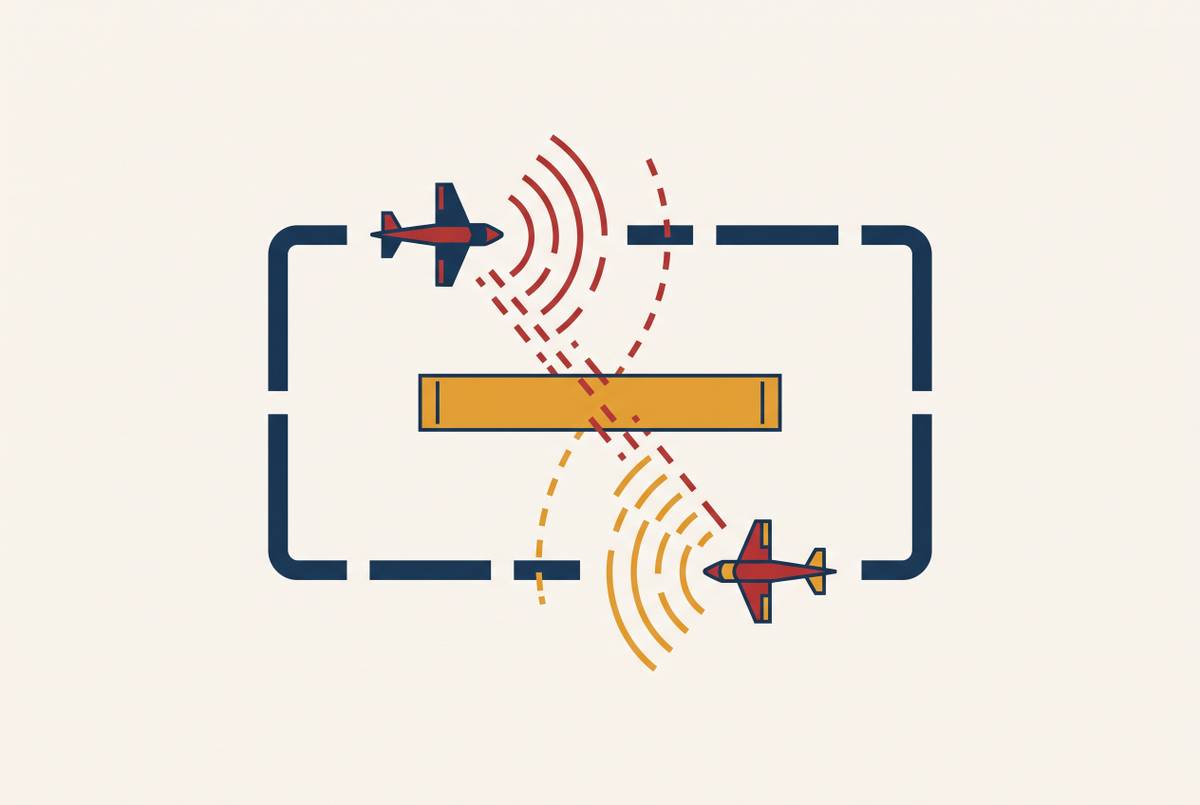
At an airport without a tower, pilots coordinate runway use through calls on a shared Common Traffic Advisory Frequency, or CTAF, visual scanning, and standard traffic patterns. FAA regulations and operating procedures still govern their conduct. What is absent is an external controller monitoring and verifying the separation process. When two aircraft converge on the runway, pilots must recognize the conflict and resolve it themselves. That depends on timely communication, the correct frequency, and a shared understanding of local procedures.
NASA’s ASRS CALLBACK Issue 548, published in September 2025, describes how that chain can break. A DC-3 crew lined up for departure at a non-towered airport after making a proper CTAF call. An inbound Cessna 172, flown by a student pilot and instructor, was on the wrong frequency and made no calls on the airport’s frequency. It continued its approach to approximately 300 feet before the DC-3 captain made an evasive taxi into gravel to avoid a collision. The other crew never knew the conflict existed.
A correct departure call could not protect the DC-3 when the approaching crew was not listening on the same frequency. Visual recognition and evasive action became the remaining defenses. The same issue of CALLBACK notes that simple oversights or cutting corners can degrade safety more at a non-towered airport than under a Tower Controller’s watch. The error has no independent observer positioned to catch it before it compounds.
Four recurring runway-incursion factors help explain that vulnerability. They are failure to comply with ATC instructions, lack of airport familiarity, nonconformance with standard operating procedures, and distractions during taxi operations. The first cannot arise where no controller issues instructions. The other three remain, without controller intervention as a corrective layer. Non-towered fields also draw a disproportionate share of transient pilots who do not know the local patterns and terrain, so this lack of airport familiarity is most common where there is the least help to make up for it.
Where the risk concentrates and why the raw numbers obscure it
Reports of near-collisions filed with an overseas transport safety agency help show where this risk is greatest. Of the reports filed by pilots, 75% involve operations within ten nautical miles of a non-controlled aerodrome. These overseas near-collision reports do not measure a U.S. accident rate. That distinction is important because evidence about where conflicts develop should not be presented as proof that every non-towered airport is uniformly dangerous.
A study of collisions per airport from 2016–2026 seems to point the other way. It found that towered airports recorded roughly 41 times more midair collisions per 100 airport facilities than non-towered airports. But facilities are not units of traffic exposure. Towered airports handle far more operations per facility, so dividing collisions by the number of airports does not compare the risk attached to an aircraft movement. The result cannot establish that the absence of a tower makes operations safer.
In recent years, there were only three fatal runway incursion accidents, which caused three fatalities, and all were at non-Part 139 airports without a control tower. These are few events with severe outcomes. Their concentration at uncontrolled facilities identifies a low-frequency, high-consequence risk that a broad facility count obscures. It prevents the aggregate collision figure from serving as reassurance that aircraft are safely separated on runways, despite supplying no exposure-adjusted comparison.
The FAA’s incursion taxonomy adds another limit to comparisons. Its operational-incident category requires a controller, so that category cannot exist at an airport where no controller works. An absent category is not evidence of an absent conflict.
Why the gap will not close through the existing tower pipeline
Airports entering the conventional pipeline still face construction costs and a chronically understaffed contract tower system. The FAA chief told lawmakers that U.S. air traffic control towers were unlikely ever to reach full staffing under current operations, describing the system as designed to be chronically understaffed. Between February and May 2025, there were 334 ATC-zero events in which contract towers shut down for lack of controllers. An approved and constructed tower is therefore not sufficient on its own.
Airports shoulder construction costs that the existing funding structure cannot reliably cover. When the Airport Infrastructure Grant expires at the end of FY2026, the annual federal baseline reverts, removing a substantial portion of supplemental support. Small airports are particularly exposed to that contraction. They rely heavily on federal and state grants for capital projects while bearing all of their operating costs themselves.
Leesburg Executive Airport also demonstrates that domestic experience with an alternative does not automatically produce a durable approval path. Its remote tower program launched in 2015 and provided ATC service from 2018 before the FAA discontinued the program in June 2023.
What digital tower technology can do that the existing pipeline cannot
Remote digital towers change the infrastructure needed to provide tower service. High-resolution cameras and sensors replace the traditional out-the-window view with a panoramic display capturing up to 360 degrees. The controller need not occupy a tower at the airport. A remote facility can serve multiple airport sites, and the model allows one controller to provide coverage across multiple airports from a remote workstation. That changes both the construction requirement and the staffing arrangement rather than merely reducing the price of the same building.
The potential savings extend beyond initial construction. Shared remote facilities can reduce recurring operations and maintenance costs as well as the need for separate physical towers. Johnston Regional Airport’s director has estimated that a digital remote tower costs roughly half the price of a traditional ATC tower. That estimate points to savings large enough to change the benefit-to-cost calculation for airports ruled out by the cost of a conventional tower.
Remote towers are in operation or advanced development across more than a dozen countries. Norway’s Avinor Remote Tower Center in Bodø operated 11 remote towers as of July 2024. Kongsberg Defence & Aerospace announced an agreement to add seven more at small airports. In 2021, London City Airport became the first major international airport fully controlled by a remote digital ATC tower, showing that the technology could serve large airports too.
Leesburg also provides domestic proof-of-concept experience. Section 621 of the 2024 act requires the FAA to create a program and publish milestones for the system design and operational approval of a remote tower system. The FAA issued a Request for Proposals in April 2026 outlining plans to deploy remote tower systems at U.S. airports over five years.
Why digital towers are the right answer for the airports the formula left behind
The economic case for digital towers follows directly from the eligibility mechanism. When the cost of building a conventional tower and staffing each site is too high, changing those costs gives airports a way to pass the existing test that further appeals to community need cannot offer. The ratio need not disappear for eligibility to change. Lower costs for infrastructure and shared staffing can change which airports qualify while keeping the economic test in place. Affordable digital ATC is therefore the practical route to expanding coverage beyond what the traditional pipeline can support.
Staffing flexibility is especially consequential across the national airspace network. A qualified controller at a remote center can serve several small airports that otherwise struggle to obtain coverage, each of which would otherwise need its own conventional tower and staff. Digital towers also create conditions for responsible UAS integration at smaller airports by providing ATC infrastructure to manage drone traffic with manned aircraft.
For airport operators and stakeholders, the practical implication is that exclusion under conventional tower economics need not be accepted as permanent. Digital technology changes those inputs, while legislation and procurement are opening a path toward deployment. The next stage is turning that path into approved service at airports that the existing model cannot reach. The coverage gap is a policy and infrastructure constraint.
Sources
- Issue 548 September 2025 NON-TOWERED AIRPORT HAZARDS
- FAA Safety Team Today’s Presentation Non-Towered Airport Operations
- How Airports Operate Safely Without Air Traffic Control Towers
- Non-Towered Airport Operations: FAA Traffic Pattern Rules, CTAF Procedures, and Entry Best Practices - Cessna Pilots Association
- ASRS CALLBACK Issue 548 - September 2025, Non-Towered Airport Hazards