UAV and Manned Aircraft Conflict at Uncontrolled Airports
Uncontrolled airports lack the infrastructure to separate drones from manned aircraft.

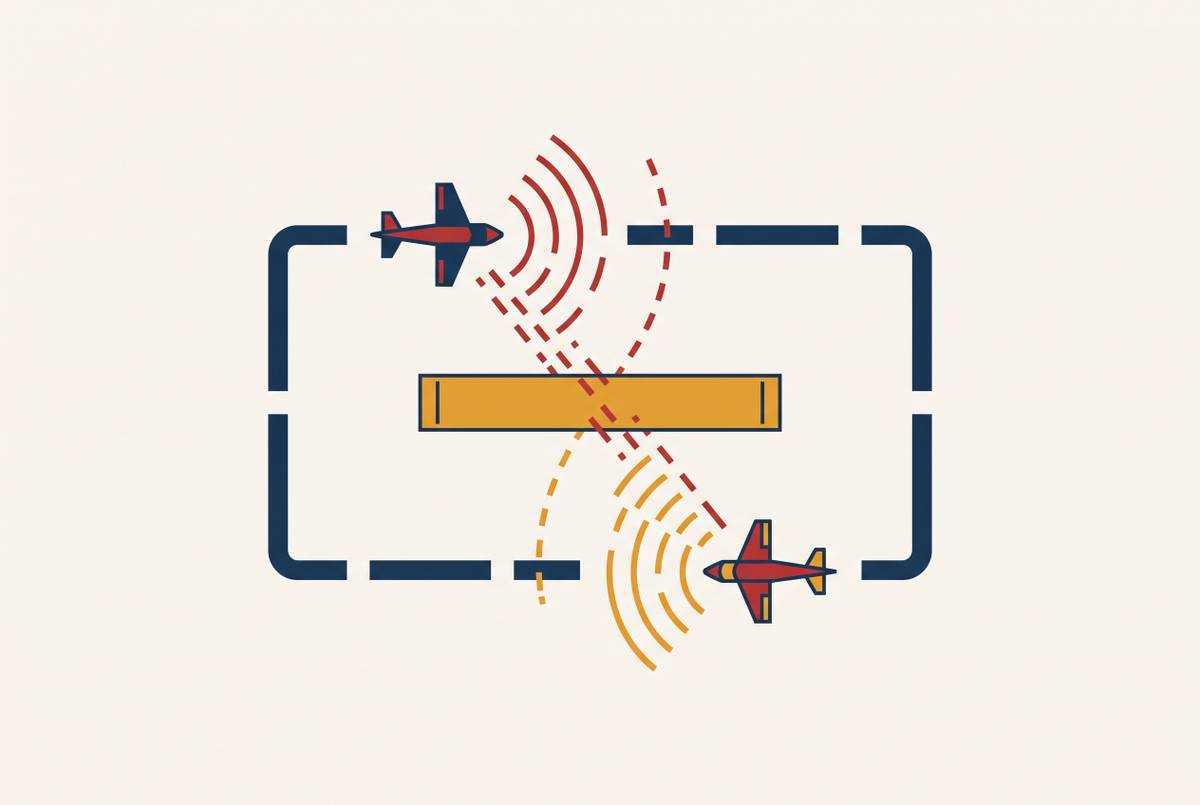
Most U.S. airports have no control tower at all, and that absence is the central fact behind every drone conflict at a non-towered field. Without a tower, pilots and drone operators share the same airspace with no authority to sequence, warn, or separate them, relying instead on radio calls and visual scanning that were never built to account for an unmanned aircraft. That condition, not any single bad actor or faulty sensor, is why uncontrolled airports carry the sharpest UAV conflict risk in the national airspace system.
Why uncontrolled airports concentrate the UAV conflict risk that towered airports largely avoid
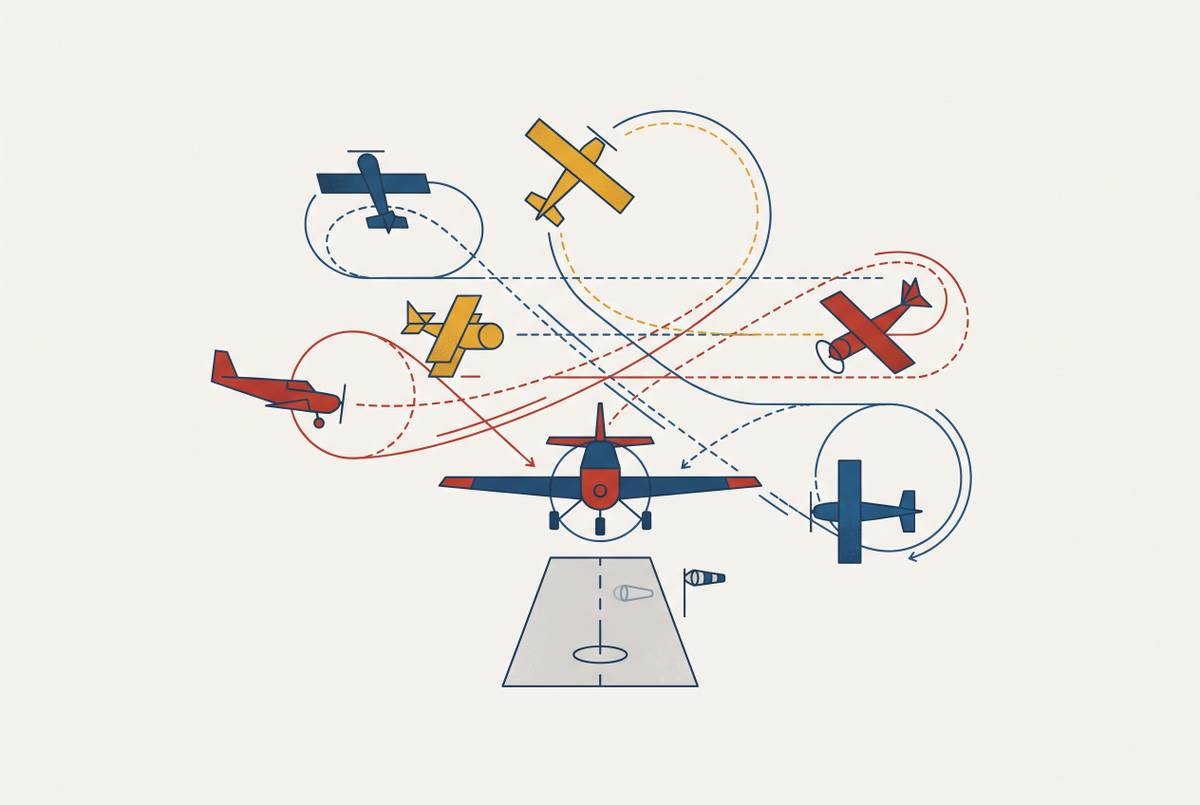
The director of Johnston Regional Airport put the condition this way: "It's very similar to, as if you removed all of the stop signs and all of the stop lights from downtown Raleigh and expected the drivers to effectively and efficiently and safely get to where they're going. That comparison captures something a regulatory description tends to flatten. At a towered airport, a controller holds the standing to sequence arrivals, call out conflicting traffic, and order an aircraft to go around. At an uncontrolled airport, no equivalent figure exists. Pilots announce where they are on a shared radio frequency and watch for each other, and that system assumes aircraft that fly predictable patterns at predictable speeds and carry transponders. A drone fits none of those assumptions. It may be small, slow, erratic, silent on the radio, and invisible against a cluttered background, and the self-separation model simply has no mechanism for folding it in.
The scale of the exposure follows directly from how the U.S. airport system is built. The vast majority of airports in the country operate without a control tower, making the conflict condition described above the default operating environment across most of general aviation, not a fringe scenario confined to a handful of rural strips. Compounding the problem, most drone flights carry no statutory requirement to report to any aviation authority, so operators are free to fly in uncontrolled airspace without informing anyone that they are there. Regulators, airport operators, and pilots end up with only a partial picture of how much UAV activity occurs near these fields. The vacuum is baked into both the structure of the airspace and the incentives around who has to report what to whom.
Where UAV Conflicts Occur and Go Unreported
The FAA now gets more than 100 reports of drone sightings near airports every month, and that volume means the exposure is persistent and ongoing, not a series of isolated events. You can't trust that figure, because the reporting system depends on the same visibility and awareness that the underlying problem degrades. A study comparing Remote ID telemetry against ADS-B data found near-midair collisions between drones and manned aircraft that never appeared in any official UAS sighting report. In other words, encounters close enough to count as near-misses by objective flight-track data were going entirely unrecorded in the system regulators rely on to understand the scope of the problem.
Part of the undercount traces back to a basic limit of human vision. Even when a pilot knows a drone is nearby, it is hard to spot, because its small size and irregular flight path defeat the kind of visual scanning that works for spotting another airplane. That difficulty worsens at night and during the high-workload phases of flight, landing and takeoff, when a pilot's attention is already split between airspeed, runway alignment, and traffic calls. The challenge runs in both directions: drone pilots and ground-based visual observers struggle just as much to spot a manned aircraft on approach, so the "see and avoid" principle that uncontrolled airports depend on fails on both sides of the conflict at once.
The recent high-profile drone incidents at JFK and Newark happened at towered, Class B airports, where controllers were on duty and radar coverage was in place. That detail matters precisely because it shows how much penetration is possible even under the best available conditions. If drones have crossed into protected airspace and created conflict at some of the most heavily monitored airports in the country, the conditions for detection and response at an uncontrolled field, where none of that infrastructure exists, are categorically worse.
Why Detection at Uncontrolled Airports Fails Before Any Conflict Response Can Begin
Before anyone can respond to a drone conflict, somebody has to see it, and that first step is where the system breaks down hardest at uncontrolled airports. The FAA's own advisory committee found that the agency's preferred method for confirming a drone sighting is visual or other confirmation from a pilot or someone on the ground, and that visual verification is inaccurate and difficult to obtain in certain conditions, especially at night. So when eyesight works worst, that is exactly when detection has to rely on it.
Federal counter-UAS objectives exist on paper, but the systems, authority, and trained personnel needed to carry them out do not yet exist in practice at most airports, and that gap between stated policy and deployed infrastructure is widest at small, uncontrolled fields that never had radar coverage or dedicated staff to begin with. GNSS jamming and GPS spoofing incidents rose sharply in 2025, degrading a positioning tool that both pilots and drone operators rely on for navigation, with particular consequence at uncontrolled airports where GPS often serves as the primary navigation reference among several inputs.
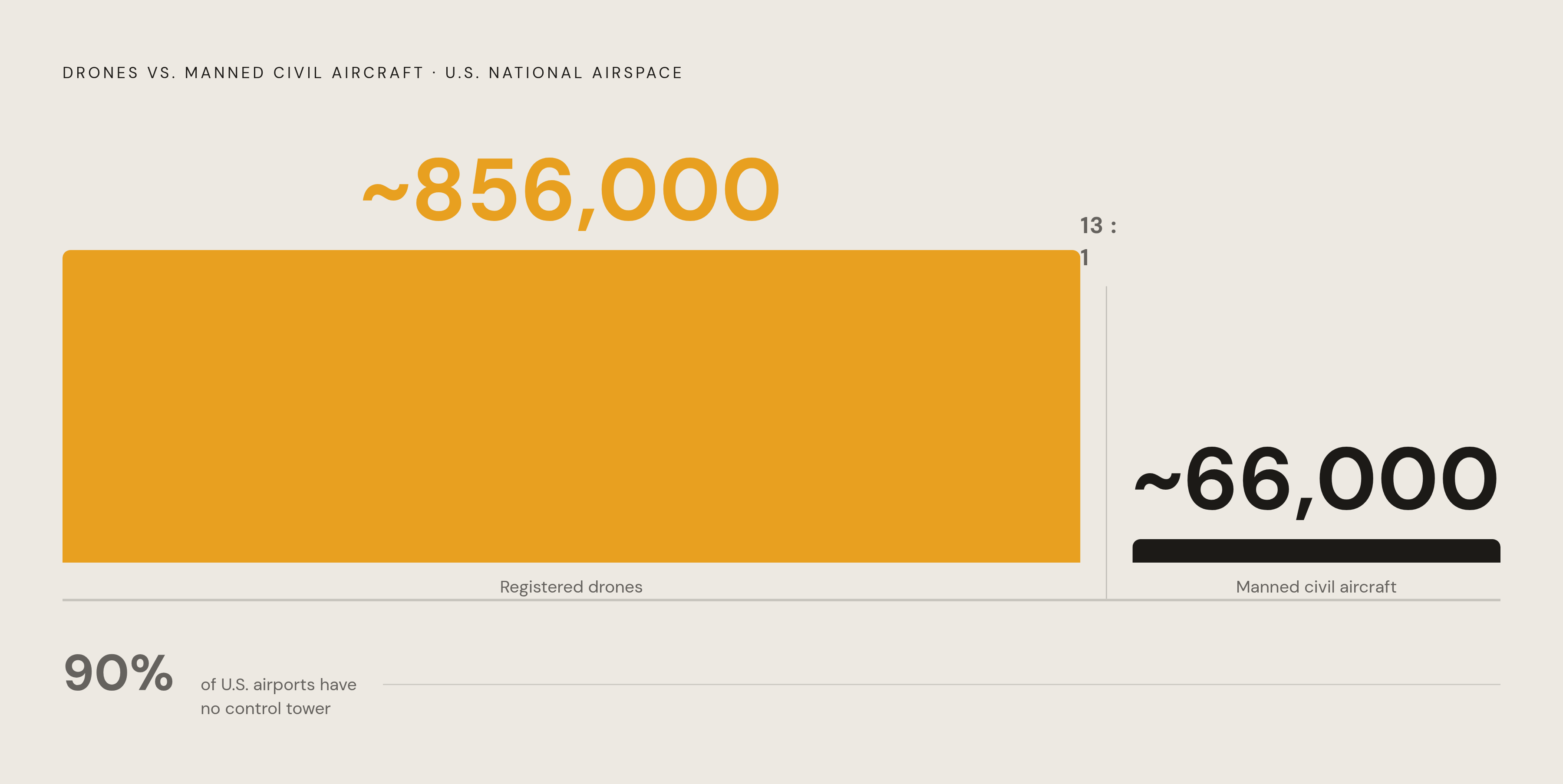
The scale of the mismatch is stark. Drones outnumber manned civil aircraft in the national airspace system by nearly 13 to one, and neither detection infrastructure nor pilot attention was built for an environment with that ratio. Remote ID, the FAA's primary tool meant to make drones electronically identifiable, has faced delays and inconsistent compliance since its rollout, and operators who fly beyond line of sight, disable safety features, or are simply unaware of the requirement are not captured by the system in any operationally useful way. The detection gap precedes the authority gap: there is no one watching at uncontrolled airports, and the tools to enable remote detection and shared situational awareness do not yet exist in practice at these facilities. Digital tower platforms combine automated monitoring with a human controller's judgment, and they are built to reconstruct exactly that observational capacity at small and general aviation airports, where it has historically cost too much to install.
Why small airport economics make the conventional solution, a manned tower, inaccessible
The airports most exposed to this risk are also the ones least equipped to pay for the fix, and that pairing is not coincidence. It follows from how small airport finances actually work. Airport sponsors have to cover their own day-to-day operating costs, and they usually pay for them with aeronautical activity revenue, much of which goes straight to staff labor. There is little money left over for large capital outlays.
A traditional control tower can run into the many millions of dollars to build and staff, more than most general aviation airports can justify. Johnston Regional Airport and Raleigh Executive Jetport in North Carolina have each already received FAA approval to build a tower, and neither has been able to move forward. Approval is not the obstacle. Money is.
The federal funding picture is about to tighten further. The Bipartisan Infrastructure Law directed substantial aviation funding over a five-year period running through FY2026, and that supplemental stream is scheduled to expire at the end of that fiscal year. Once it lapses, federal airport grant funding reverts to the baseline Airport Improvement Program, so small airports lose the main capital funding mechanism they have used for infrastructure upgrades of any kind, towers included. The combination leaves a category of airports carrying real UAV conflict risk, no tower to manage it, no financial path to a traditional tower, and a closing window on the best funding tool it has had for any capital project in years. That timeline is a deadline that makes the search for a cheaper, deployable alternative more urgent with each passing quarter.
How Digital Tower Technology Addresses the Structural Vacuum
Digital tower technology matters here because it restores the one variable that uncontrolled airports structurally lack: a human observer with continuous situational awareness and the standing to direct traffic. Remote tower systems replace the out-the-window view of a traditional cab with a digital environment built from cameras, sensors, and panoramic displays. A controller sits at a remote workstation, next to the runway or hundreds of miles away, and watches a continuous 360-degree feed of the airfield and surrounding airspace.
That 360-degree digital view removes the blind spots built into traditional tower cabs, and it holds up against glare in a way the human eye does not, so it helps with drone detection, where small size and shifting light routinely defeat casual visual scanning. Artificial intelligence adds a further layer of autonomous alerting. The Atrak MAESTRO platform, unveiled at Airspace World in Lisbon in May 2026, uses AI for object recognition and tracking, fuses optical and radar data, automatically flags potentially hazardous situations, and transcribes pilot-controller communications, which together allow earlier identification of conflicts developing on runways and approach paths. AI is increasingly treated as a necessary component of drone detection specifically. A digital tower is not a fixed, one-time replacement for a staffed cab but a platform that can absorb drone-specific detection capability as that capability matures.
Cost is the detail that makes this more than a technical curiosity. The director of Johnston Regional Airport said a digital remote tower costs roughly half what a traditional tower costs, so it is within reach of airports that have already decided they cannot afford a manned one. General Aviation builds affordable digital ATC towers for the roughly 90 percent of U.S. airports that now operate without any tower at all, so the technology reaches the facilities where the UAV conflict gap runs deepest. The structural problem is not a gap in procedure but the full absence of an intermediary, an observer with the standing to sequence, warn, or exclude traffic, and that vacuum defines most of the country's airports. Companies building toward that gap are inserting the missing piece where it is most needed and has been missing longest.
Deployment at Scale and What the U.S. Still Has to Learn
Digital towers are already running at operational scale abroad, and the question for the U.S. is how quickly regulatory process can catch up to technology that has already proven itself elsewhere. Belgium's skeyes DiTo project applies the centralization model to airports that previously had low enough traffic to make a dedicated tower hard to justify. A new control center in Namur is set to guide the airports at Charleroi and Liège remotely, with the project aiming to be fully operational by the end of 2026.
Progress in the U.S. has been real but slower. In April 2026, the FAA issued a request for proposals for remote air traffic control tower systems, and the procurement could run to dozens of units over five years. So that procurement effort shows the agency wants to move past its single Atlantic City test bed and toward broad deployment at the airports where UAV conflict risk now goes almost entirely unmanaged. Getting there has not been smooth: the FAA's sudden publication of new draft technical requirements in June 2024 delayed installation at the Atlantic City Tech Center by at least four months, a concrete example of how the gap between European and U.S. deployment speed traces back to regulatory process rather than any shortfall in the underlying technology.
What a Digital Tower Can and Cannot Do About a Non-Cooperative Drone Operator
A digital tower controller can see a drone and warn manned aircraft away from it, but cannot physically force a non-cooperative operator out of the sky. Many UAV conflicts at uncontrolled airports involve operators who either do not know the rules or are choosing to ignore them. Remote ID, meant to make every drone electronically identifiable, has been delayed and only partially adopted. A controller watching a remote tower feed can spot a drone and call it out over the radio, but has no way to compel that operator to land.
The limitation does not erase the value of detection and early warning. A controller who sees a drone in time can redirect manned traffic away from it, issue a ground stop, or notify law enforcement, options that the current baseline of no detection makes impossible. Enforcement authority is also catching up. Legislation enacted in December 2025 set congressional guidance on drone detection and counter-drone operations at airports, and in 2026 the FAA updated its enforcement policy, so it must now take legal action when drone operations endanger the public, violate airspace restrictions, or occur in furtherance of another crime. That authority still depends entirely on detecting the drone first. Counter-UAS technology, including AI-enabled object detection, radar fusion, and Remote ID integration, is developing in parallel with digital tower infrastructure and can be layered onto a digital tower platform in ways unavailable at an uncontrolled airport with no ground infrastructure. The fact that a tower cannot stop a rogue operator on its own is an argument for pairing tower deployment with stronger enforcement capability, not a reason to skip the tower.
What closing the structural vacuum would require, and why the window is narrowing
Closing the gap described throughout this piece requires three things moving together rather than in sequence: detection infrastructure that works in the dark and in degraded GPS conditions, a funding mechanism that reaches small airports before the current one expires, and a regulatory process in the U.S. willing to move at the pace already demonstrated abroad. None of those three pieces is sufficient alone. Detection without funding leaves the technology priced out of the airports that need it. But if funding comes without regulatory clearance, approved projects stall, the way they already have at Johnston Regional and Raleigh Executive Jetport. And if regulatory clearance comes without detection infrastructure, uncontrolled airports stay exactly where they stand today, watching the sky with the same tools pilots have used for decades.
The FY2026 expiration of Bipartisan Infrastructure Law funding sets a real deadline against which all of this has to happen. If airports move now, while that funding window is still open and federal procurement is still shaping how remote tower systems get deployed, they can close the vacuum this piece has described. Airports that wait are likely to find themselves back where Johnston Regional and Raleigh Executive Jetport already sit: approved, exposed, and unable to pay for the one thing that would change the picture.