FAA Airport Improvement Program Funding for Safety Technology
Federal funding for airport safety technology now flows through AIP grants.

The supplemental era is over. The Bipartisan Infrastructure Law's airport grant programs are exhausted and authorized only through fiscal 2026, so the Airport Improvement Program now stands as the dominant federal capital-funding pathway for non-hub airports. The practical question facing airport operators has shifted from which program to pursue to how to pursue AIP effectively. That question turns entirely on knowing how the program is structured, what it will fund, and where digital air traffic control infrastructure fits within its rules.
The IIJA provided supplemental airport grant programs through FY2026 only. The FAA's Airport Terminal Program closed its final application period on January 15, 2026, and the agency announced FY2026 selections on May 18, 2026, at which point the program was complete and its funding exhausted. Every dollar of the $5 billion allocated under that authority has now been awarded. Small airports that missed the IIJA window or were underfunded by it face a narrower set of options. AIP is not a fallback. It is the path forward. AIP stays authorized at $4.0 billion a year for FY2025 through FY2028 under the FAA Reauthorization Act of 2024, so it is the largest single dedicated federal source for airport capital projects.
The Senate Appropriations Committee's FY2026 transportation spending bill matched that $4 billion AIP authorization and added a supplemental allocation for airport earmarks and AIP grants. That reinforcement of AIP's structural centrality signals that Congress intends the program to carry the weight the IIJA programs previously shared. For airport operators, the implication is direct. Understanding AIP's mechanics is no longer optional context. It is the prerequisite for any credible capital planning effort.
How AIP is structured: entitlement grants versus discretionary grants
AIP allocates capital through two fundamentally different mechanisms, and knowing which one applies to a given project determines the entire application strategy. The first channel is entitlement grants. These are formula-based allocations guaranteed annually to eligible airports, tied to airport classification and passenger enplanements. The FAA publishes entitlement amounts in advance, and the program is governed by the AIP Handbook, FAA Order 5100.38D. An airport operator knows what its entitlement will be before the fiscal year begins, which makes this channel predictable for planning purposes.
The second channel is discretionary grants. These are competitive awards evaluated on project merit and national significance criteria. They are not guaranteed, but they are open to airports of any hub class and can fund projects that entitlement allocations cannot cover alone. The distinction matters practically. A small general aviation airport with low enplanements will receive a modest entitlement, likely insufficient to fund a major safety infrastructure project. But a well-argued safety technology project can compete in the discretionary channel for funding that dwarfs that baseline. Eligibility for both channels runs through one gate: an airport must be listed in the National Plan of Integrated Airport Systems. NPIAS inclusion is the threshold requirement, and it is worth confirming before any application work begins.
AIP is funded through the Airport and Airway Trust Fund, which collects federal aviation excise taxes from passengers, cargo shippers, and fuel purchasers. That dedicated revenue base insulates the program from general appropriations volatility. For most safety technology projects, the discretionary channel is where the opportunity lies, which means the eligibility and scope rules carry unusual weight. What AIP will fund determines whether a digital tower project can be framed as a capital investment or dismissed as something else.
What AIP is permitted to fund, and where safety technology sits in that scope
AIP's eligible project categories explicitly include safety technology, and recent grant rounds confirm that the FAA is actively funding it under that authority. The program's established eligible uses cover runways, taxiways, airport signage, lighting, markings, and other safety-related infrastructure. That scope is broad enough to encompass a range of technology deployments, and the September 2026 grant round demonstrated the point concretely.
The VMAT investment is a notable precedent. VMAT is sensor and tracking technology deployed specifically to improve controller situational awareness, funded under standard AIP authority. That is the same logic that supports digital ATC infrastructure. Sensor technology improves what controllers can see and understand about aircraft and vehicle movements. The FAA funded it as safety infrastructure under AIP, without special programmatic authority. Contract tower construction tells the same story. When AIP funds a contract tower, it establishes that ATC capability at small airports is recognized as an eligible capital project, not a staffing expense excluded from capital grants. The physical infrastructure of air traffic control qualifies. The FAA's program language reinforces the trend, framing recent investments as part of "modernizing airport operations and reducing safety risks." The agency's evaluative posture toward technology projects is favorable. These precedents matter because digital tower technology represents the next step in this trajectory, and the FAA has recently taken formal steps to define it within the funding framework. The agency has updated its nomenclature from "Remote Tower" to "Digital Tower," signaling that it treats this as a distinct, recognized infrastructure category.
How digital tower technology fits the AIP eligibility framework
A digital tower system replaces the physical control tower with high-definition cameras, sensors, microphones, and digital displays that provide a 360-degree real-time view of the airport. Feeds transmit to a remote control center where controllers guide traffic. This is capital infrastructure, not an ongoing staffing cost, and that distinction is central to its fit within AIP. The FAA's definitional work confirms the point. A Digital Tower Center, or DTC, uses cameras and sensors to provide controllers with the visual information they would otherwise gather by looking out the windows of a traditional tower. The agency's terminology update from "Remote Tower" to "Digital Tower" was made to better represent the system's digital technology, and that definitional effort signals recognition of a distinct infrastructure category.
Digital tower systems can do exactly what AIP's safety mandate pays for. A digital tower gives you a 360-degree field of view and can include automatic object detection, infrared imaging for low-visibility and nighttime operations, and enhanced zoom for hazard detection. Each of these is an enhancement to operational safety, which is precisely what AIP is structured to fund.
Operational efficiencies compound the case for discretionary grant funding. A remote Digital Tower Center can serve multiple airports from a single facility, with one manager per shift. It can reduce controller travel for training, and it can provide coverage during hours when a conventional tower would be closed. These efficiency arguments speak directly to the "national significance" criteria used to evaluate discretionary grants. The VMAT precedent from the September 2026 round is directly analogous. VMAT systems and digital tower sensors give controllers the same awareness, just at different scales. A small GA airport with modest entitlement funding can pursue discretionary grants for high-impact safety projects. Digital air traffic control infrastructure for non-towered airfields often competes strongest in the discretionary channel because it addresses a defined National Airspace System safety imperative that evaluators recognize as both urgent and scalable.
Why small and uncontrolled airports are the right target for this funding
The airports that stand to benefit most from AIP-funded digital ATC are the ones the current system leaves most exposed. Small, non-towered fields concentrate safety risk but operate on margins that preclude conventional tower construction. Small GA airports make money from fuel sales, hangar rent, and tie-down fees. Those structurally thin margins leave capital budgets unable to absorb the tens of millions of dollars a conventional control tower costs to build and staff. The economic case for a manned tower at a small airport was already marginal, and construction cost inflation has made it worse.
The safety consequence of no tower is concrete and documented. Pilot deviations account for the majority of all U.S. runway incursions. At a non-towered airport, that category becomes the default outcome of nearly everything that goes wrong operationally, because no controller is present to intervene. The Mankato Regional Airport contract tower funded in the September 2026 AIP round illustrates the pattern. A smaller, lower-activity airport in Minnesota received federal capital to add ATC capability it could not otherwise afford. Digital tower infrastructure follows the same logic at even lower cost, which positions it as the realistic entry point for the airports that need coverage most. AIP's eligible project categories explicitly cover safety-related infrastructure and controller-situational-awareness technology, and recent awards for vehicle-movement-area-transmitter systems and contract tower construction establish a clear precedent that digital ATC capability at uncontrolled airports qualifies as a legitimate capital project under the same authority. Remote tower solutions that bring tower-level air traffic control to small fields, such as those developed by General Aviation, fit that framework as affordable capital deployments.
The National Airspace System modernization context reinforces the urgency. The administration's announced plan to ask Congress for tens of billions of dollars for replacing aging ATC towers, ATC technology, and airport improvements signals that federal policy is moving toward broader ATC coverage. The Modern Skies Act proposes $30 billion in funding, split into three equal tranches for digital ATC architecture and technology, tower and airport infrastructure replacement, and a pilot program for mid-sized transitional airports. Airports positioned with AIP applications for digital infrastructure are aligned with that policy direction. With IIJA supplemental programs expiring after FY2026, small airports increasingly lack alternative federal capital sources, a constraint that makes AIP not just a funding option but the only realistic pathway for projects addressing the National Airspace System's most persistent safety gaps, including digital air traffic control infrastructure purpose-built for the large majority of U.S. airports that currently operate without any tower.
What airport operators need to do to access AIP funding for digital ATC projects
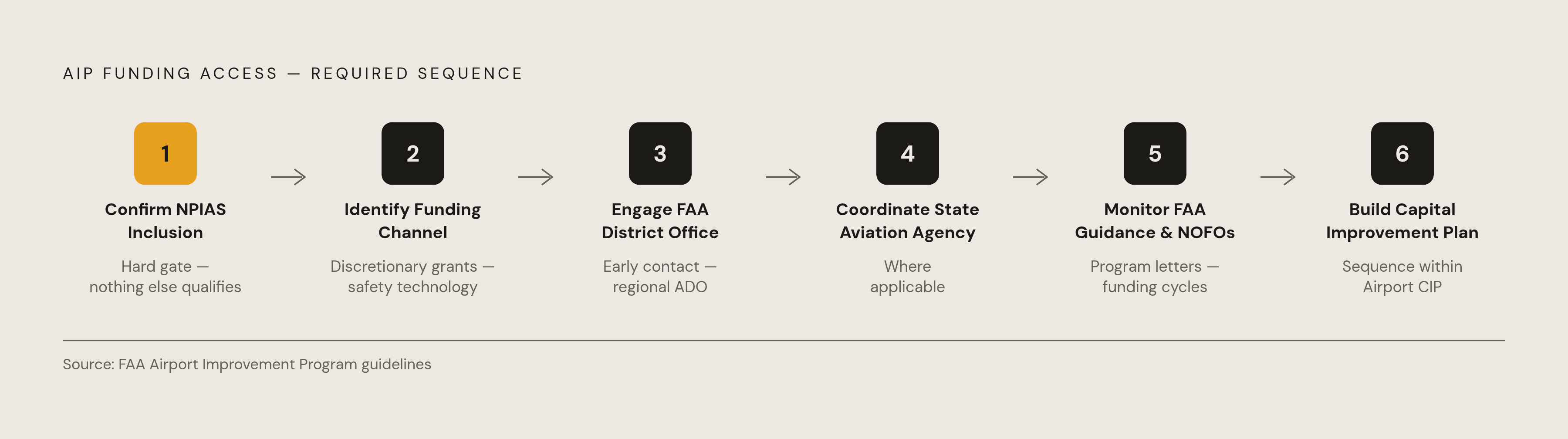
Accessing AIP funding for digital ATC infrastructure requires working through a defined sequence of eligibility confirmation, project scoping, and regional coordination before an application is competitive. The first step is confirm NPIAS inclusion. AIP eligibility requires listing in the National Plan of Integrated Airport Systems, so operators at airports that are not currently listed should treat NPIAS inclusion as the prerequisite step, not an afterthought. Nothing else in the process matters until that threshold is met.
The second step is identifying the right funding channel. Safety technology projects at the scale of a digital tower system are most likely to be pursued as discretionary grants, which require demonstrating national significance and safety impact. The VMAT and contract tower precedents in the September 2026 round provide a concrete template for how the FAA frames these arguments. Third, engage the regional FAA Airports District Office early. FAA guidance tells you to work through your Regional Office or ADO. Early engagement shapes the project scope into language the agency's evaluation criteria recognize, and ADO staff can flag whether a project fits current national program priorities. Fourth, coordinate with state aviation agencies where applicable. The FAA State Block Grant Program routes some AIP funding through state agencies for smaller airports, and if your airport falls under a state block grant arrangement, that affects who processes your application.
Fifth, monitor FAA Program Guidance Letters and Notices of Funding Opportunity. The FAA issues guidance letters that define eligibility for specific project types and NOFOs for competitive discretionary grant rounds. Staying current with these documents is how operators learn when a digital tower project type has been formally recognized in program guidance. Sixth, build a capital improvement plan that sequences the project. AIP applications are stronger when embedded in a broader Airport Capital Improvement Plan that shows the digital tower as part of a phased safety infrastructure program, not a standalone request. Throughout, frame the application around safety outcomes rather than technology novelty. AIP evaluates projects on safety impact and national significance, so an application that leads with runway incursion risk, lack of controller coverage, and the operational gap the digital tower closes will be stronger than one that leads with the technology itself.
For operators ready to pursue this pathway, the practical question is which digital tower solution fits the funding framework. General Aviation's digital tower solutions are designed with the AIP funding pathway in mind, built to be affordable at the scale small airports can pursue through entitlement and discretionary grants, and structured as capital infrastructure that fits AIP's project categories. The funding exists. The eligibility framework supports digital ATC as a recognized capital investment. The operators who engage the process now, confirming NPIAS status, building the ACIP, and working through their regional ADO, are the ones positioned to close the safety gap at their airports.