Cybersecurity Requirements for Digital ATC Infrastructure
Digital towers trade a window for data, and security must follow.

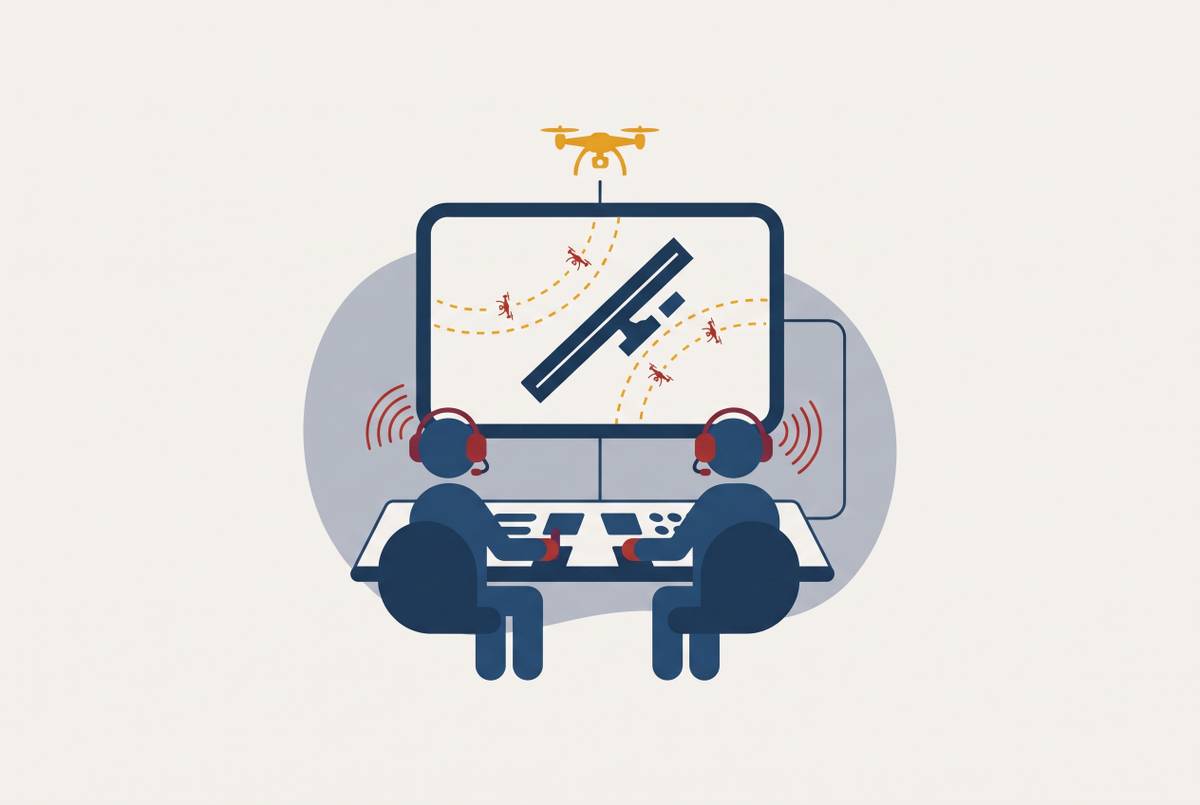
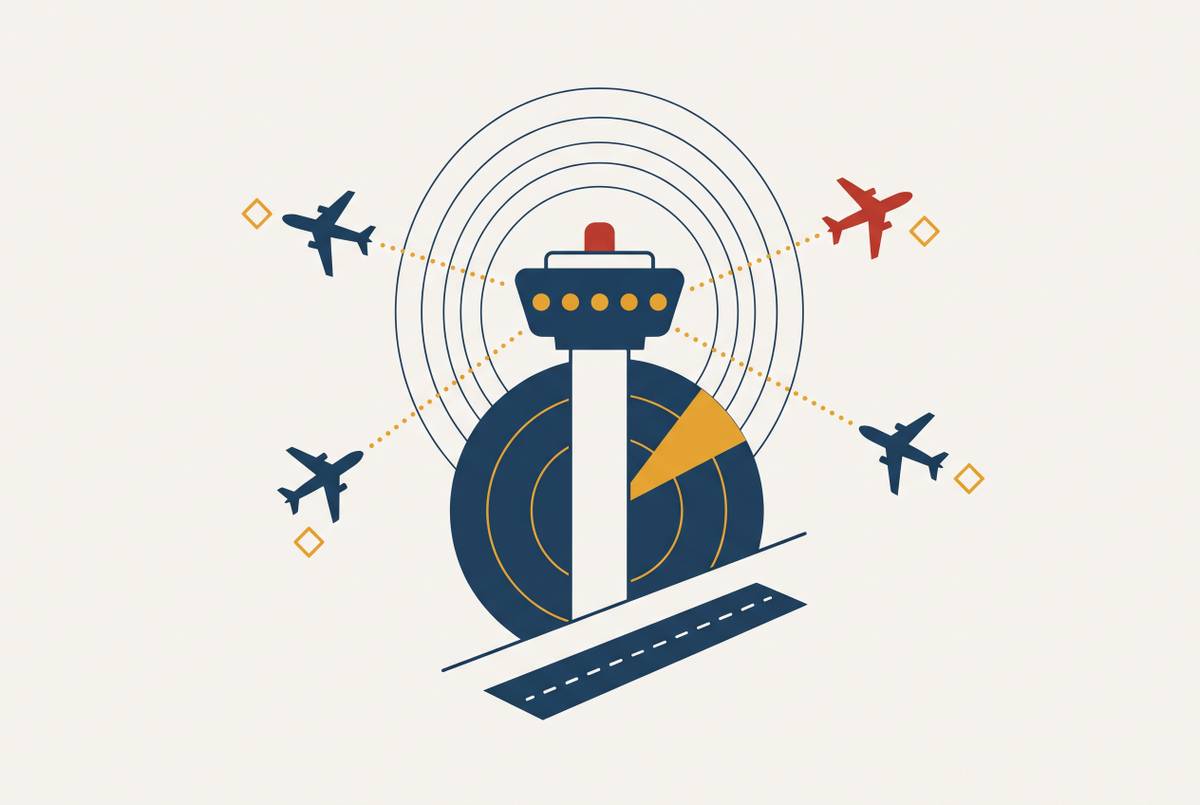
Digital ATC infrastructure can give non-towered airports situational awareness through cameras, sensors, automatic target detection, and aircraft data tags. For airports considering drone integration, those capabilities need data they can trust as well as better displays. Cybersecurity requirements for digital ATC infrastructure must therefore be built into the network, devices, operating procedures, and governance from the start.
Why digital ATC towers create a cybersecurity surface that physical towers never had
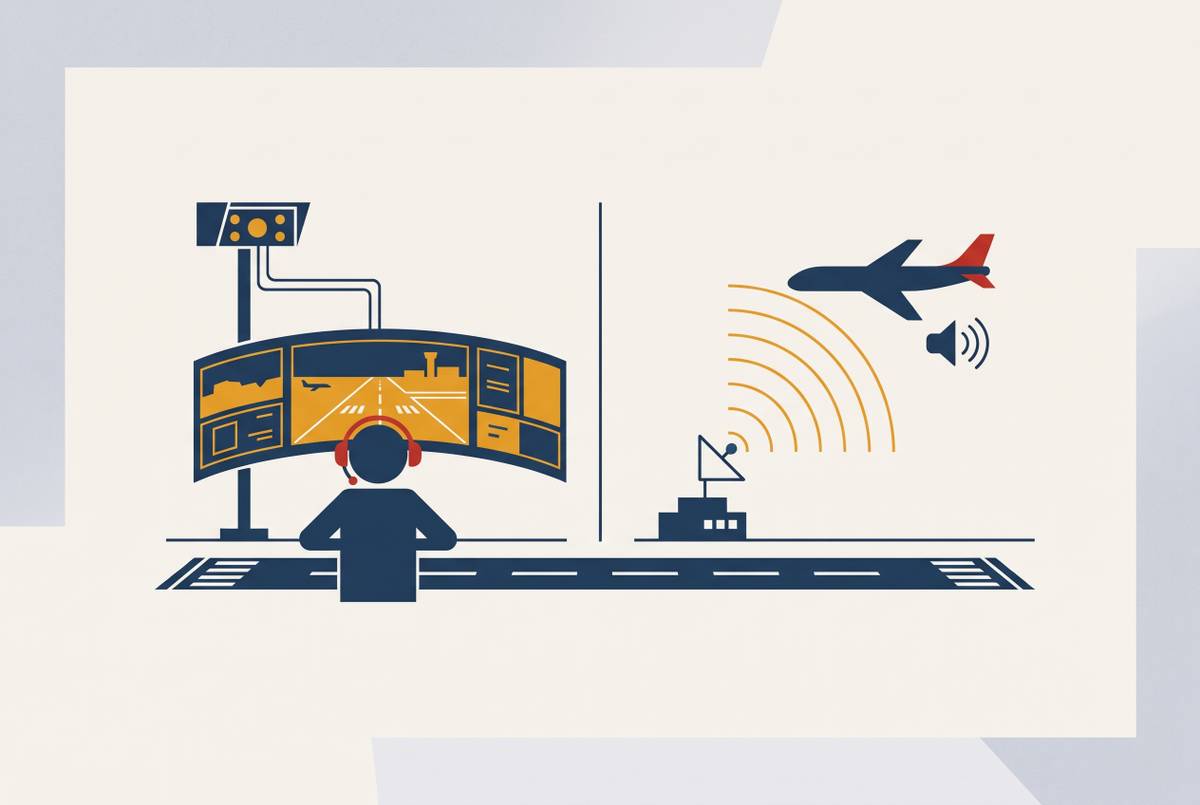
A traditional tower gives a controller a direct view through a window, with radios providing a narrowly scoped communication function and the facility forming the physical perimeter. A digital tower replaces that sight line with a chain of cameras, sensors, fiber feeds, displays, and control workstations. The view becomes a stream of data. Each link must keep the information the controller relies on intact, and each part of the network can be a way in.
Infrared cameras, enhanced low-light visibility, automatic target detection, and aircraft data tags help the controller see and make sense of more. Yet those capabilities also introduce hardware and software that require protection. Capability and exposure grow together. This shift is especially consequential at small and uncontrolled airports, where existing IT security resources are limited. The architecture must absorb much of the security burden rather than assume that a local technical team can compensate for weaknesses after installation.
The existing NAS cybersecurity baseline that digital towers must build on — and its gaps
The CSC 2.0 report “Turbulence Ahead,” published in April 2025, describes documented weaknesses in the National Airspace System through findings from federal oversight bodies. The U.S. Department of Transportation Office of Inspector General audit it discusses found that the FAA had not fully implemented required protections for dozens of high-impact computer systems. Their compromise could have severe or catastrophic effects on ATC and related services. These are not merely administrative systems. Their security condition is part of the environment that digital towers will join.
The audit findings also expose an accountability problem. A large share of high-impact systems still used older NIST security standards, and the records for most gave an inaccurate picture of how secure they were. The GAO review discussed in the same context found that the majority of FAA air traffic control systems were considered unsustainable.
The CSC 2.0 report identifies fragmented oversight, limited investment, and workforce shortages as reasons these gaps persist. It also warns that cyber-physical protections fall short and that NextGen modernization has been delayed. Digital towers can move ahead before the NAS is perfect. They do, however, need designs that avoid importing its weaknesses, beginning with an explicit account of the threats those weaknesses permit.
The specific threat categories a digital tower's architecture must be designed against
Legacy and IoT vulnerabilities create opportunities for lateral movement. When infrastructure has no native authentication, encryption, or segmentation, an intrusion can spread through flat networks or jump-server-based remote access. Digital towers add cameras, sensors, displays, and environmental equipment that usually have no endpoint security agents. Conventional monitoring may not see these devices. Vendor update cycles ranging from quarterly to annually or longer compound the exposure when operators defer patches pending validated testing.
The Akira ransomware incident illustrates this device-level weakness. After endpoint detection and response blocked an initial attempt on a computer, attackers pivoted to an unsecured webcam without that protection or monitoring to deploy ransomware. The incident was not a digital tower attack. Even so, it shows how an overlooked camera can become a way into safety-critical systems.
Weak credentials, unqualified personnel, intentional insider misuse, and undocumented vendor access can defeat an otherwise controlled network. Social engineering supplies another route through phishing, impersonation, or pressure to share credentials. A digital tower design must therefore account for who can enter the system as well as how its network connects.
Bangladesh’s paper at the ICAO APAC DGCA-60 conference, held from 28 July – 1 August 2025, identifies corruption or manipulation of flight and surveillance data as a primary threat. The dangerous output may look plausible. Compromised controller-pilot or sensor-control-center links can also cause delayed instructions, miscommunication, or blackouts, while denial-of-service attacks can degrade communication, navigation, and surveillance services. Integrity and availability require distinct protections.
GNSS-synchronized sensor data creates another dependency for aircraft identification and augmented reality overlays. Authentication and anti-jam defenses do not eliminate interference or spoofing. Thirteen EU Member States called for action against GNSS interference in June 2025, and EASA and EUROCONTROL published a joint Action Plan in March 2026 on how to coordinate detection, monitoring, and mitigation. AI-driven tools further lower the barrier to sophisticated spoofing and impersonation. The CSC 2.0 report also notes that shared civilian and military ATC infrastructure makes disruption a risk to DoD mission readiness, military logistics, and local airport operations.
What FAA Engineering Brief No. 112 requires, and why the closed-network mandate is the right starting point
FAA Engineering Brief No. 112, issued September 28, 2026, requires digital tower network communications to transfer data over a closed, physical point-to-point network. Wireless communication is not allowed at this time. The brief also requires an independent fiber optic telecommunication feed between DT System sensors and the control room. This is a mandatory architectural constraint. It separates the sensor path from general airport and internet traffic.
That separation removes the wireless attack surface from the required network and limits exposure through shared communications infrastructure. Physical protection becomes correspondingly important because the fiber route is part of the security boundary. The brief explicitly treats physical security and cybersecurity as interdependent. Airport sponsors must assess the conditions at each airport and meet the security standards that apply. A closed connection does not, however, establish that its endpoints or authorized users are trustworthy.
The brief applies to DT Systems owned by airport sponsors, and projects with federal funding, including those supported through the Airport Improvement Program, must meet its standards. Integration starts with Class D airports that have sponsor-owned Non-Federal Control Towers and FAA Contract Towers. It also applies to Class E and G airports transitioning to Class D. That scope is important for uncontrolled airports considering adoption. The brief supplies a starting point rather than a complete security specification, with further performance-based requirements under development through FAA research and coordination.
The layered security requirements that the closed-network baseline cannot cover on its own
Access controls help deal with threats that remain when a network is physically isolated. Multi-factor authentication is needed at every access point for operators and vendors, and role-based permissions limit what each credential can reach. A camera maintenance account should not have read access to flight data processors. Vendor access must be documented, monitored, and time-limited. These controls constrain both credential theft and misuse by people already permitted inside the perimeter.
Device security begins with a complete inventory of cameras, sensors, displays, and environmental hardware. An invisible device cannot be defended reliably. Default credentials must change during commissioning, and penetration testing should probe for overlooked defaults, including the documented “admin/admin” problem on radar interfaces. Firmware updates require vendor coordination and scheduled maintenance windows. This closes the gap between acknowledging a vulnerable device and maintaining it.
Encryption and integrity checks protect the information itself. Sensor data and control communications should remain encrypted in transit even over closed fiber because isolation does not remove insider interception or manipulation. Sensor-feed integrity checks should detect anomalous or altered inputs. A functioning display is not sufficient evidence of trustworthy data. Segmentation must also keep safety-critical systems apart from administrative and support networks, and real-time anomaly detection must catch intrusions that get past perimeter controls.
GNSS resilience needs integrity monitoring and fallback sources for positioning or timing because even a protected local network cannot stop interference with satellite signals. The joint Action Plan provides a coordination model for U.S. deployments to track. Local isolation has a defined limit here.
ICAO Doc 10213, Global Cyber Risk Considerations, provides an international framework for harmonizing cyber risk management across aviation safety, security, and air navigation efficiency and capacity. Its 2025 first-edition material supplies context alongside prescriptive U.S. requirements. Bangladesh’s conference paper similarly brings together advanced firewalls, intrusion detection, encryption, dedicated governance, and ATM-specific incident response planning.
Why staff training and human factors belong in the security architecture, not the afterthought column
Even with network segmentation, someone with authorized access can be tricked into bypassing a control. Phishing, impersonation, and requests to share credentials take advantage of how people make decisions. People are part of the security boundary. AI-driven phishing and voice impersonation increase the challenge in an environment where controller communications are voice-based and operator interfaces create opportunities for credential attacks.
The person who fuels aircraft may also have access to airport operational systems, so role separation cannot be assumed. Training must reflect that staffing reality. Staff should be taught regularly about password hygiene, phishing recognition, external devices such as USB drives and personal laptops, and the bring-your-own-device and user access policies that must be enforced. Written rules alone do not establish access discipline.
Penetration testing can expose default credentials, undocumented access paths, and susceptibility to social engineering that a documentation review will miss. Its findings connect training to actual control weaknesses. Prevention still needs a response counterpart. Staff must know whom to contact after a suspected breach and which fallback procedures exist. ATM-specific contingency planning turns recognition into action, but only if responsibility for directing that action is clear.
The governance and oversight structure that makes security requirements stick over time
A commissioning record establishes what was accepted at one point. The earlier OIG findings on documentation show how records of compliance can fall out of step with conditions on the ground. Governance must keep that drift in view. At small airports without in-house cybersecurity expertise, responsibility can otherwise fall between the airport sponsor, technology vendor, air navigation service provider, and FAA.
Each party must have clearly defined security duties. Continuous monitoring requires someone accountable for reviewing anomaly signals and acting on them. Periodic audits cannot perform that operational role. The fragmented oversight described in the CSC 2.0 report makes clear why overlapping involvement is not a substitute for assigned ownership. Investment and staffing must support the responsibilities that the governance structure names.
Bangladesh’s conference paper describes a national approach being developed with a cybersecurity cell, work with national cybersecurity authorities, and ATM-specific incident response planning. Those elements illustrate explicit ownership and escalation. They were proposals. Their relevance lies in connecting technical detection to an organization responsible for decisions and response.
Long-term accountability also includes maintaining an upgrade path. The FAA has framed quantum-resistant, crypto-agile security as a foundational enabler of NAS modernization and set a 2028 implementation deadline for a new ATC system. It supports planning for cryptographic changes without full system replacement, keeping a horizon issue within lifecycle governance.
Why building security in from the start is both the right and the practical choice for small airports
Roughly nine in ten U.S. airports operate without air traffic control, making the small-airport opportunity substantial. Digital ATC has an established global track record, while uncontrolled airfields face a real risk of near mid-air collisions. Adoption nevertheless depends on more than technical capability. Airports need infrastructure whose security can stand up to checks by regulators and those who run it, especially when they consider new activity such as nearby drone operations.
The practical case favors early investment because retrofitting security into deployed infrastructure is harder and more expensive than incorporating it during commissioning. Safety-critical operations strengthen that case. A closed fiber network, layered permissions, managed devices, monitoring, trained staff, and assigned ownership belong in the original system specification. For a U.S.-built solution designed for small airports, those features should be visible to airport operators, policymakers, and pilots before they rely on it.
Early deployments will also establish institutional habits for this category of infrastructure. A serious security incident could prompt scrutiny that delays broader adoption at airports with the fewest alternatives. Building security into the initial design establishes norms that later deployments can follow, rather than embedding weaknesses that the sector must spend years unlearning.
Sources
- Federal Aviation Administration Memorandum Date: September 28, 2026 To:
- DGCA ⎯ 60/DP/04/19 60th CONFERENCE OF DIRECTORS GENERAL OF CIVIL AVIATION
- Turbulence Ahead: Navigating the Challenges of Aviation Cybersecurity Jiwon Ma
- Doc 10213 — Unrestricted Global Cyber Risk Considerations
- Turbulence Ahead: Navigating the Challenges of Aviation Cybersecurity - CSC 2.0