Cost Comparison of Digital Towers Versus FAA Contract Towers
Digital towers cost a fraction of traditional ones, opening new options for small airports.

Johnston Regional Airport in Smithfield handles a substantial volume of daily operations with no tower. Pilots land, taxi, and take off by self-managing the sequence, the way drivers might navigate an intersection with no signal and no stop sign. Airport director David Harris has compared the arrangement to stripping every traffic light out of downtown Raleigh and trusting commuters to sort it out on their own. The vast majority of U.S. airports operate with no control tower because traditional towers have always been priced beyond their reach. The FAA's own Federal Contract Tower program, 254 facilities covering a significant share of NAS operations, was created because most airports couldn't afford a fully FAA-staffed tower, and the program is now oversubscribed by nearly ten to one in grant requests. That capital gap between what a tower costs and what an airport can pay has widened to the point where digital alternatives are no longer a footnote in the conversation. They are the conversation.
What a traditional FAA tower costs to build
Conventional tower costs swing widely depending on height, location, and equipment, but the floor is already steep. The FAA's own estimate for a 115-foot tower at Kissimmee was $17 million, a figure Colorado's transportation commission has since cited as a similar benchmark for a new conventional tower in that state. Johnston Regional and Raleigh Executive Jetport both received FAA approval to build towers priced in the tens of millions of dollars apiece, with taxpayers covering much of the bill.
Those numbers describe construction alone. They say nothing about the staffing, maintenance, and operations costs that start accumulating the day the tower opens, costs that stack on top of the capital outlay for as long as the facility runs. A full FAA-class tower, larger and more heavily instrumented than the contract-tower scale described above, can cost an order of magnitude more to build. For most small and mid-size general aviation airports, that number simply isn't reachable, and that gap is the entire reason the contract tower program exists.
What the FCT program costs to run
The Federal Contract Tower program is the cheapest form of staffed air traffic control the federal government runs, and a DOT Inspector General report covering 2015 through 2019 backs that up in concrete terms. Contract towers saved well over a million dollars annually per facility against FAA-operated towers, used far fewer resources per aircraft movement, and were found equally safe, according to Flying Magazine's coverage of the DOT Inspector General report. That's a genuinely strong result. Nothing about the program is broken.
The program was built for airports sitting close to the threshold where a tower already made financial sense, not for the thousands of airports still well below it. Even with a decade of that level of investment behind it, contract-tower funding doesn't come close to reaching the volume of airports currently flying without any tower coverage. Part of the reason is structural rather than a matter of budget priorities: staffing a contract tower, even a low-activity one, requires a dedicated crew and supervisors on every shift, a fixed labor cost that holds steady regardless of how few aircraft actually move through the pattern that day. Traffic volume can be minimal. The staffing bill isn't.
What a digital tower costs to build and operate
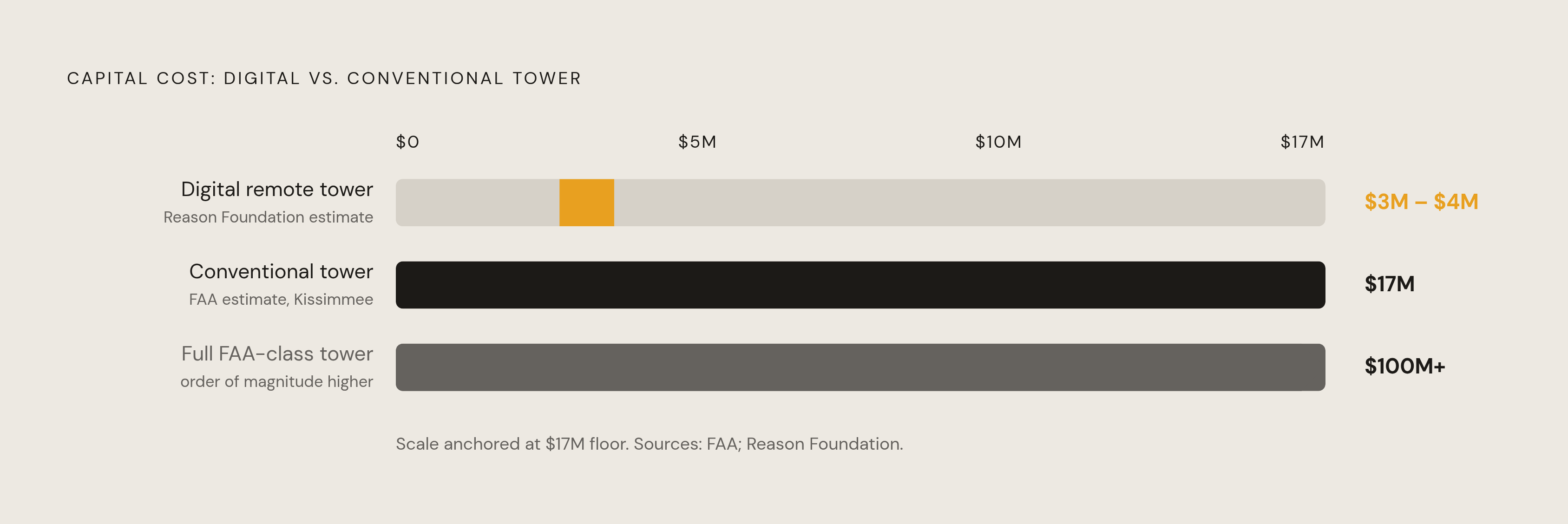
A digital remote tower costs a fraction of a conventional tower to build, with operating savings compounding further when multiple airports are served from a single center, though the two sources of savings are distinct, and the Reason Foundation's report puts a full setup at $3 million to $4 million, compared to many times that for a modest conventional tower and far more for larger facilities. Colorado's transportation commission has discussed similar order-of-magnitude figures for digital systems and airport-side infrastructure, in the low millions for an initial install, while staff cautioned that final numbers depend on the vendor selected, the scope of the project, and the FAA certification path involved. At Johnston Regional, David Harris has estimated the digital option at roughly half the cost of the conventional tower his airport was already approved to build.
Two distinct things produce that gap, and they shouldn't be lumped together. The first is structural: a digital tower replaces the multi-story concrete tower cab with cameras and sensors mounted on a steel mast, feeding a control room that sits at ground level and often somewhere entirely removed from the airfield itself. No concrete shaft, no elevator, no glass cab exposed to wind load calculations. That alone accounts for most of the capital savings.
The second source of savings is organizational, and it only appears under a specific model. When one Remote Tower Centre serves several low-activity airports at once, staffing gets pooled: controllers certified across multiple airports can cover for one another, cutting the idle time that a low-traffic shift otherwise burns through without any loss of safety margin. That's an important qualifier, because a single-airport digital tower doesn't automatically shrink the controller headcount. Practitioners in the field have said as much directly: the same number of controllers is needed whether they're sitting in a tower cab at the airfield or in a remote facility miles away. The staffing savings only materialize once multiple airports share one hub.
Colorado's own staff laid the trade-off out: a single digital tower at one airport clears FAA approval more easily, but the economics it delivers are narrow, while a centralized hub serving five or six airports produces the bigger savings at the cost of a larger upfront facility investment and a more demanding FAA systems-design approval process. A digital tower's operation also carries an environmental cost worth adding to that ledger. Egis Group's project documentation reports annual emissions from a digital tower centre running dramatically below those of a conventional tower, a difference now showing up in FAA grant guidance as a factor airports can cite.
How the global deployment record validates the cost case
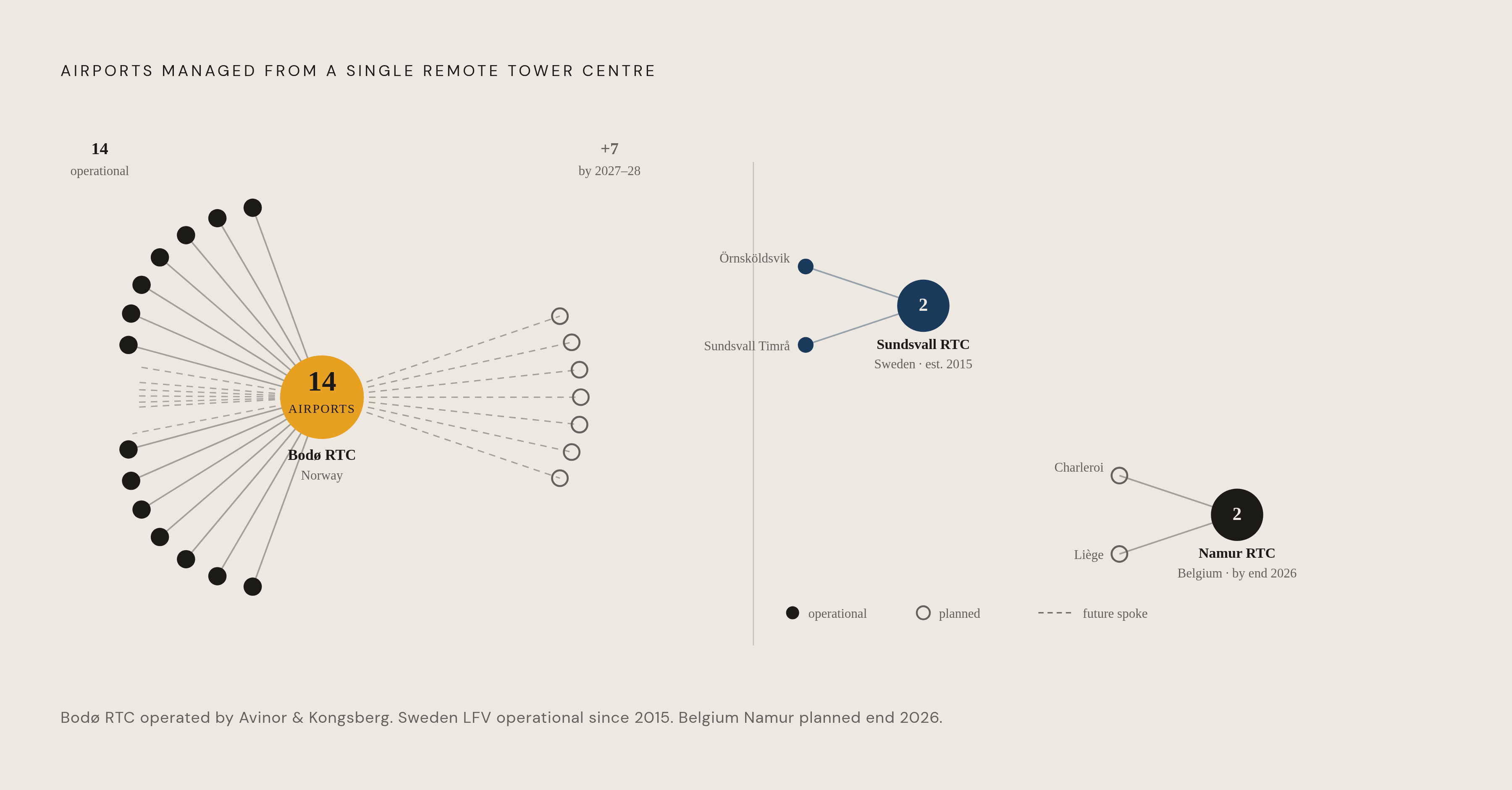
None of this is theoretical anymore. Countries running remote towers at scale have already proven out the cost and operational model that U.S. airports are still locked out of, and the gap between what's operating abroad and what exists domestically has grown wide. Sweden has run Örnsköldsvik Airport through the LFV Remote Tower Centre in Sundsvall since April 2015, added Sundsvall Timrå Airport to the same centre in December 2016, and as of September 2026 Saab is digitalizing Stockholm-Västerås Airport for remote ATC service. Across that entire operational record, the Reason Foundation's report notes no safety incidents attributed to the remote tower technology itself.
Norway has pushed the hub model furthest. As of April 2025, Avinor and Kongsberg manage 14 airports from a single Remote Tower Centre in Bodø, with seven more airports scheduled to come online within two to three years. In 2026 Norway's Civil Aviation Authority went a step further, approving a trial of multiple simultaneous airport operations across four paired routes: Rørvik and Namsos, Mehamn and Hasvik, Vardø and Berlevåg, and Røst and Svolvær. That's the hub model running at full stretch, one controller effectively watching over two airports at once.
Belgium is building toward the same structure. By the end of 2026, Skeyes plans to manage air and ground traffic at both Charleroi and Liège airports through a new Remote Tower Centre in Namur. More than a dozen countries now have remote towers operating or in advanced development, several of them running centres that each handle multiple airports simultaneously. Remote towers are in operation or advanced development across more than a dozen countries, and multiple remote tower centers each manage several airports, but the U.S. has none, despite the FAA having pioneered the original research. The international deployments also settle a question that might otherwise seem open: the pilot-side experience is unchanged, since radio communication and procedures at a remote tower match a staffed physical tower exactly, so the switch is invisible to flight crews on the other end of the frequency.
Why the U.S. has none of these systems
The gap between what's proven abroad and what's approved at home traces back to one bottleneck: the FAA has never published a System Design Approval process for remote towers, and that absence has blocked deployment of technology already running routine operations across Europe. Airports and pilots bear the cost of that delay. The agency does not.
Leesburg, Virginia offers the sharpest illustration of what's been lost. The airport ran a remote tower pilot from 2015 to 2023, with continuous ATC service delivered from 2018 onward, and during that stretch traffic grew substantially, as a second flight school opened, a second Fixed Base Operator arrived, and a U.S. Customs office set up shop. The FAA terminated the pilot anyway. Airport director Scott Coffman said afterward that Leesburg was "proud" the remote tower had "operated successfully from 2015 to 2023", a statement that reads less like celebration than like an obituary for a program that worked.
The FAA has continued testing since. As of May 2025, the agency was evaluating a system built by RTX and Frequentis at Atlantic City International, but it still hadn't certified any system for use in the National Airspace System. Congress noticed the stall. The FAA Reauthorization Act of 2024 directed the agency to build a clearly defined system design and operational approval process, publish milestones publicly, measure safety benefits against the real baseline (which for most of these airports is no tower at all, not a staffed one), and allow testing across multiple field sites instead of funneling every trial through Atlantic City. That Congress had to spell out instructions that specific suggests the agency hadn't moved on its own.
Industry pressure hasn't let up either. The Digital Tower Technology Coalition, part of the Modern Skies Coalition formed in 2025, has been pushing for adoption alongside a broader group of airports, controllers, equipment makers, and federal partners. As of January 2026, 186 airports are eligible for the IIJA FCT competitive grant program, and the program's language permits funds to be used for construction of a digital tower certified by the FAA. That last clause is where the door swings shut again. Colorado's transportation commission has pointed to meaningful FAA funding already set aside for digital and remote tower development, a sum that looks generous against typical small-airport grant awards but thin once measured against thousands of public-use, non-towered airports nationwide.
The strongest objection to the cost savings argument
The sharpest pushback on the digital tower cost case comes from the labor side of the debate, and it deserves a direct answer rather than a dismissal. Critics point out that a single-airport remote tower doesn't reduce the number of controllers needed to handle local control functions. Somebody still has to watch the runway and talk to pilots, whether that person sits in a tower cab overlooking the airfield or in a control room hundreds of miles away. On this view, the staffing-savings argument only applies once multiple airports share a single hub.
That objection is correct, and the Reason Foundation's report says essentially the same thing: remote tower technology doesn't shrink the national demand for controllers, it lets existing and newly trained controllers get deployed more efficiently. Conceding that point matters, because overselling the staffing case would undercut the more defensible parts of the argument.
Where the objection runs out of road is the hub model itself, which isn't a hypothetical fix, it's already running at scale. Norway's Bodø center manages a fleet of airports from a single facility, and Belgium's Namur RTC handles both Charleroi and Liège, demonstrating the multi-airport hub model at scale. Multi-airport efficiency isn't a projection in a vendor slide deck; it's an operating fact in two countries right now.
The objection also misses a second savings channel that has nothing to do with staffing. Even a single-airport digital tower still swaps a conventional concrete structure, costing well into the millions, for a system priced at $3 million to $4 million. That capital saving holds even if the airport never joins a hub. For an airport like Johnston Regional, currently running with no tower coverage of any kind, the relevant comparison is digital tower cost versus the safety and efficiency costs of continued uncontrolled operation, costs that raise risk and inefficiency without appearing as a line item on any budget.
What airport operators and policymakers can do now
The funding mechanics already support a decision. The FAA's grant program page states that the IIJA FCT Competitive Grant Program permits funds to be used for FAA-certified digital towers, and the FY 2027 application period opened September 18, 2026 and closes October 19, 2026. Airports on the 186-airport eligibility list have a narrow, dated window to confirm their status and apply before that period closes.
For airport directors weighing a conventional tower application against a digital one, the cost figures assembled here point in one direction: a digital system costs a fraction of even a modest conventional tower to build, and the savings compound further for any airport positioned to join a multi-airport hub down the line. Certification is the remaining obstacle, since the grant language already covers digital towers explicitly and cost is no longer the barrier. It's certification. Airports that move now to document their eligibility and prepare an application are positioning themselves to act the moment that bottleneck clears, rather than starting the process from zero once it does.
Sources
- ADVANCING REMOTE TOWER DEPLOYMENT IN THE UNITED STATES
- Report Says Contract Towers Are Safe, Cost Less Than FAA Facilities
- The FAA Is Blocking Remote Towers Used Worldwide—Even Though They’d Help Solve The Controller Shortage For A Fraction Of The Cost
- Coalition Pushes for Remote and Digital Air Traffic Control Towers
- Johnston Regional Airport hopes to pioneer FAA's next-gen digital air traffic control :: WRAL.com
- Division outlines options for digital/remote towers; FAA funding and a multi‑airport hub discussed | Citizen Portal
- FAA Contract Tower Competitive Grant Program | Federal Aviation Administration
- FAA Contract Tower Program | Federal Aviation Administration