Latency and Reliability Requirements for Remote Tower Audio
Digital tower audio requirements reveal the gap between spec compliance and operational safety.
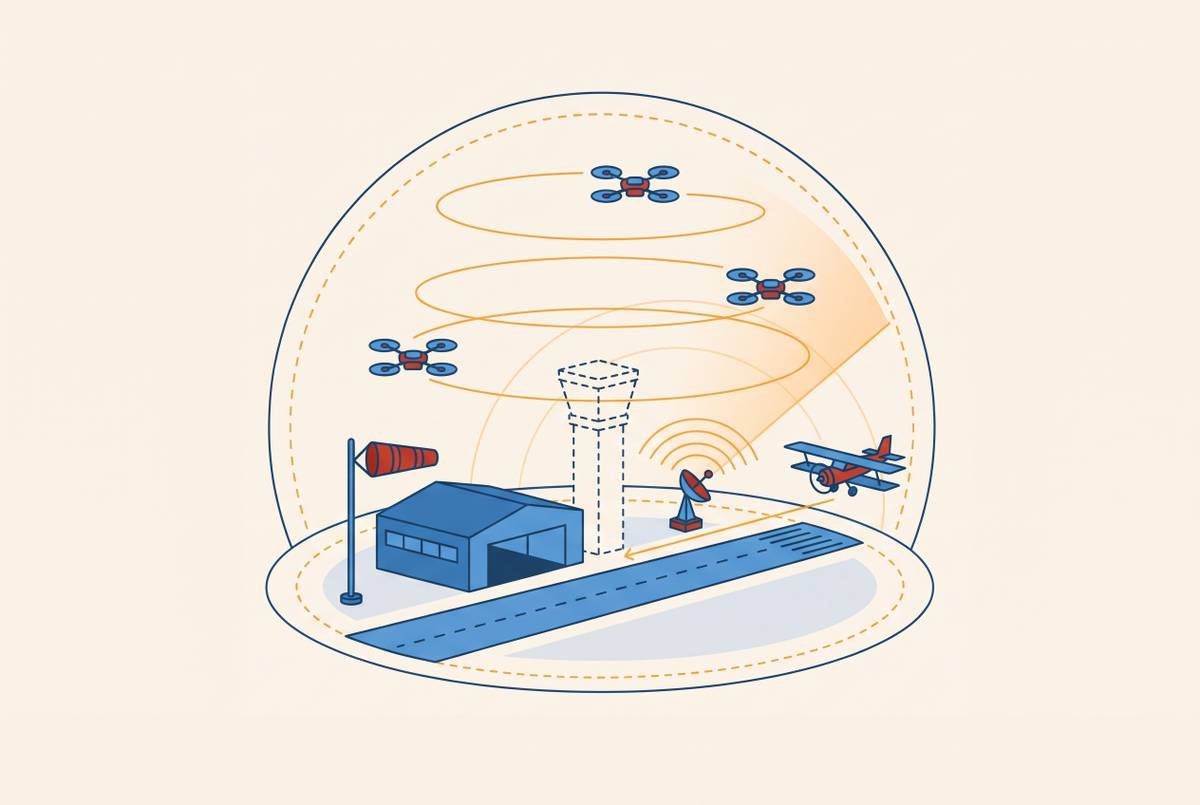
Remote tower audio is safety-critical digital ATC infrastructure. Its requirements set out how much delay and audio-video alignment are allowed and how service must keep working through failures and system changes. For non-towered airports considering uncrewed aircraft systems and drone integration, those requirements help give controllers situational awareness, but they do not prove that a digital tower alone can manage drone traffic.
Why audio is the load-bearing safety element in a remote tower, not an add-on
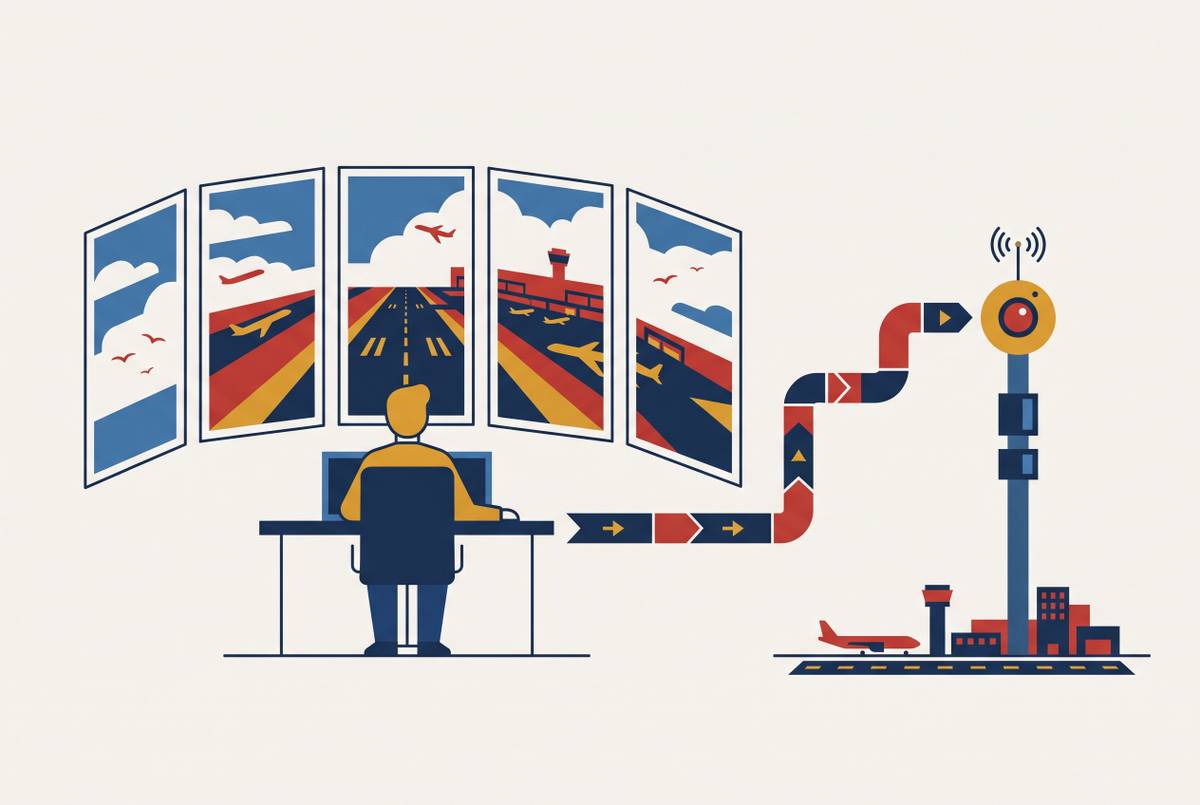
Remote towers are often shown through the technology people can see, including cameras, displays, and panoramic views. Engine noise, radio calls, ground movement sounds, and ambient cues help the controller understand what is happening before making a decision. The image alone does not establish whether an aircraft is responding to a clearance. Audio connects the visible scene to the actions and intentions that the controller must assess.
In a brick-and-mortar tower, physical proximity supplies part of that awareness without a separate digital path. A remote tower must reproduce the relevant cues through its architecture, making their timing part of the safety case. The UK aviation regulator’s remote tower guidance warns that long audio delays will “undoubtedly negatively affect the ATCO's situational awareness, with a direct safety impact”. The FAA’s Operational Safety Assessment identifies “AAA not provided in near real time” as a formal hazard that supplies misleading information to the controller. This is not merely a degraded listening experience. It must be assessed under the same hazard assessment framework used for loss of visual display.
What the formal requirements actually specify for audio latency and synchronization
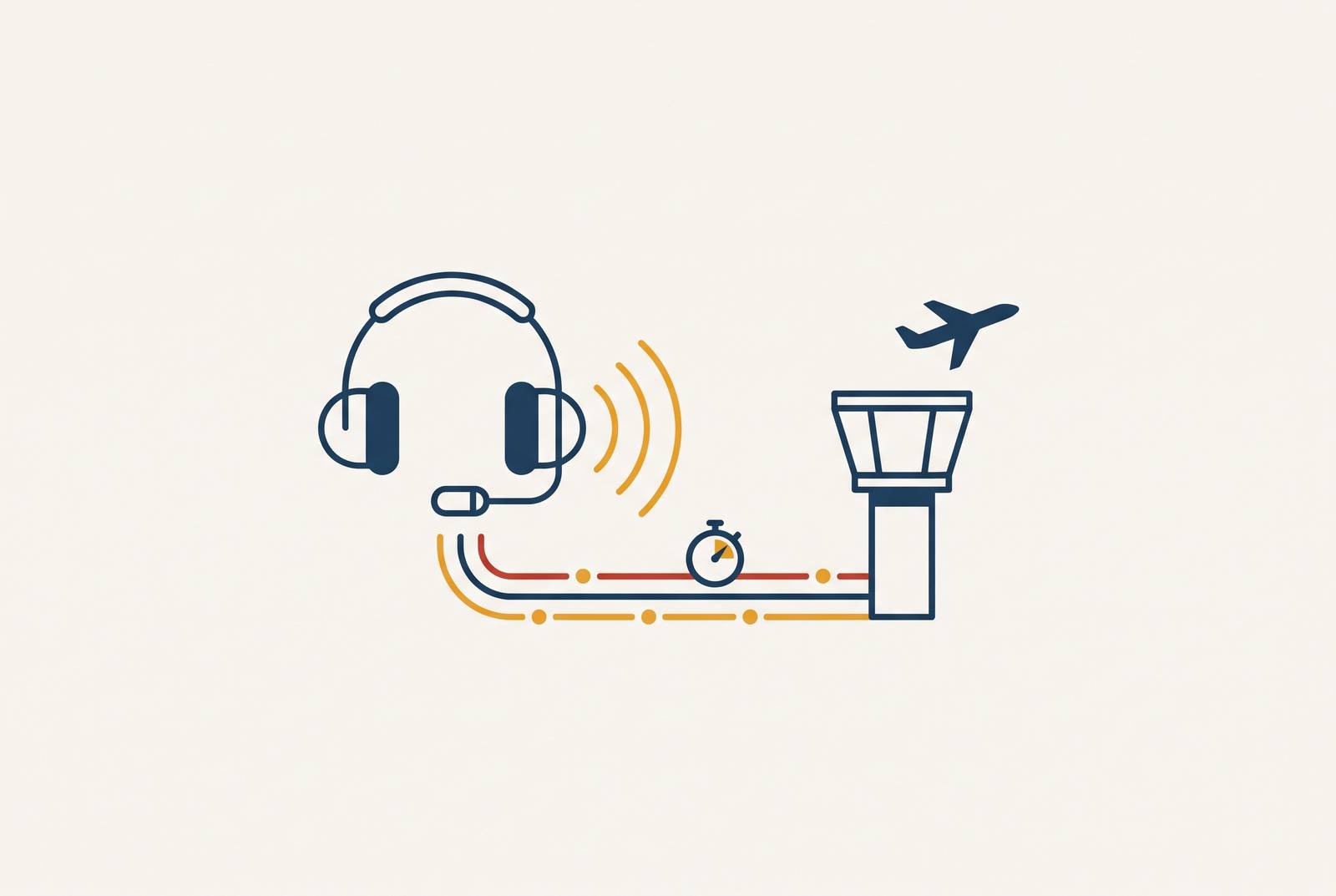
The one-second audio delay limit and the 45-millisecond audio-video synchronization target measure different things. The first bounds how long sound can take to reach the controller. The second bounds the separation between sound and its corresponding image. They are not interchangeable measures of system performance. A stream can arrive within the one-second limit while remaining too far out of alignment with the video to meet the synchronization target.
Audio that stays within the hard limit but outside the optimal synchronization threshold can satisfy the delay criterion while presenting an operationally degraded picture. The controller receives the sound soon enough under one measure, but not in the right temporal relationship to the scene. Compliance with one criterion does not establish compliance with both. Neither number should therefore stand in for the complete audio requirement.
The CAA guidance states that the exact maximum delay must follow from operational needs and local conditions. That approach requires a context-specific limit rather than leaving latency unconstrained. It also means that the one-second limit should not be presented as a universal CAA allowance. The numerical requirements and the local operational assessment have distinct roles in defining acceptable performance.
The three distinct failure modes audio problems create, and why each has a different operational consequence
The first failure mode is raw audio delay beyond the one-second limit. A controller hears an engine spool, a radio call, or a ground vehicle after the corresponding visual scene has already changed. The resulting decision can refer to an airfield state that no longer exists. The OSA identifies hazard AAA-MALF-1 as “misleading information provided to ATCT” and assigns it Minimal severity. That rating describes consequence severity within the assessment, with the hazard remaining part of the safety case regardless of its probability of occurrence.
The second failure mode is audio-video desynchronization. Neither stream needs to exceed its individual delay limit for their relationship to become misleading. A controller may see an aircraft on short final while hearing engine sound associated with an earlier position, producing a spatial and temporal mismatch. Cues that no longer describe the same moment can cause a misread of the traffic picture.
The third failure mode is multi-airport frequency confusion. When one controller serves multiple airports on separate frequencies, a transmission may go unheard while the controller is occupied on another frequency. Pilots at one aerodrome also cannot hear traffic calls from the other aerodrome that the same controller serves. This is distinct from late or misaligned sound. Reducing transport delay does not resolve a listening and coordination problem created by the allocation of frequencies across airports.
What Avinor's Bodø Remote Tower Centre reveals about the gap between spec compliance and operational reliability
Avinor postponed the transfer of three airports to its Bodø Remote Tower Centre because it wanted to “further improve stability” before proceeding. The transfers involved Molde, Leknes, and Sandnessjøen following a planned system upgrade. The operator’s decision was not presented as a latency specification failure. Formal requirements were being met, but the stability needed to extend service was not yet sufficient. The deliberate pause exposes a distinction that a successful latency test cannot settle.
Bodø provides an unusually mature setting for that distinction. As of April 2025, it managed a substantial number of airports from a single centre, with additional airports planned to enter service within two to three years. It was the world’s largest operational centre for digital towers, with a multi-year reliability record at scale. This was not an early demonstration encountering its first deployment hurdle.
The case therefore turns on consistency across operating conditions. The system must stay stable through upgrades and ordinary service, as weather and load change. Avinor began a trial in February 2026 enabling one AFIS representative to handle more than one airport from a single working position. It framed this Multiple Operations trial around “safe, stable and efficient service provision”.
Why the U.S. safety record at non-towered airports makes audio reliability a present-tense safety imperative
The Bodø lesson has an immediate counterpart at airports without a tower. Reliable remote service could give those airports a controller who can step in when needed. A controller must be present to hear a call, interpret it against the airfield picture, and intervene before an error compounds. A missing service layer is different from a degraded one, but both shape the safety case for deployment.
Pilot deviations account for close to two-thirds of all U.S. runway incursions. At a non-towered airport, there is no ATC layer to catch those errors before they develop further. The number of severe U.S. runway incursions rose sharply in 2025 even as the total number of incursions fell. That pattern strengthens the case for extending coverage, while leaving open whether a remote tower could have prevented every event.
Canada’s transportation safety investigator’s 2025 Watchlist recorded runway incursions in 2024 at the highest annual total in the dataset’s history. Airports with flight training units played a large part in that pattern. This points to a runway safety concern that extends beyond the U.S., though it does not show that every airport recorded was non-towered. New controller coverage needs reliable audio to provide dependable intervention.
The asymmetry the FAA's own safety framework creates for remote towers versus brick-and-mortar towers
The OSA concludes that ambient audio is “not essential” to ATC service. Brick-and-mortar towers have not had to meet a formal ambient audio latency requirement, while remote towers must meet explicit technical requirements for that function. The asymmetry is real and deserves direct acknowledgment. Critics of rapid deployment argue that these additional obligations set an unfairly high certification bar, delaying service at airports that currently have none. Against that baseline, certification delay has an operational cost as well as an administrative one.
The stronger response is not to deny the disparity. Traditional towers relied on the controller’s physical location to provide cues that did not need a separately specified transmission path. Remote systems remove that proximity and must define explicitly what it once supplied informally. The absence of a legacy specification is therefore not evidence that timing is irrelevant. It reveals a limit in using the brick-and-mortar baseline as a complete technical specification for its digital replacement.
The distinction between ambient sound and radio communication also remains important. A finding about ambient audio does not classify every audio function as dispensable. The OSA’s Minimal-severity classification for loss of ambient airfield audio assumes visual, procedural, and communication redundancies. An airport without tower service has no existing tower-based intervention layer on which to rely. The architecture must be assessed against the services and redundancies actually present, rather than borrowing reassurance from a different operational setting.
What meeting the audio reliability floor actually demands of a digital tower architecture
Meeting the requirements is an architecture problem before it is a network speed problem. The layers include how sound and images are captured, sent, and presented, how their timing is aligned, and how monitoring and backup functions keep the service running. Redundancy, monitoring, and failover must be specified from the start, before nominal latency has been demonstrated. A fast primary path cannot establish how the system behaves when that path changes.
The one-second limit requires control of the complete end-to-end delay through encoding, transmission, decoding, and rendering. That control must hold in bad weather and at peak load as well as in favourable test conditions. The 45-millisecond synchronization target requires active alignment between the audio and video streams. Independent speed is not enough for this task. Two quickly delivered streams can still present conflicting moments if their timing is not coordinated.
The FAA’s draft performance requirements make redundant element management a formal requirement. The system must detect a component failure and transition to a backup without exceeding the latency limit. A switchover that breaks the requirement cannot be excused by acceptable performance before the failure. Bodø adds the operational test of planned change. Maintenance, upgrades, and configuration changes require the same attention to stability because degradation during scheduled work still affects the service delivered to controllers.
Small and non-towered airports impose a further constraint through cost. Requiring enterprise-grade fiber infrastructure and dedicated bandwidth at every location would restrict deployment at the scale of the U.S. coverage gap. The FAA’s April 2026 solicitation for Remote Tower Systems seeks systems for rural, small community, and non-towered airports. Affordability makes performance under locally deployable infrastructure while meeting the safety requirements part of the architectural challenge from the start.
Where U.S. policy and funding now stand, and what still has to happen for the requirements to be enforced at scale
Congressional authorization and funding proposals have moved remote digital towers beyond a research-only proposition. The FY2026 Senate DOT/FAA spending bill sets a minimum amount of funding for the remote towers program, while the House version proposes much more money for the broader Contract Tower Program. These commitments cover different funding scopes. Their gap reflects negotiation over the scale and pace of deployment. A defined path to certified, operating systems at hundreds of airports has yet to follow.
The FAA’s April 2026 solicitation emphasizes deployment, operational support, and performance validation. That combination moves the effort from writing requirements toward procuring systems and demonstrating their performance. FAA Administrator Bedford and DOT Secretary Duffy described the modernization baseline in April 2026 as much of the National Airspace System relying on “outdated technology, including copper wiring, analog radios and paper flight strips”. Against it, explicit audio timing and reliability requirements define what replacement infrastructure must deliver, rather than optional refinements to an otherwise complete service.
Digital Tower systems have been eligible under the Airport Improvement Program statute since the FAA Reauthorization Act of 2018, with further requirements added by the FAA Reauthorization Act of 2024. Only airport sponsors taking part in the FAA Contract Tower Program remain eligible. Congressional authorization must now become a repeatable national deployment strategy that enforces audio delay, synchronization, and reliability as hard specifications, including during failures and planned changes. Whether the architecture deployed at scale will meet that floor remains unresolved.